
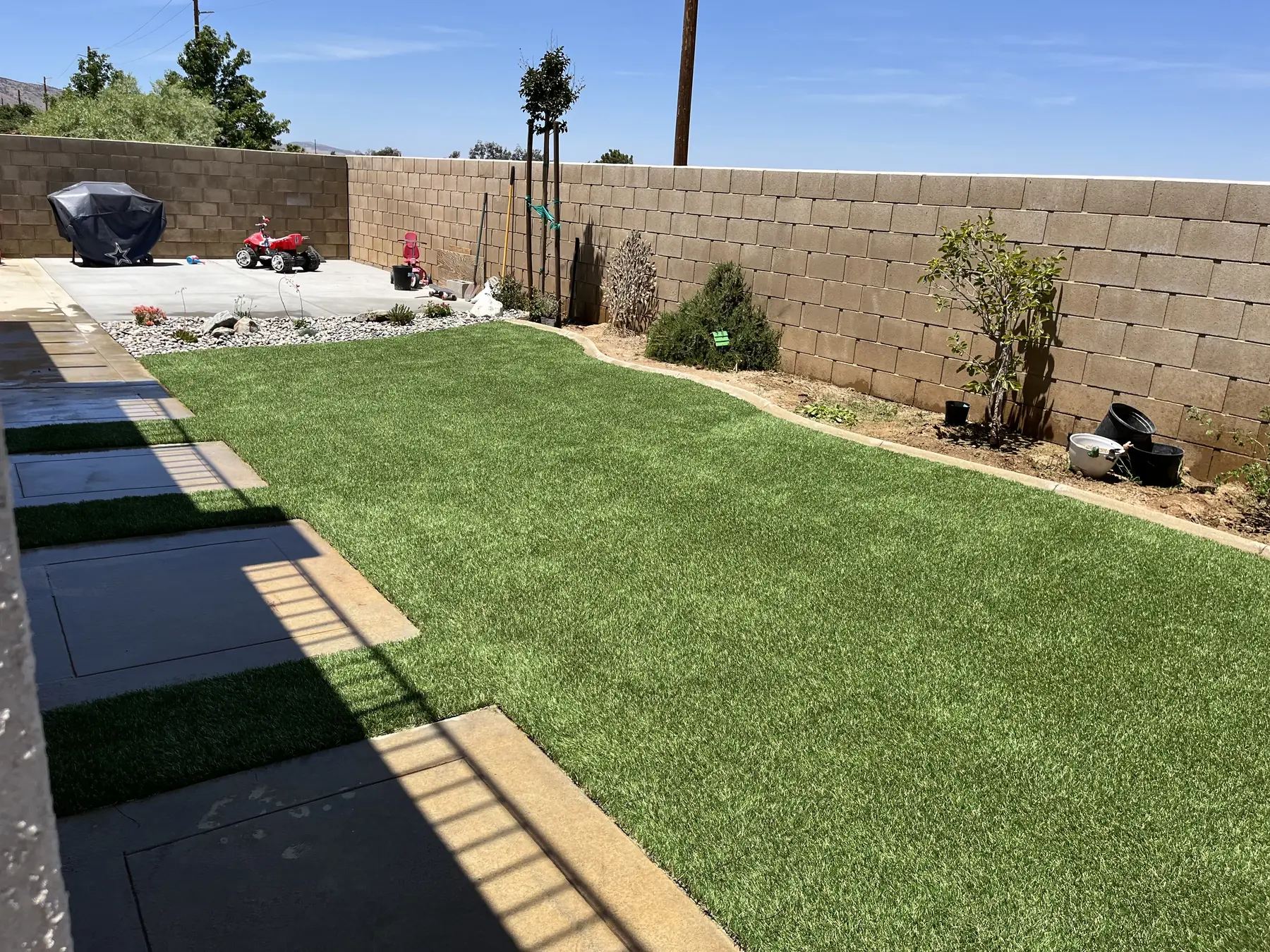
Landscape lighting is the low-voltage system of fixtures that lights a yard after dark, for beauty, for safety, and for the hours you actually use the space. It covers path and step lights along walkways, uplights that throw a tree or a wall into relief, softer wash lighting across a facade, and the practical security and entry lighting that makes a property feel safe. Almost all of it runs on a low-voltage system, twelve volts stepped down from household power by a transformer, which is safer to work around and gentler on the yard than line voltage. Done well, the fixtures disappear and only the light shows.
What kinds of landscape lighting are there?
There are more kinds than most people expect, and a good yard uses several together. Path and step lights make walkways and stairs safe to move along at night. Uplights sit low and throw light up a tree trunk, a wall, or the front of the house, which is where a lot of the drama comes from. Downlighting from up in a tree, sometimes called moonlighting, casts a soft, natural pattern on the ground below.
Wash and grazing light spreads evenly across a wall or a fence to show texture, while spotlights pick out one feature. Add the practical layer, security and entry lighting near doors and dark corners, and lighting around a pool or patio for the hours you actually use them. The art is layering these so the fixtures disappear and only the light shows.
What is low-voltage lighting, and why does it matter?
Almost all residential landscape lighting runs on a low-voltage system, which means twelve volts rather than the one hundred twenty volts in your house. A transformer steps the power down, and everything past it runs at the lower, safer level.
This matters for a few reasons. Low voltage is far safer to work around and to have buried in a yard where people, pets, and shovels live. The cable does not need the deep burial and conduit that line voltage does, so it is gentler on planting and easier to adjust later. And low voltage pairs perfectly with LED, which sips power, so you can run a lot of fixtures off one modest transformer. Line voltage still has its place for certain fixtures, but for lighting a landscape, low voltage is the standard for good reason.
Why do LED fixtures make the difference?
LED has replaced the old halogen bulbs that used to run hot and burn out every year or two. A quality LED fixture lasts for many years, draws a fraction of the power, and barely warms up, which means less maintenance and a smaller load on the transformer.
LED also lets you choose the color of the light. A warm tone around twenty seven hundred kelvin feels soft and natural on planting and stone, while a cooler tone reads crisp and modern, and the right choice changes how the whole yard feels at night. The fixtures themselves matter too. Solid brass and copper hold up outdoors for years and age gracefully, while cheap plastic and thin aluminum corrode, fade, and crack after a season or two in the sun and sprinklers.
Why does the install matter more than the fixtures?
You can buy beautiful fixtures and still end up with a system that dims, flickers, or dies in a year, because the wiring is where landscape lighting is won or lost. The most common problem is voltage drop. Over a long cable run, the voltage falls, so fixtures at the far end glow weakly while the near ones burn bright. Solving that takes the right wire gauge, a sensible layout, and a transformer with the correct taps, not guesswork.
Beyond that, connections have to be truly waterproof or they corrode and fail, the transformer has to be sized for the load with room to grow, and every fixture has to be aimed with care so it lights the target and not your neighbor's window. This is the part a cheap kit skips, and it is exactly the part that decides whether the system still looks right in year three.
How is a landscape lighting system controlled?
Most systems run themselves once they are set. The simplest control is a timer or a photocell at the transformer that brings the lights on at dusk and off at a set hour or at dawn. An astronomical timer tracks the changing sunset through the year so you never have to reset it.
From there it goes as smart as you want. Many transformers now connect to an app, so you can adjust hours, dim zones, or turn areas on and off from your phone, and you can split the yard into zones so the front, the back, and a feature area run on their own schedules. The goal is a system you set once and enjoy, with the option to fine tune it whenever you like.
Should you hire a pro or buy a kit?
A boxed kit from a big-box store is tempting on price, and for a few path lights along a short walk it can be fine. The trouble starts as the yard gets bigger. Those kits tend to come with plastic fixtures, an undersized transformer, and thin wire, so they hit voltage drop quickly, corrode at the connections, and look tired within a season.
A designed, professionally installed system costs more up front and pays it back in the years it keeps working and looking right. You get fixtures chosen for your yard, wiring sized to beat voltage drop, waterproof connections, careful aiming, and someone to call if anything goes wrong. If you plan to light more than a corner of the property, it is worth doing once, properly, rather than twice.
Where do we do landscape lighting?
We install landscape lighting across the San Fernando Valley. See the detail, local projects, and pricing for your city:
- Landscape Lighting in Arleta
- Landscape Lighting in Burbank
- Landscape Lighting in Calabasas
- Landscape Lighting in Canoga Park
- Landscape Lighting in Chatsworth
- Landscape Lighting in Encino
- Landscape Lighting in Granada Hills
- Landscape Lighting in Hidden Hills
- Landscape Lighting in Lake View Terrace
- Landscape Lighting in Mission Hills
- Landscape Lighting in North Hills
- Landscape Lighting in North Hollywood
- Landscape Lighting in Northridge
- Landscape Lighting in Pacoima
- Landscape Lighting in Panorama City
- Landscape Lighting in Porter Ranch
- Landscape Lighting in Reseda
- Landscape Lighting in San Fernando
- Landscape Lighting in Sherman Oaks
- Landscape Lighting in Studio City
- Landscape Lighting in Sun Valley
- Landscape Lighting in Sunland Tujunga
- Landscape Lighting in Sylmar
- Landscape Lighting in Tarzana
- Landscape Lighting in Toluca Lake
- Landscape Lighting in Valley Glen
- Landscape Lighting in Valley Village
- Landscape Lighting in Van Nuys
- Landscape Lighting in West Hills
- Landscape Lighting in Winnetka
- Landscape Lighting in Woodland Hills