

FAQ
Landscape Lighting in Burbank, answered
The questions we hear most from Burbank homeowners.
Low voltage systems run at 12 volts, stepped down from household power by a transformer, which makes the buried cable far safer to work around and much simpler to modify later. Fixtures can be repositioned as plants fill in, added to as the garden matures, and serviced without tearing up conduit. Line voltage systems demand deeper trenching, rigid conduit, and heavier permitting, and they are far less forgiving of change. For residential gardens, low voltage delivers the same visual result with better flexibility and dramatically less disruption to your yard.
It converts 120 volt household power down to the 12 volt range the fixtures require, and it is the heart of the system. Capacity is sized to the total load of all fixtures plus headroom for later additions, since a transformer running at its limit has no room for the garden you will want to light next year. Multi tap models offer several output voltages, which lets us compensate for voltage lost over long cable runs. We mount it on a wall near the supply, weather protected, and easy to reach for adjustment.
Voltage falls as electricity travels along a cable, and the longer the run and the heavier the load, the more it falls. Left uncalculated, fixtures nearest the transformer burn bright while those at the end of the line go dim and shift color, and the whole yard looks uneven. We calculate loads per run, use appropriately sized wire, and set the multi tap output to land every fixture in its correct operating range. On large Burbank lots with long distances between the house and the back garden, this calculation is not optional.
Rather than daisy chaining fixture after fixture down a single line, we run a heavier home run cable out to a hub placed near a cluster of fixtures, then connect each fixture to that hub with its own short lead. Because the fixtures share a common point, they see nearly identical voltage, so brightness and color stay consistent. It also makes troubleshooting straightforward, since a problem isolates to one leg instead of dropping everything downstream. Hubs go into accessible boxes, not buried loose in the soil.
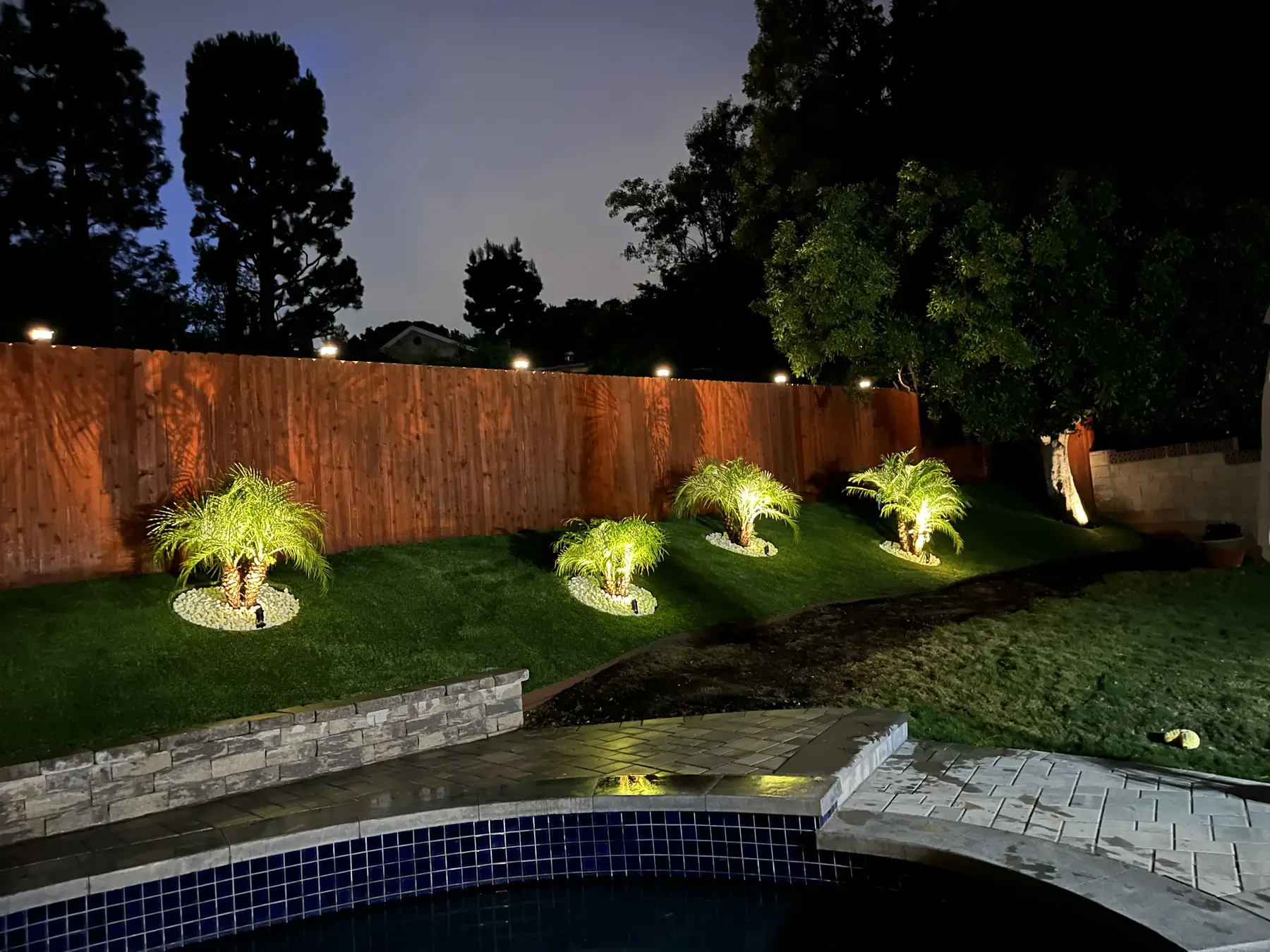
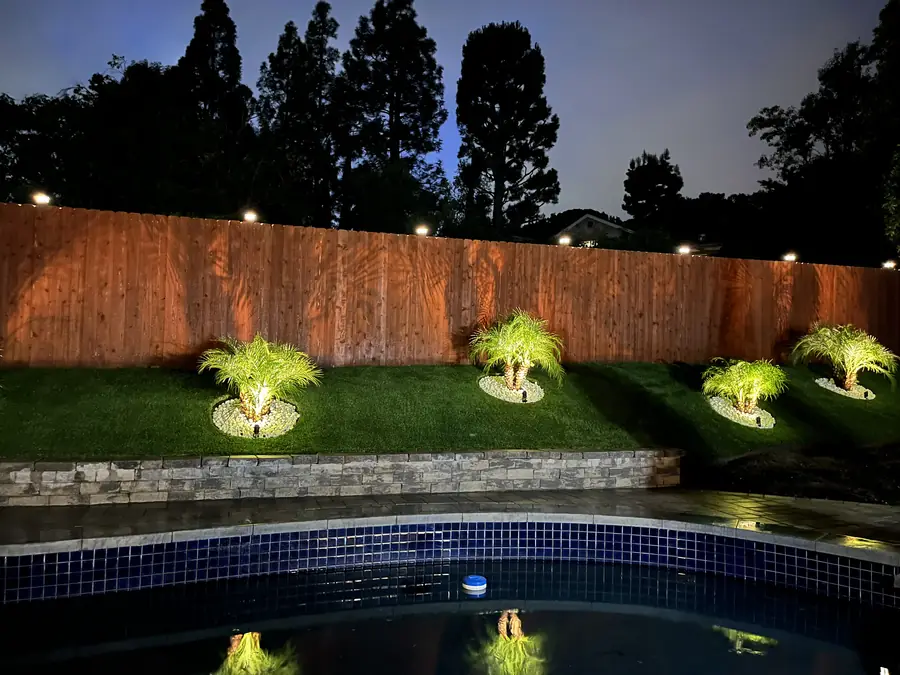
Path lights cast a soft pool downward to mark walkways and steps without lighting your face. Bullets and uplights aim a narrow to medium beam upward at trees, columns, and architecture. Well lights do the same job from a flush in ground housing where nothing should be visible during the day. Step and wall lights push light down onto treads and low surfaces. Wash and flood fixtures spread a broad even sheet across a facade or hedge. A finished design usually blends four or five of these, never one type repeated.
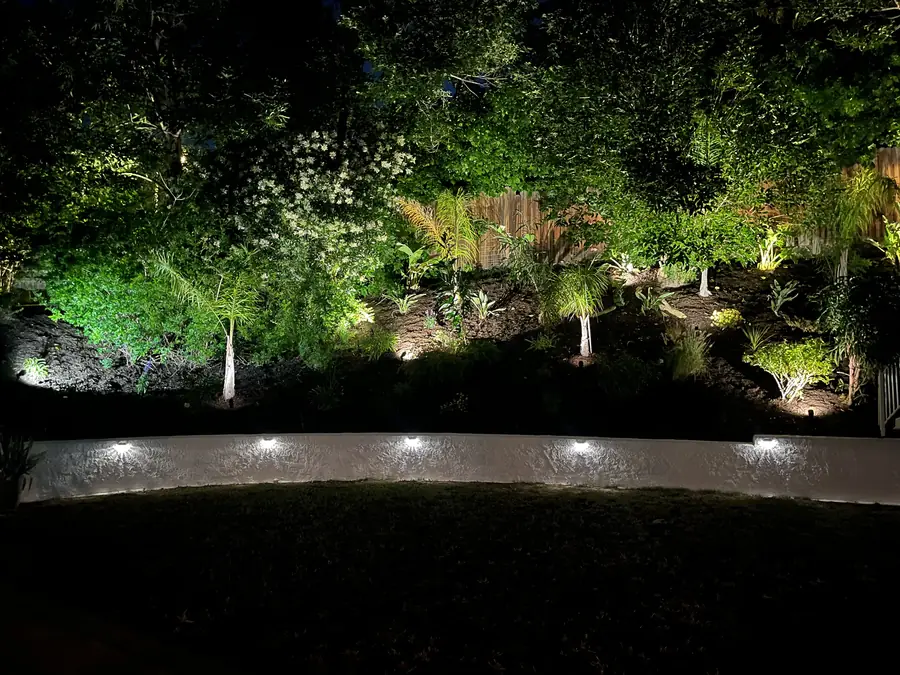
Layering is placing light at different depths and heights so the garden reads three dimensionally instead of as a flat lit wall. A typical composition puts something bright and distant at the back, a mid ground tree or specimen catching a soft uplight, and quiet low level light at your feet. The contrast between lit and unlit areas is what creates depth, which is why a design that lights everything equally always feels lifeless. We build the layers on site at night, adjusting as we go rather than guessing from a plan.
Glare comes from seeing the source instead of the effect, and it is the fastest way to ruin an otherwise good design. We control it by aiming fixtures away from primary sightlines, recessing lamps deep within shrouds, adding cowls, hex louvers, and glare guards, and choosing beam spreads that match the target rather than spilling past it. Fixtures near seating areas and entry paths get the most attention, because those are the spots where people stand still. Done right, you notice the lit tree and never notice the fixture.
Premium fixtures placed poorly still look bad, while modest fixtures aimed with care can look extraordinary. Position, beam angle, distance from the target, mounting height, and the choice of what to leave dark are the variables that actually create the effect. Add correct voltage at each fixture, tidy hub wiring, and connections that survive irrigation and weather, and you have a system that performs for years. Brand matters for durability and warranty support, but it will never rescue a design that put a bullet light in the wrong place.
LED is the sensible choice now. It draws a fraction of the power of halogen, which lets a single transformer support many more fixtures, and lamp life is long enough that maintenance visits become rare. On color, warmer temperatures flatter stucco, wood, and stone and feel residential, while cooler light can suit certain foliage and modern architecture. Consistency matters most, since mismatched temperatures across a yard look accidental. We also watch color rendering, because cheap diodes make green plants look gray no matter how bright they are.
Low voltage cable is buried shallow, typically in a narrow trench a few inches down, deep enough to stay out of the way of routine gardening and mower blades. Under lawn we go a little deeper, and where cable must cross a driveway or walkway we sleeve it in conduit so it can be pulled or replaced later without breaking concrete. We map the routes and share that layout with you, which prevents an unpleasant surprise the day somebody plants a new hedge.
A photocell senses ambient light and switches the system on at dusk, which keeps the start time accurate through the year without anyone touching a dial. The timer then handles the off point, whether that is a set hour or a duration after sunset. Many transformers include astronomic timers that calculate local sunrise and sunset from the calendar. Some clients prefer zones on separate schedules, with entry and path lighting running late for safety while decorative garden lighting shuts down earlier. We configure whichever pattern fits how you use the property.
The low voltage portion generally does not, since it operates at 12 volts. What can require review is the 120 volt side, meaning a new exterior outlet or a dedicated circuit for the transformer. Burbank is its own incorporated city, so any electrical permitting goes through the City of Burbank rather than Los Angeles. We assess your existing exterior power during the estimate and tell you plainly whether the plan works from what is already there or whether city review needs to be part of the project.
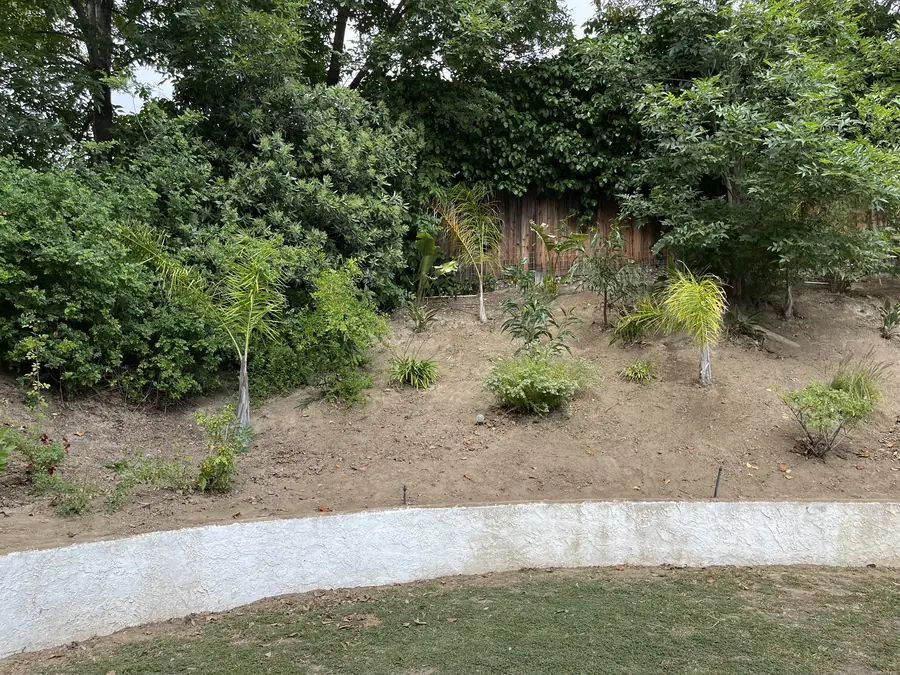
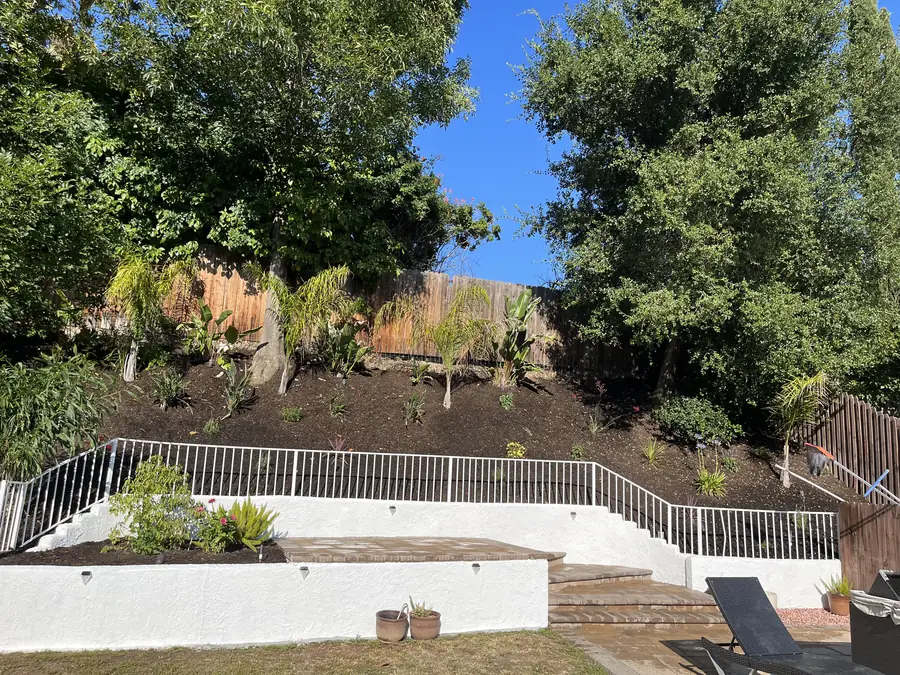
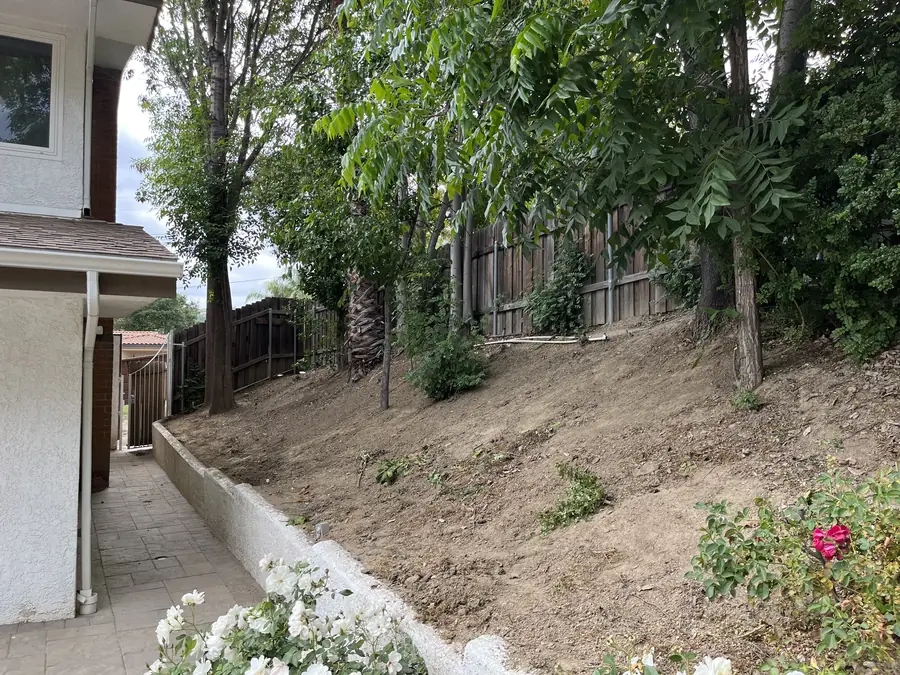
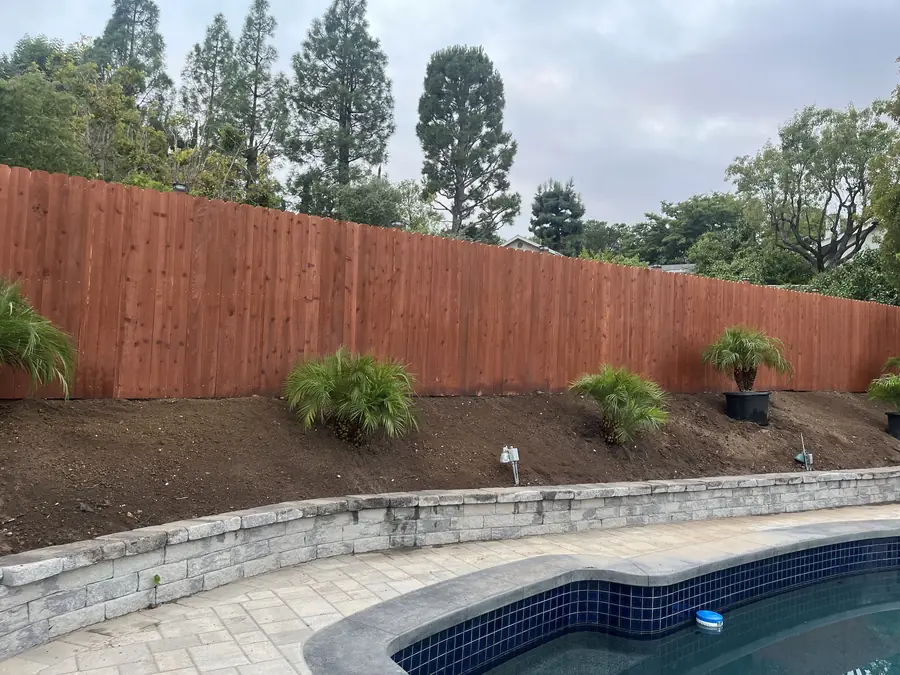
Yes, and hillside lots in the neighborhoods rising toward the Verdugo Mountains foothills are some of the most rewarding to light. Elevation gives you long sightlines and layered views back toward the house. The technical challenge is distance, because cable runs up a slope get long and voltage drop compounds, so we plan hub placement and wire gauge around the grade. Terraced retaining walls and stepped paths also become natural homes for step lights, which handle the real safety problem of navigating changing levels after dark.
Older Burbank streets carry substantial mature trees, and their roots spread well beyond the canopy. We hand dig near trunks and route cable to avoid cutting structural roots, and we never strap or lag a fixture to a trunk in a way that girdles it as the tree grows. Uplights typically sit at grade or in a well housing set back from the base, angled to graze the trunk and catch the canopy. Where a fixture must be mounted in a tree, we use adjustable hardware designed to be loosened as the tree expands.
They should not, if both were planned together. Problems arise when a bullet light lands directly in a spray pattern, which coats the lens in mineral deposits and drops output within a season, or when a trench cuts a lateral line nobody mapped. We locate existing irrigation before trenching, keep fixtures clear of head arcs where possible, and select sealed housings for locations that will inevitably get wet. Since we install irrigation as well, coordinating the two systems on one property is routine work for our crew.
Less than people expect, though not zero. Plants grow, so fixtures that were perfectly aimed in spring end up shooting into a shrub by fall and need repositioning. Lenses collect dust, mineral spray, and cobwebs that cut output noticeably. Occasionally a connection corrodes or a fixture gets knocked by a mower. An annual walk through at night to clean, re aim, and check the transformer keeps a system looking the way it did on the first evening. We are glad to handle that visit or show you how to do it yourself.
No. Daniels Landscaping installs every lighting system with one licensed contractor. The people who lay out the design, trench the cable, set the hubs, wire the transformer, and aim each fixture at night work under one licensed contractor. That structure is why the aiming session at the end gets the same care as the trenching at the beginning, and why you deal with one company from the first walkthrough through any adjustment you want a month later.
Give Daniels Landscaping a call at (818) 443-9300 and we will schedule a look at your Burbank property, ideally including an evening walk so we can see what the space actually does after sunset. We discuss which trees and architectural features deserve attention, where safety lighting is needed, and what existing exterior power can support. You then receive a free written estimate covering fixture counts, transformer sizing, and scope. Daniels Landscaping is licensed in California, number 1138709, and installs with one licensed contractor.