

FAQ
Landscape Lighting in Sun Valley, answered
The questions we hear most from Sun Valley homeowners.
It can, but the design has to account for it. Where spill light already comes over a back fence, low level ambient lighting simply disappears into it, so we work with contrast rather than quantity. That means putting deliberate light on specific things close to the house, a tree canopy, a wall texture, a seating area, so the eye has somewhere to rest inside the yard instead of tracking the glow beyond it. Planting and walls placed as a screen help as well. Adding more light everywhere is the wrong answer, it only competes.
By building depth with light rather than with grade. On a flat property everything sits at one elevation, so lighting only the ground plane leaves the yard reading as a single flat sheet after dark. We layer instead. Low path and step light near the walking surface, uplights carrying the eye into trees and up a wall, then a soft wash on a fence or hedge at the back to set a boundary. Three distances of light give a flat yard the dimension it does not have in daylight.
Usually yes, and it costs less than people expect. A single glaring floodlight on a dial timer is the arrangement we find at a lot of the older homes here, and it does the opposite of what lighting should do, it blinds you and throws everything behind it into black. We take it off, set a properly sized transformer, run new buried cable, and place small fixtures where they actually do some work. The old timer goes too. Modern controls follow sunset through the year without anyone resetting pins every few weeks.
It does not shorten the life much, but it dulls the output, and that happens faster on blocks with truck traffic and open industrial frontage. Film builds on the lenses and a fixture can lose a noticeable amount of brightness before anyone notices, because it dims gradually rather than all at once. We choose fixtures with lenses that wipe clean easily and gaskets that keep grit out of the housing, and we set them where a hose or a cloth can reach. Wiping the lenses twice a year restores most of what was lost.
Only if the system is designed badly. Voltage drops over distance in a 12 volt system, and a long run with fixtures hung off it one after another leaves the last ones visibly dimmer and shifted in color. On larger parcels we plan for that. Heavier gauge cable on the long legs, hub connections so fixtures share a common point instead of daisy chaining down the line, multiple tap voltages at the transformer, and sometimes a second transformer placed nearer the far group. Measured properly, the last fixture matches the first.
It helps, though not the way a bright floodlight does. Even, low level light across the approaches to a property removes the deep shadows where somebody can stand unseen, and it makes the place look occupied and cared for. One harsh light does the reverse, since your eyes adjust to the bright spot and everything outside it goes darker than before. We light entries, gates, side yards and the paths between them at modest levels, aimed down and shielded, so the property reads clearly from the street without glaring at anyone.
Sun Valley falls under the City of Los Angeles, so anything requiring a permit goes through Los Angeles Building and Safety. Low voltage lighting downstream of the transformer is the mild part of the system, since it carries roughly 12 volts. The connection feeding the transformer is standard household power, and if a new circuit or an added exterior outlet is involved, that is the piece subject to electrical permitting. We tell you at the estimate whether your project touches that, and we take care of it rather than leaving you to sort it out.
It steps 120 volt household power down to roughly 12 volts, which is what makes the rest of the system safe to bury at shallow depth and safe to work around. Sizing matters. A transformer loaded to its limit leaves no room to add a fixture later and runs hot, so we specify capacity with headroom and use the multiple tap voltages to compensate for drop on longer runs. It gets mounted on a wall out of sight, near the power source, at a height where it stays dry and can be reached for service.
We trench the cable in rather than tucking it under mulch where a shovel finds it later, and we route it along beds and edges where a future repair will not mean cutting into a surface. Connections are made at hubs using waterproof, gel filled connectors, never twisted and taped. Where a run crosses a walkway or a drive, it goes through a sleeve. We also plan the routes before the first fixture is placed, because reworking cable once planting and hardscape are finished is the expensive way to do it.
Far enough that you do not create a runway. The common mistake is a row of identical fixtures at even spacing down both sides, which looks like an airstrip and lights nothing but itself. We stagger them, use them where the path turns, steps or reaches a destination, and let the pools of light overlap loosely with darkness in between. Fewer fixtures placed with intent light a walk better than twice as many placed by the tape measure. Shielded tops keep the source out of your eye as you walk toward them.
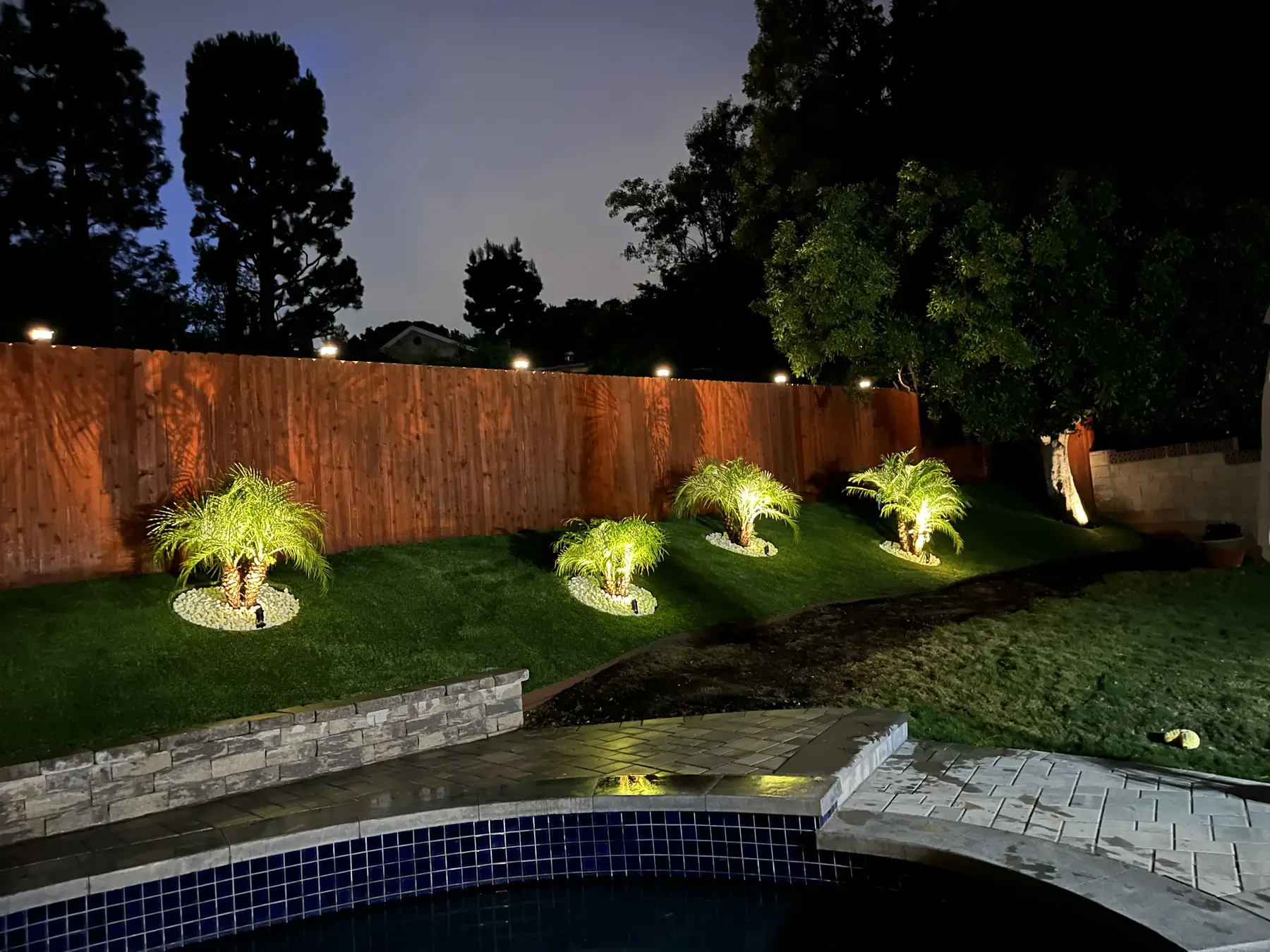
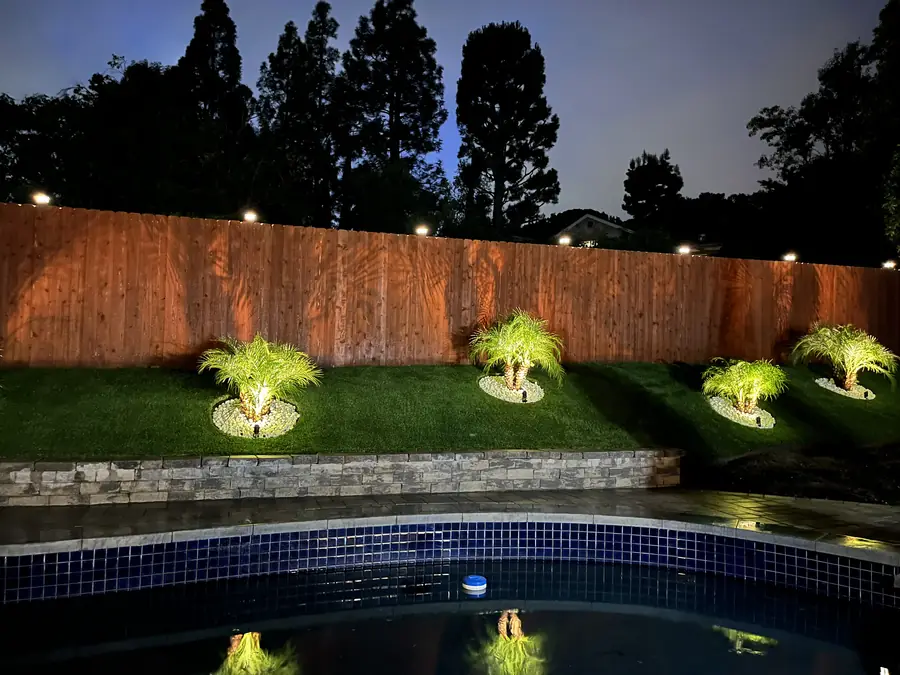
The ones with structure. A tree with an interesting trunk, layered branching or a canopy that catches light from below gives you something after dark, while a dense round shrub just turns into a bright blob. We set bullet fixtures at the base, aim up through the canopy, and use narrower beams on tall trunks with wider ones on spreading forms. Two fixtures from different angles read better than one straight on, since a single beam flattens the shape. Aiming happens at night, on site, never from a plan on paper.
A well light sits in the ground with its housing buried and only the top flush with grade, so the fixture disappears and you see nothing but the effect. They are the right choice where a standard fixture would be in the way, alongside a driveway, out in a lawn area, across a patio, or tight against a wall being grazed with light. Because they sit at grade they need drainage in the housing and a location that does not hold water. On flat ground we set them slightly proud and grade around them.
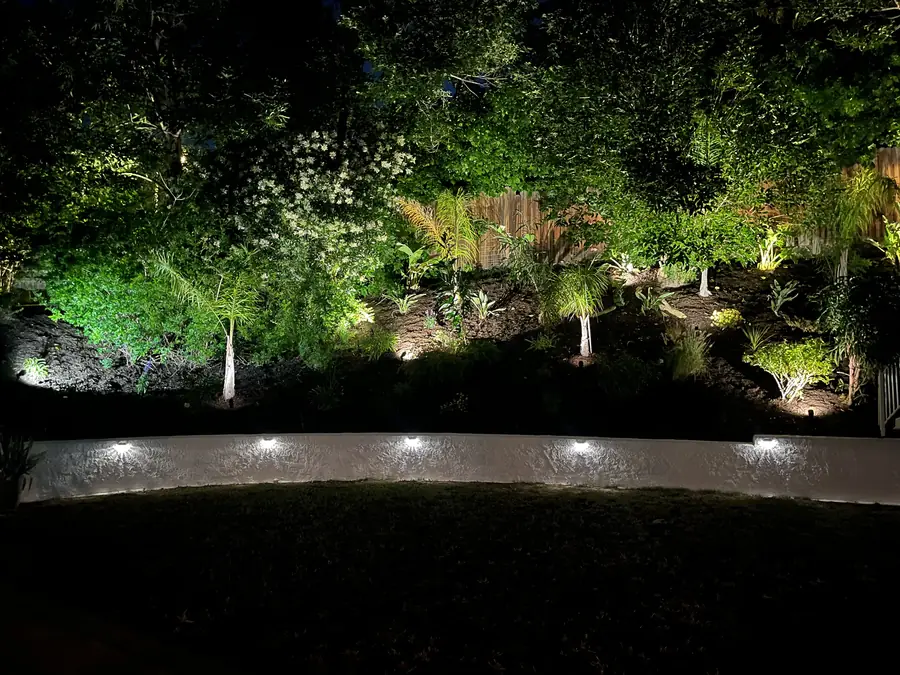
Steps do, without question. A step you cannot see is the most common way people get hurt in a yard after dark, and lighting it from a distant fixture usually casts a shadow across the tread instead of onto it. We use recessed step lights in the riser or in the adjacent wall, aimed down across the surface so the edge of every tread reads clearly. Low wall lights do the same for seat walls and changes of level. The fixture stays hidden, and you see the surface rather than the lamp.
Aiming and shielding, done after dark with the system running. Every fixture we place gets a shroud, a hex louver or a glare guard where the source could be seen from a seating area, a window or the sidewalk. Wash and flood fixtures on a house face get aimed so the beam lands on the wall rather than skimming past it into the yard next door. On closely spaced lots this matters more, because the neighboring house is not far away. If you can see the lamp itself, the fixture is aimed wrong.
Warm, and consistent. LED fixtures in a warm range flatter stucco, wood and stone and keep a yard feeling like an outdoor room instead of a parking lot. Cooler light reads harsh on warm toned materials and makes planting look gray. Mixing temperatures across a yard is the more common error, since one replacement lamp in a different tone stands out immediately. We specify a single temperature across the system and choose fixtures from a line that will still be available when something eventually needs replacing.
An astronomic timer at the transformer is the usual answer. It tracks sunset and sunrise for this location through the year, so the system follows changing daylight without anyone adjusting anything. A photocell does something similar by reading actual darkness, which handles overcast evenings well and pairs nicely with a timer that shuts things down late. Many transformers now offer app control, useful if you want the entry lights running later than the garden. What we avoid is a mechanical dial that drifts and needs resetting every few weeks.
Daniels Landscaping crews, every part of it. We work under one licensed contractor. The same people who design the layout dig the cable trenches, mount the transformer, set the fixtures and come back after dark to aim them. Nobody unfamiliar turns up on your property, and there is no gap where one company sits waiting on another. If you call us a year from now about a fixture, we already know how your system was built and where the cable runs.
Reach Daniels Landscaping at (818) 443-9300 and we will come look at the property. We walk it in daylight to see the trees, the materials, the walkways and the sight lines, and we talk about what you want to see at night and where the glare is coming from now. You then get a free written estimate covering fixture counts, transformer, cable and the scope of the install. Daniels Landscaping is licensed in California under number 1138709, and there is no charge for the visit or the estimate.