

FAQ
Landscape Lighting in North Hills, answered
The questions we hear most from North Hills homeowners.
Four parts, and each one matters. A transformer mounted near an exterior outlet takes household power down to 12 volt. Cable buried through the yard carries that power out to the fixtures. The fixtures themselves throw light in specific ways, whether that is a path light washing a walkway or a bullet aimed up into a tree. A timer or photocell decides when everything comes on. The design tying those pieces together is the real product, because identical fixtures placed thoughtlessly produce nothing but glare and hot spots.
Safety and flexibility, mostly. Low voltage cable is far less hazardous than line voltage running through a yard where people dig, plant and let children play, and it does not demand the same conduit and burial depth. Fixtures can be moved, reaimed and added as planting fills in, which counts for a great deal, because a tree lit correctly today grows into something different within a few years. Line voltage systems lock you into their original layout. Twelve volt lets a system evolve alongside the landscape.
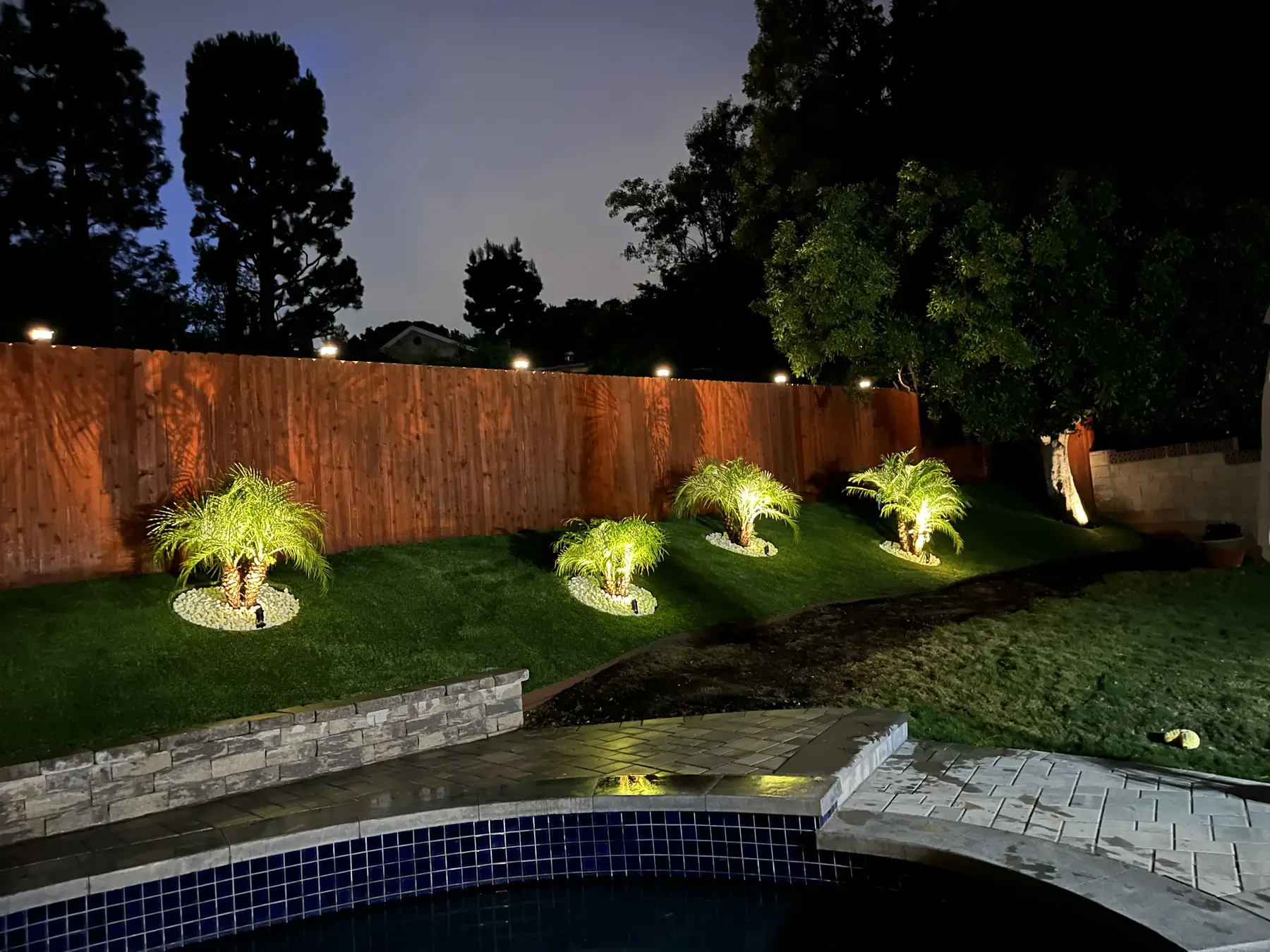
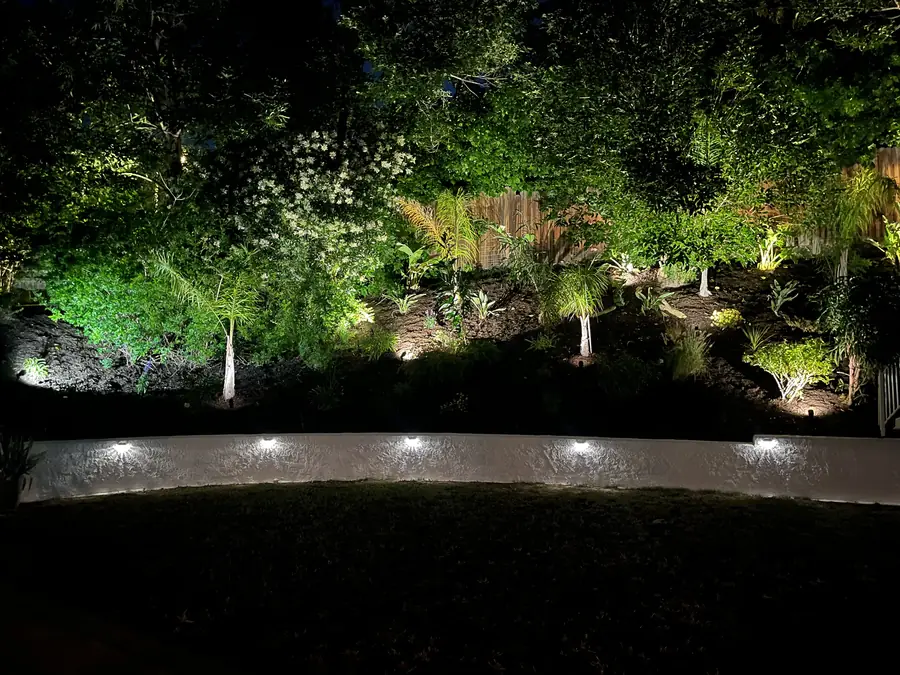
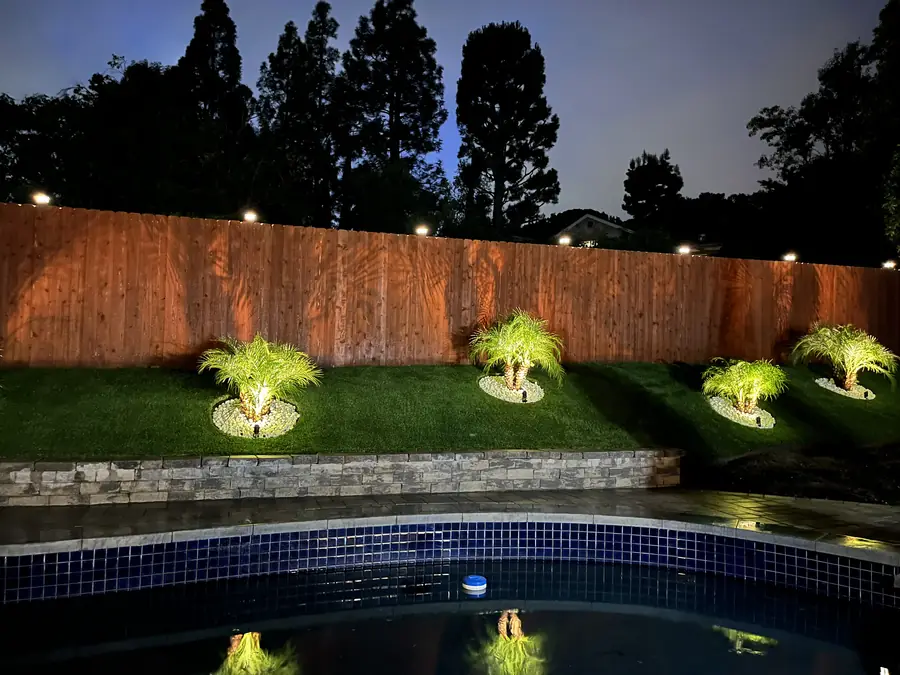
Layering is the whole answer. Level ground offers no natural elevation to work with, so depth has to be manufactured out of light at different distances and heights. We might uplight a tree at the back of the yard, wash a fence or a block wall in the middle distance, and keep path lighting low and restrained in the foreground. The eye reads those planes as depth. Lighting everything at one brightness from one direction is exactly what makes a yard resemble a flat wall at night.
These homes present a simple, horizontal front elevation, and lighting works best when it respects that rather than fighting it. A pair of uplights grazing the wall on either side of the entry gives the facade shape without turning it into a billboard. Mature front yard trees, which many of these streets have, take bullets aimed up through the canopy. Path lights along the walk want enough spacing to read as a rhythm instead of a runway. Restraint looks expensive. Overlighting looks like a used car lot.
A well light sits flush in the ground with the lamp recessed down inside its housing, so the source stays hidden and only the effect shows. That makes it useful in open lawn, inside a planting bed, or right at the base of a wall where a standing fixture would be in the way of a mower or simply look like clutter. The tradeoff is drainage and debris, since anything set at grade collects leaves and water. We install them with drainage below and keep them clear of the low spots where a level yard collects.
Anywhere people change elevation in the dark, yes. A single riser between a walkway and a porch is easy to miss at night, and on a flat lot it is the most common trip point precisely because nobody is expecting it. Small step lights recessed into the riser or the adjacent wall put light on the tread without shining into anybody's eyes. Wall lights do comparable work along a seat wall or a low block wall, grazing the surface so the patio edge reads clearly without floodlighting the whole area.
More capacity than the fixture count strictly requires. We total the wattage of everything on the plan and size the unit with headroom, because a transformer run at its limit runs hot and leaves nothing for a second phase, an added tree light, or a future patio. Multiple taps let us feed different runs at slightly different voltages to compensate for distance. On a compact lot one well placed transformer near an outdoor outlet generally serves the entire property, which keeps the installation simple and the wiring tidy.
It matters less here than on a sprawling property, but it still separates a good installation from a mediocre one. Voltage falls with distance and with the number of fixtures sharing a line, and starved lamps at the far end go dim and shift color. Short runs on a compact lot forgive a fair amount of sloppiness. We size the wire properly anyway and use hub connections, where several fixtures branch from one point fed by heavier cable, so every light on the system sees comparable voltage.
In trenches deep enough to stay clear of a shovel and a lawn aerator, routed along bed edges and fence lines instead of straight across open lawn. Connections are made with waterproof fittings, never tape or twisted wire, because a corroded splice underground is the failure everybody eventually calls about. Where a run crosses a walkway or driveway, we sleeve it in conduit so cable can be pulled or replaced later without breaking concrete. Runs get documented so the next person knows what is under the yard.
That is the ideal moment, and we suggest it whenever both jobs are on the table. The ground is already open, the crew is already trenching, and pulling lighting cable alongside a new sprinkler line costs a fraction of returning later to cut a finished yard apart. Even when the fixtures belong to a later phase, we will lay the cable and cap the runs so the system is ready when you are. On these lots, where so much original irrigation is due for replacement, that overlap comes up constantly.
Most systems benefit from both. A photocell senses darkness and brings the system on as the sun goes down, so the start time follows the season without anyone adjusting anything. A timer or astronomical clock then shuts things off at a set hour, which is what people generally want, since nobody needs the back yard lit at three in the morning. Splitting the system so entry and path lighting stay on later than the accent lighting is simple to set up and saves both energy and lamp life.
Aiming and shielding, which is most of the craft in this trade. Houses on these tracts sit close to one another, so a bullet pointed carelessly at a tree will also light the bedroom next door. We aim fixtures at the object rather than past it, use shrouds and glare guards to hide the lamp from normal sight lines, tuck fixtures behind planting where we can, and check the result from the sidewalk and from the far side of the fence after dark. If the bulb is visible, the aim is wrong.
For any system going in today, yes. LEDs draw a fraction of the power the old halogen lamps did, which means a smaller transformer, longer runs on the same wire, and dramatically less lamp replacement. Just as important, they come in specific beam angles and color temperatures, so a warm narrow beam can travel up a trunk while a wider soft wash covers a wall. Quality varies widely, though. Solid brass or copper housings with sealed sockets survive years of sun and sprinkler spray. Inexpensive plastic does not.
Connections and cable, ahead of everything else. Systems installed decades ago tend to have wire nuts or taped splices buried in soil, and those corrode until whole sections drop out. Cable insulation turns brittle. Transformers fail, or were undersized for the fixtures somebody kept adding over the years. Old halogen fixtures are usually past saving, with cracked lenses and rusted sockets. Frequently the cable path is the only salvageable part, and even then the gauge may be too light for what the yard needs now.
Because placement determines what you see, and hardware only determines how long it lasts. A premium brass fixture aimed at the wrong angle produces glare. An ordinary fixture placed well, shielded and set at the right distance, produces something that looks intentional. The same holds underground, where wire gauge, hub layout and waterproof connections decide whether the system still works in five years. Homeowners get sold on fixture catalogs, and the part that genuinely makes a yard look good is not in the catalog.
Phasing is common and easy to plan around. The usual first stage covers the front, the entry, the path and the trees people see from the street, since that is where the impact is greatest. Back yard accent lighting and patio work follow. The key is laying out the full plan at the beginning and sizing the transformer and cable for the finished system, so stage two becomes a matter of connecting fixtures rather than pulling everything back out. That approach fits the way most people here budget for yard work.
Daniels Landscaping does, with one licensed contractor. One licensed contractor stays accountable for the work. The people trenching the cable, mounting the transformer and aiming fixtures after dark work under one licensed contractor. Aiming in particular is a judgment call made on site at night, and that is not something you get from a crew handed a plan and told to be finished by five. One company designs it, one company installs it, and one company answers for how it looks.
Call (818) 443-9300 and we will arrange a visit, in North Hills or in Sepulveda as many residents still know it. We walk the property in daylight to see the trees, walls, entry and planting, then talk through what you want the yard to feel like after dark and where you actually spend time outside. From there you receive a free written estimate covering layout, fixture types, transformer and cable work. Daniels Landscaping is licensed in California under number 1138709, and the installation stays under one licensed contractor.