

FAQ
Landscape Lighting in North Hollywood, answered
The questions we hear most from North Hollywood homeowners.
Four parts, and only one of them is visible. A transformer mounted near an exterior outlet takes household voltage down to twelve volts. Buried cable carries that power out into the yard, usually to hub points where several fixtures connect close to where they stand. The fixtures are the part you see, and they come in types chosen by job, meaning path, uplight, well, step and wash. The fourth part is control, a timer or photocell bringing the system on at dusk and off at a set hour. Systems succeed or fail on the middle two parts.
Not if it is aimed properly, and on lots this close together that takes genuine care. We keep uplights tight to the trunk or wall being washed, use narrow beam angles when the target is small, and add shrouds, hoods or glare guards so the source is not visible from off the property. Fixtures near a shared fence point back toward the house rather than across the line. We also walk the property after dark from the sidewalk and from the neighboring side, because the only honest test is standing where they stand.
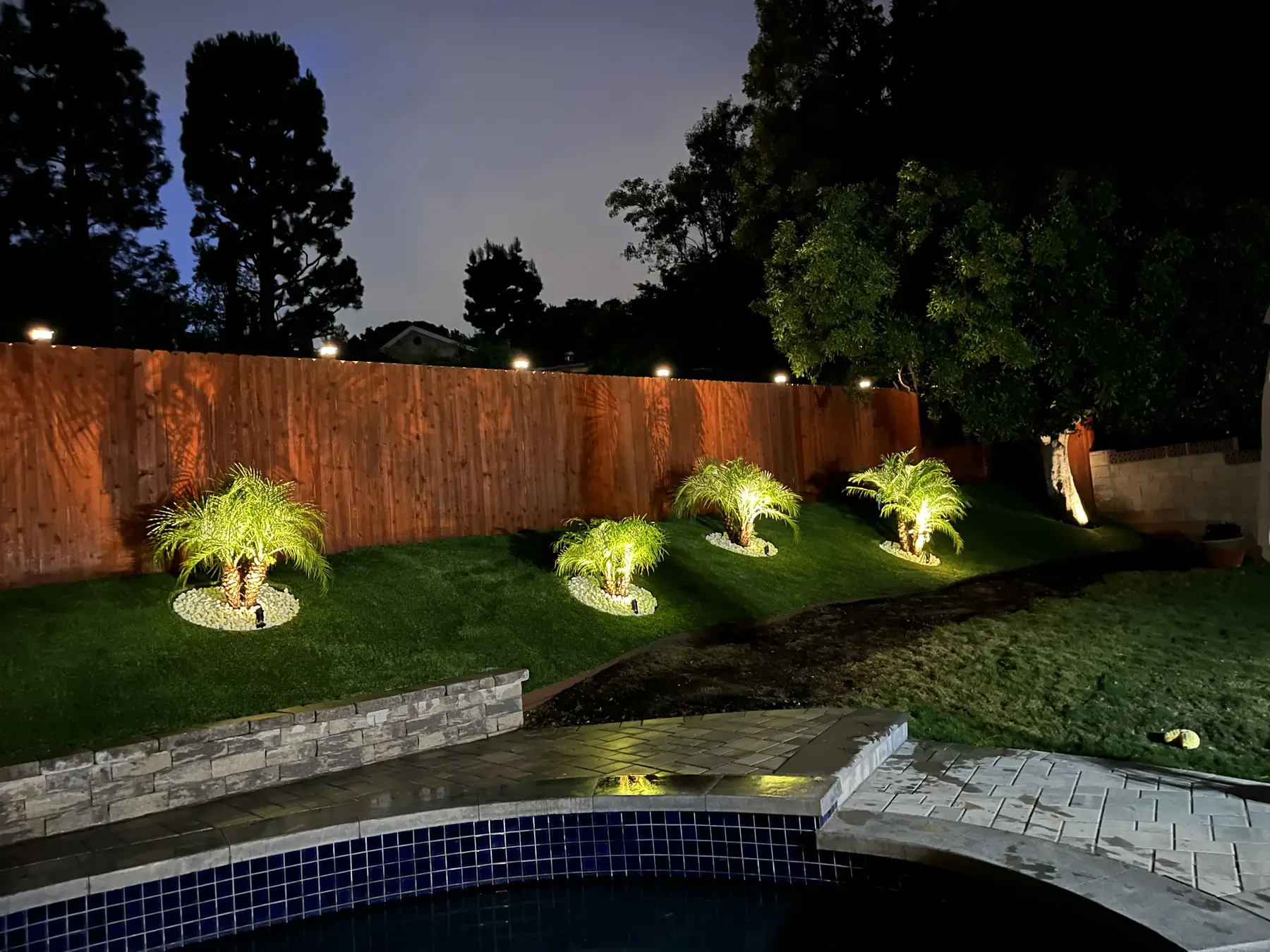
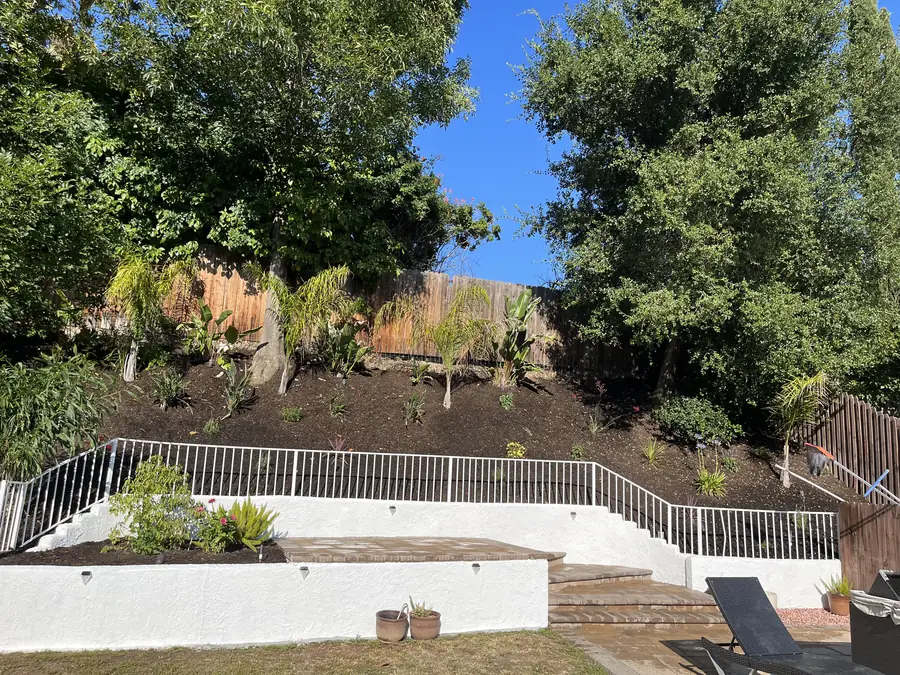
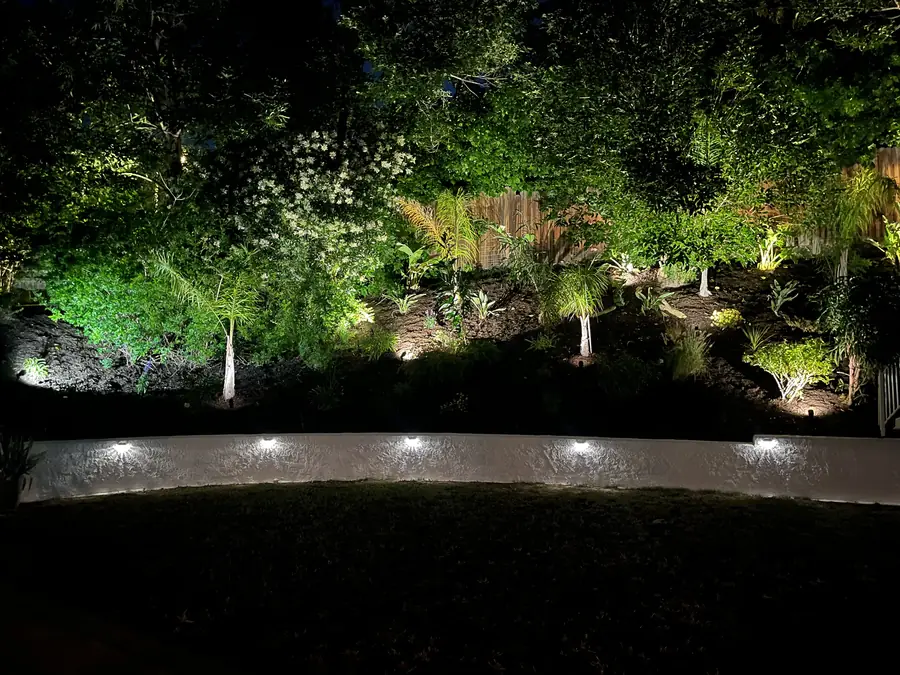
Flat ground removes the easy trick, which on a hillside is simply lighting different elevations. Here depth has to be manufactured through layering. We set a background layer, meaning a wall wash or a tree lit at the rear of the yard, then a middle layer of uplit shrubs or a specimen tree, then a low foreground layer at path and step level. Brightness steps down as light comes toward the viewer, so the eye reads distance. Leaving sections deliberately dark is part of it, because contrast is what creates a sense of space.
Farther apart than most people expect. Path lights are meant to graze the walking surface and signal direction, not to form a lit runway down both sides. We stagger them, place them at decision points such as a turn, a step or a gate, and let the pools of light overlap only at their edges. A short front walk often needs two or three fixtures, not eight. Height matters as much as spacing, since a taller fixture spreads a wider pool while a shorter one keeps the light down where feet are.
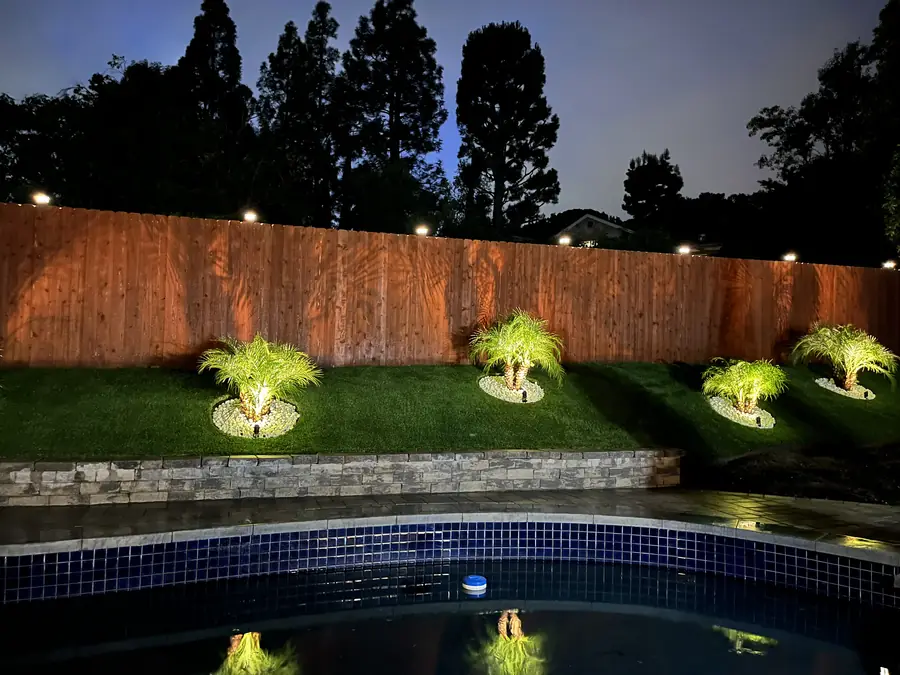
Anything with structure. A tree with an interesting trunk and a canopy that catches light, a textured wall or stone veneer, a mature shrub with real form, or the vertical lines of the house around an entry. Smooth flat stucco with nothing on it rarely rewards the effort. We match beam spread to the target, using a narrow beam for a tall palm and a wider one for a low spreading tree, and we set the fixture back far enough that light climbs the whole subject instead of blasting the first three feet.
Well lights install flush with grade, so they vanish during the day and nothing sticks up to be mowed over, tripped on, or knocked out of aim. That makes them the right answer in a lawn, in a narrow planting strip along a driveway, or anywhere a fixture would be in the way on a compact lot. The tradeoffs are real. Drainage beneath the housing has to be handled, debris collects in the well, and aiming is less adjustable afterward, so placement gets decided carefully the first time.
Wherever the walking surface changes height, light belongs at that change. Step lights recessed into a riser or a side wall put illumination directly on the tread without a glare source at eye level, which is precisely what a path light standing beside a stair fails to do. Small hardscape fixtures tucked under a seat wall cap or a stair nosing accomplish the same thing invisibly. On entries used by tenants or guests unfamiliar with the property, this is the portion of the system that exists for safety rather than appearance.
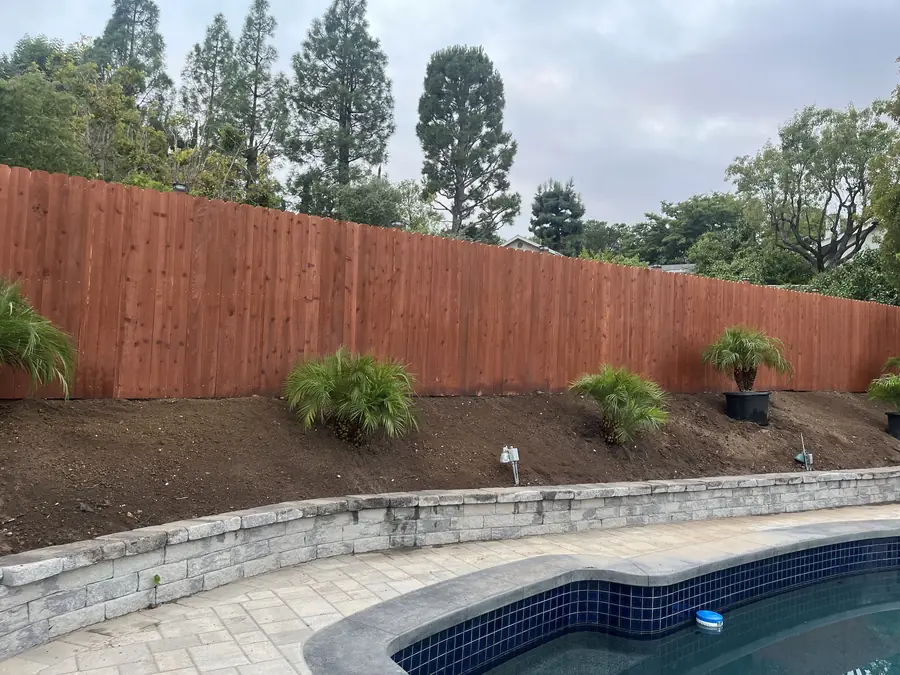
A back fence is often the largest surface in a compact yard, and lighting it changes how big the space feels. We use wash or flood fixtures placed close to the base and angled up so light spreads evenly rather than forming hot spots, or we mount downward from a structure to graze the surface and reveal texture. Restraint matters, since a wall lit too brightly becomes the only thing anyone sees and it throws spill past the fence as well. Lower output across a broader area almost always reads better.
The transformer mounts on an exterior wall near an outlet, off the ground, somewhere reachable but out of a main view. We size it with headroom above the current load rather than filling it to capacity, precisely because phased work is so common around here. Adding another area later then means running new cable to spare terminals instead of replacing the power supply. Multiple taps let us feed long runs at a higher voltage while shorter runs get their own, which keeps brightness consistent across the property.
Cable is direct burial rated and goes into a shallow trench, deep enough to stay clear of routine digging and edging, routed along bed edges and fence lines rather than across open lawn. In tight side yards we hand trench, and we probe first because irrigation lines, gas and old abandoned pipe tend to share that same narrow corridor. Connections happen at hub points using waterproof connectors, never with twist caps buried and forgotten. Every splice sits somewhere we can locate again without excavating half the yard.
Voltage falls as current travels down a cable, and twelve volt systems have very little margin to lose. A fixture at the end of a long run can receive noticeably less voltage than one near the transformer, and LED output drops off or the color shifts once it falls far enough. The fixes are design decisions rather than adjustments, meaning heavier gauge cable, splitting the load across several runs instead of one long daisy chain, feeding hubs from the center, and selecting the correct transformer tap. We verify by measuring voltage at the fixtures.
Set it and let it run. A photocell brings the system on at dusk automatically as the seasons shift, paired with a timer that shuts it down at a chosen hour so it is not burning until sunrise. Astronomical timers do the same without a sensor that can get dirty or shaded. For a property you visit rarely, a controller reachable from a phone is worth the small additional cost, since it lets you confirm the system is running and change hours without driving over to open a cover.
Material and serviceability matter far more than brand. Solid brass and copper age gracefully and survive being bumped by a mower or a trash can, while thin aluminum and plastic housings corrode at the socket and crack in sun. We favor fixtures with replaceable lamps over sealed units, because a sealed fixture that fails becomes a fixture replacement rather than a lamp change. Sturdy stakes, well protected leads and gaskets that can actually be renewed round it out. Repairable hardware is the right answer on income property.
Glare comes from seeing the source instead of the effect. We keep the lamp out of the normal sight line using shrouds, recessed lamps, hoods and placement behind planting, so what registers is the lit tree and not a bulb sitting in the mulch. Fixtures pointed anywhere near seating areas, windows or the street receive the most attention. Aiming happens at night with the system running, adjusted fixture by fixture, because none of it can be judged at noon with everything switched off.
No, and it is worth understanding why. Two properties can install identical hardware and look completely different, because the result comes from placement, beam angle, aiming, brightness balance and what is deliberately left dark. Beyond appearance, longevity comes from workmanship, meaning correct cable gauge, waterproof connections, sensible run layout and a transformer that is not overloaded. Expensive fixtures wired poorly still flicker, dim and fail. Modest fixtures installed carefully still look right years later, which is the outcome most owners are actually paying for.
Sometimes, and we look before recommending anything. Older systems commonly show corroded connections buried in soil, undersized cable feeding too many fixtures, halogen lamps drawing far more power than the transformer comfortably supplies, and housings crumbling at the socket. If the cable is sound and adequately sized, converting to LED lamps and rebuilding the connections is a reasonable path. When the cable itself is the problem, patching it simply repeats the same failure next season. We will tell you which situation you have rather than defaulting to the larger job.
We do, under one licensed contractor. Daniels Landscaping stays accountable for the work, so the crew trenching the cable is the crew setting the fixtures and the crew coming back after dark to aim them. That continuity is why nothing falls between trades, and it is why aiming actually gets finished instead of being left at whatever angle a fixture happened to land in. One company, one crew, one point of responsibility for how the yard looks at night.
Call (818) 443-9300 and ask for a lighting walk. Daniels Landscaping holds California license 1138709, and the written estimate is free. We look at the yard in daylight to see what deserves lighting, discuss which windows and neighboring views need to stay clear, count fixtures by type, and size the transformer and cable runs for whatever you may add later. You receive a written scope listing fixture types, quantities and locations, so you know precisely what is being installed.