

FAQ
Landscape Lighting in Arleta, answered
The questions we hear most from Arleta homeowners.
A transformer, buried cable, fixtures, and the aiming that makes all of it work. We size a transformer to the load and mount it near an exterior outlet, run cable in trenches out to the fixture locations, connect at hubs instead of chaining every fixture in one long line, set each fixture, and then return after dark to aim. That last part is the step people underestimate. A scheme that looked reasonable on paper gets adjusted while you stand in your own yard and watch what the light is actually doing.
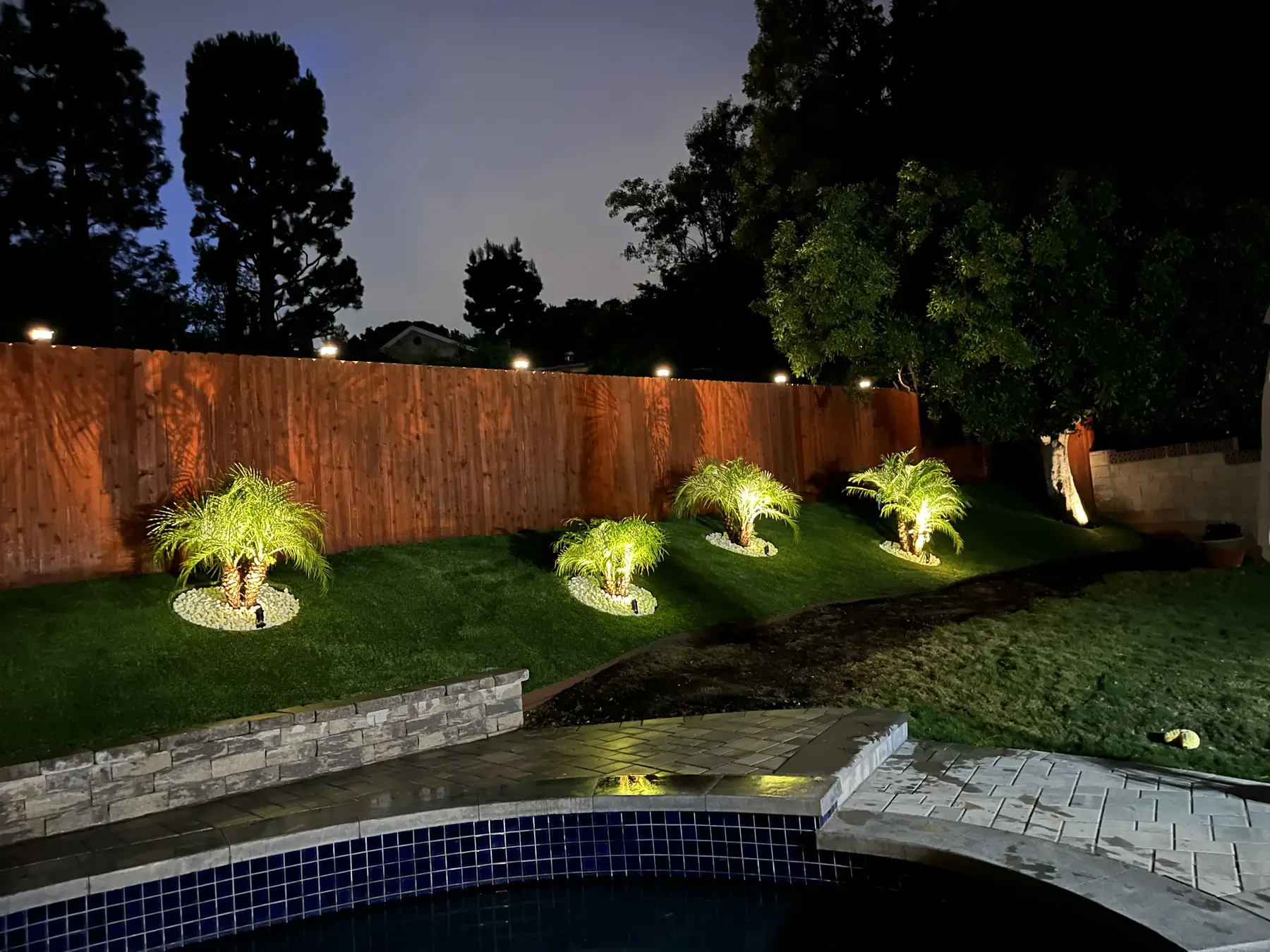
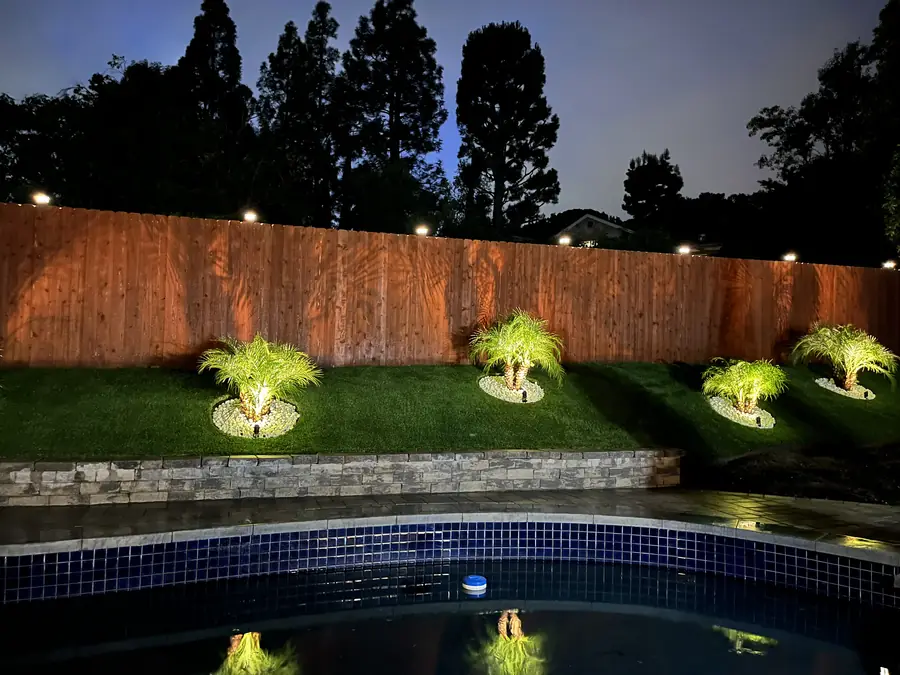
Aim, shield, and pick the beam width deliberately. On lots this close together an uplight tilted a few degrees too far clears the canopy entirely and lands on a bedroom window across the fence. We set uplights close to the trunk with a narrow beam so light stays on the object, add shrouds or glare guards wherever a fixture sits in a sight line, and check the result from the neighbor side of the property rather than only from your patio. Light that misses its target was wasted energy anyway.
Fewer than most quotes include. A small yard fills with light quickly, and once everything sits at the same brightness the effect flattens out and starts to resemble a parking lot. The better approach picks a handful of subjects worth attention, perhaps the entry, one good tree, a wall with texture, and the change of level at the steps, then leaves the space between them darker on purpose. Contrast is what makes a modest yard read as layered instead of simply bright, and it costs less to install.
Path lights anchor walkways and driveway edges, throwing a soft pool downward rather than glowing at eye level. Uplights, sometimes called bullets, sit at ground level and push light up a trunk or a wall. Well lights bury flush so nothing shows during the day, useful in a lawn or a bed people walk through. Step and wall lights recess into risers and low walls to make a tread edge readable. Wash and flood fixtures spread a wide, even sheet of light across a broad surface such as a fence or a garage face.
Quite a lot, because the facade is usually simple and low, which is straightforward to light well. Grazing light up a stucco or brick face brings out texture that disappears in daylight. A pair of fixtures set to cross under the eave gives the front a rhythm without washing the windows. One mature tree out front, lit from two sides, does more for the elevation than a row of path lights ever will. Houses here sit close to the street, so the whole effect reads clearly from the sidewalk.
It takes 120 volt house current down to the 12 volts the fixtures run on, which is what makes buried cable safe to work around and simple to extend later. It mounts on an exterior wall near an outlet, typically in a side yard or behind the garage where it stays out of view but remains reachable. We size it with headroom above the connected load so the system is not operating at its limit and fixtures can be added later without swapping the unit. Multi tap terminals let voltage be tuned run by run.
By hand dug trench in most cases, since a tight gate rules out machinery. Cable is buried at depth along the side of the house, kept clear of irrigation lines and any gas or water run, and sleeved where it passes beneath a walk or driveway. A narrow side yard also leaves fewer places to route around obstacles, so the path is planned before anyone digs. Because distances on a lot this size are short, the trenching stays limited and the disruption is confined to one strip of the property.
At hubs, using connectors rated for direct burial and filled to keep moisture out. Wiring every fixture in one long chain means the last fixture receives noticeably less voltage than the first, and one bad connection then takes out everything downstream of it. A hub gathers several fixtures at a single point on a home run back to the transformer, so voltage stays even and troubleshooting is straightforward. Twist on wire nuts and pierce style connectors are exactly what fails a season or two in, once corrosion gets into them.
Less than on a large property, and that is a genuine advantage of building here. Voltage falls as it travels along a wire, and over long runs a distant fixture ends up dim and yellow while the near ones burn bright. On a compact lot the distances stay short, so with correct wire gauge, hub connections, and the right transformer tap, every fixture sees close to the same voltage. We still calculate it rather than assume, particularly on a run reaching the far back corner of the yard.
LED is the standard now, drawing a fraction of the power for the same output, which means more fixtures on one transformer and far less heat at the lens. On color, a warm range reads natural on plants, stone, and stucco, while cooler light can suit gray stone or a modern facade and looks harsh on nearly everything else. Mixing color temperatures across one yard is the mistake to avoid. We also weigh housing material, because a solid brass or copper body outlasts a thin painted one by years.
Most systems run from a timer built into the transformer, and the type worth having is astronomic, meaning it tracks sunset and sunrise through the year instead of firing at a fixed clock time you keep resetting every season. A photocell reads actual darkness and does the same job, useful as a backup or on a simpler setup. Many owners choose to shut most of the yard down late at night while leaving the entry and path lights on, which is easy to arrange with separate circuits.
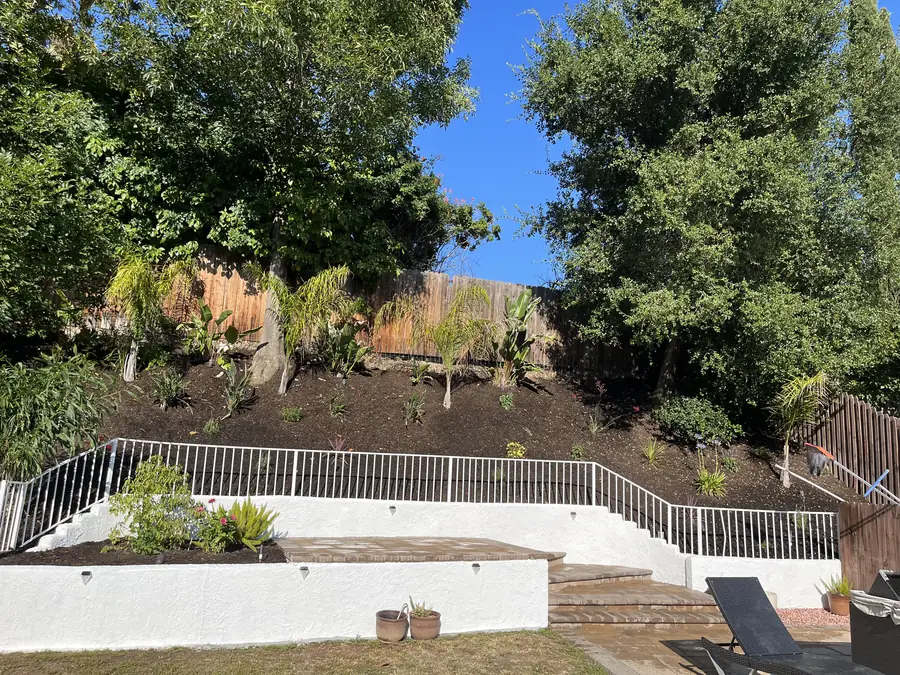
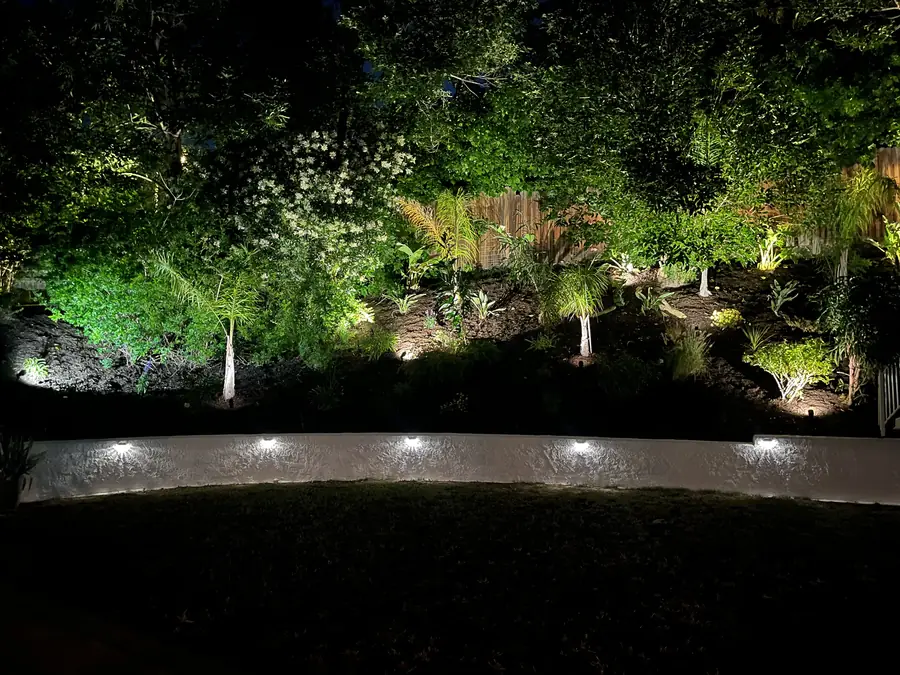
By placing light at different distances and different heights instead of relying on a slope to do it for you. A hillside hands you layers for free. On level ground we build them, with a low path light in the near ground, an uplight in a tree at mid depth, and a wash on the rear fence or wall at the back of the view. The eye reads those separations as distance. Downlighting from a tree or an eave adds another layer, dropping soft light and shadow onto the ground plane.
The difference is whether you see the source or only what the source lights. A bare lens sitting in a sight line is glare, and glare shrinks a small yard, because the eye locks onto the bright point and stops reading anything beyond it. We use shrouds, recessed lenses, and hex louvers on fixtures facing a seating area or the sidewalk, tuck fixtures behind planting where the layout allows, and tilt them so the beam does the work while the source itself stays hidden from view.
Because good fixtures aimed badly look bad, and modest fixtures placed well look expensive. Beam angle chosen for the subject, distance from the trunk, the tilt, wire gauge, connection method, and the transformer tap all decide what you see at night. Two yards can carry identical fixture lists and look nothing alike. This is also why we come back after dark to aim rather than setting everything at noon and calling the job complete. Nobody is ever standing in the yard at midday judging the lighting.
That is often the reason people call in the first place. A step becomes a hazard when tread and riser blend together in the dark, so we light the edge, either from a fixture set into the riser or a low side wall, or from above where a soffit or a tree makes that possible. The front walk gets enough light to read the surface without lining it with glare. Lighting the destination matters too, meaning the door and the house number, since people walk toward what they can see.
Not much, though it is not nothing. Plants grow, and a shrub that was small on installation day will eventually swallow the fixture aimed past it, so aiming deserves a periodic check. Lenses collect dust and sprinkler mineral deposits and want a wipe. Fixtures set in beds get bumped during garden work and end up crooked. LED lamps last a long time but not forever, and a hub connection is the place to look when a group goes dark together. We walk the yard with you after dark once the system is running.
Daniels Landscaping crews, and nobody else. One licensed contractor stays accountable for the work. The trenching, the transformer, the cable and hubs, the fixture placement, and the after dark aiming are all handled by our own people. Lighting rewards that continuity, because whoever aims a fixture at night is the same person who decided where it belonged and why. When you want something nudged next season, you are calling the company that put it in the ground rather than chasing down whoever happened to be on the job that week.
Phone Daniels Landscaping at (818) 443-9300 and we will come look at the property, usually walking it in daylight first to understand the planting and the architecture, then talking through what deserves light and what should stay dark. You receive a free written estimate covering fixture types and counts, the transformer, cable routing, controls, and the aiming visit. We are licensed in California under number 1138709. Nothing proceeds until that estimate is in your hands and you have agreed to the scope written in it.