
FAQ
Landscape Lighting in Woodland Hills, answered
The questions we hear most from Woodland Hills homeowners.
The cost depends on the size of your property, how many fixtures the design calls for, and how far the cable has to run from the transformer to the farthest light. A small entry and pathway setup is very different from lighting a large lot with mature trees, walls, and a long driveway. Rather than quote a number over the phone, we walk the property, listen to what you want, and put everything in a written estimate at no cost so you know exactly what you are paying for.
Low-voltage systems run on twelve volts through a transformer that steps your household power down, which makes them far safer to work around and much easier to adjust or expand later. Paired with LED lamps, they draw very little electricity and the lamps last for years before they need changing. Older line-voltage and halogen setups run hot, burn out faster, and cost more to run. For a Woodland Hills yard you want out most evenings, low-voltage LED is the sensible standard, and it is what we install.
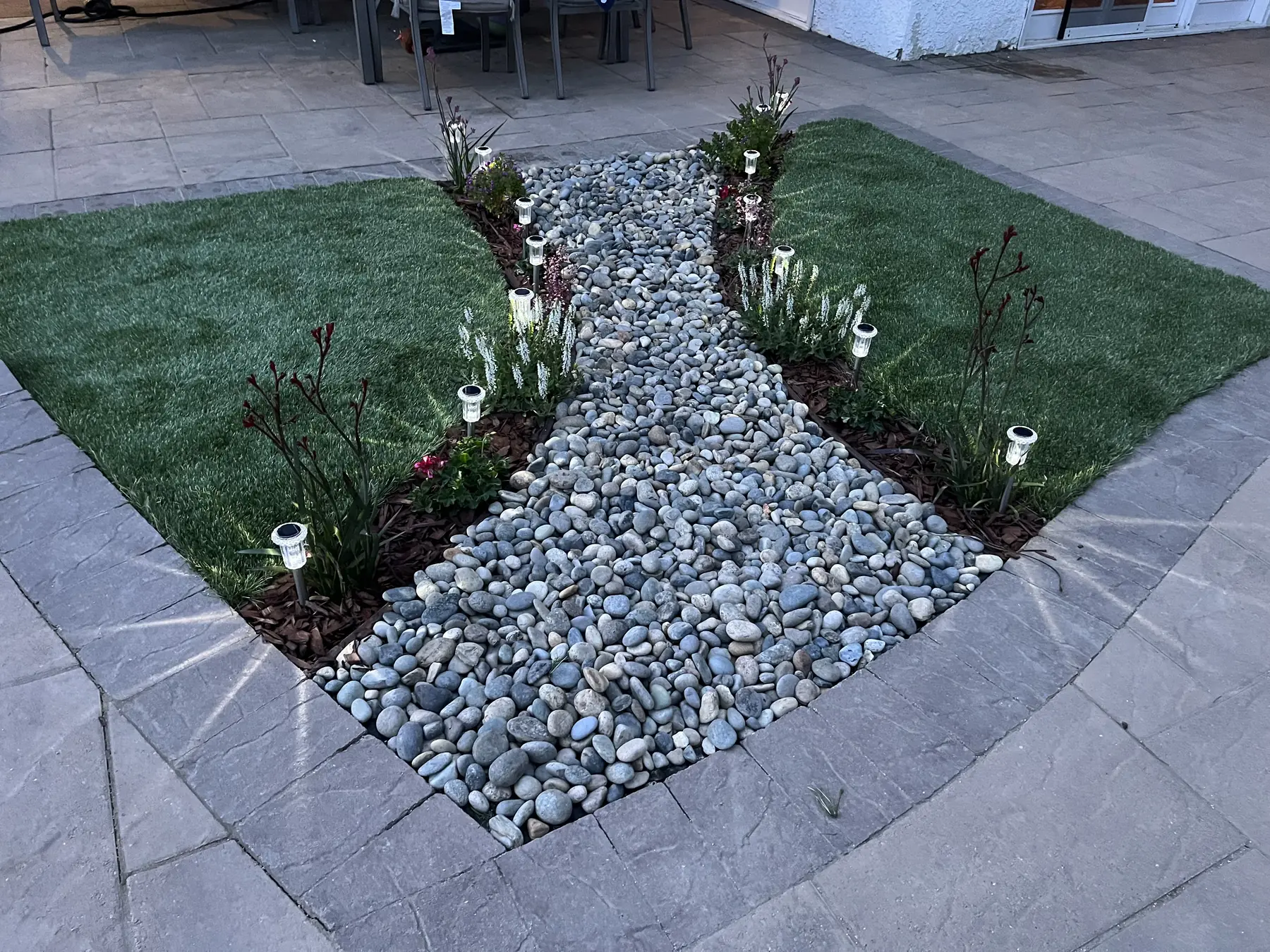
Good path lighting guides you along walkways, steps, and the edge of a driveway without blinding anyone. The trick is spacing and shielding. Fixtures set too close look like a runway, and set too far apart they leave dark gaps. We use shielded path lights that cast a soft pool downward onto the surface, then space them so the light overlaps gently along the route. On the deeper front yards common in Woodland Hills, thoughtful placement matters more than piling on fixtures, and it keeps the look clean and natural.
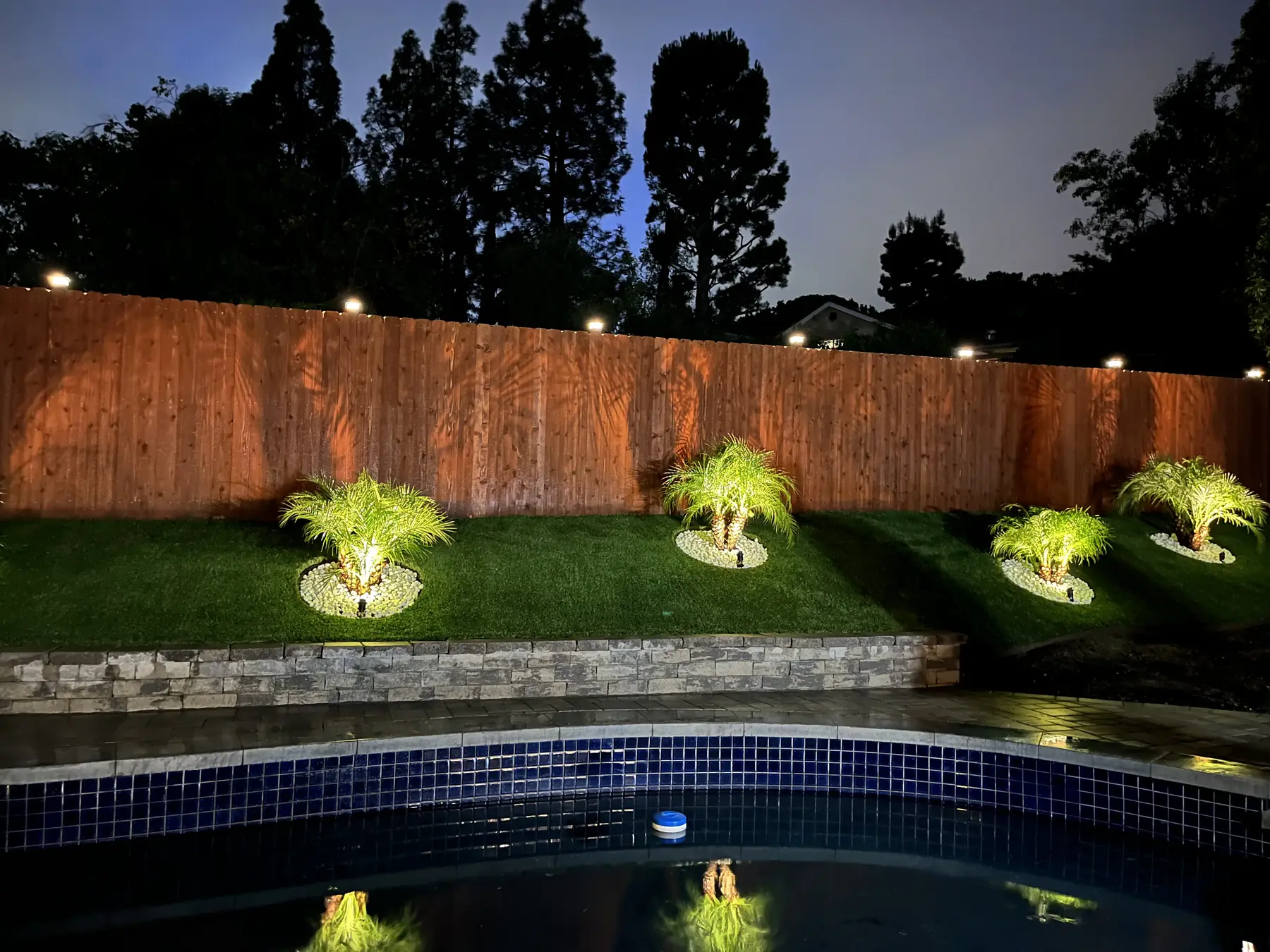
Yes, and mature trees are one of the best things to light in Woodland Hills. Uplighting places a fixture low at the base and aims a beam up into the canopy, which shows off the trunk, the branch structure, and the leaves against the night sky. Old oaks, sycamores, and pines take beautifully to it. We choose beam angle and brightness for each tree so a big specimen reads as a centerpiece while smaller ones stay in balance. The same technique works on the front of the house to bring out stone, stucco, and architectural lines.
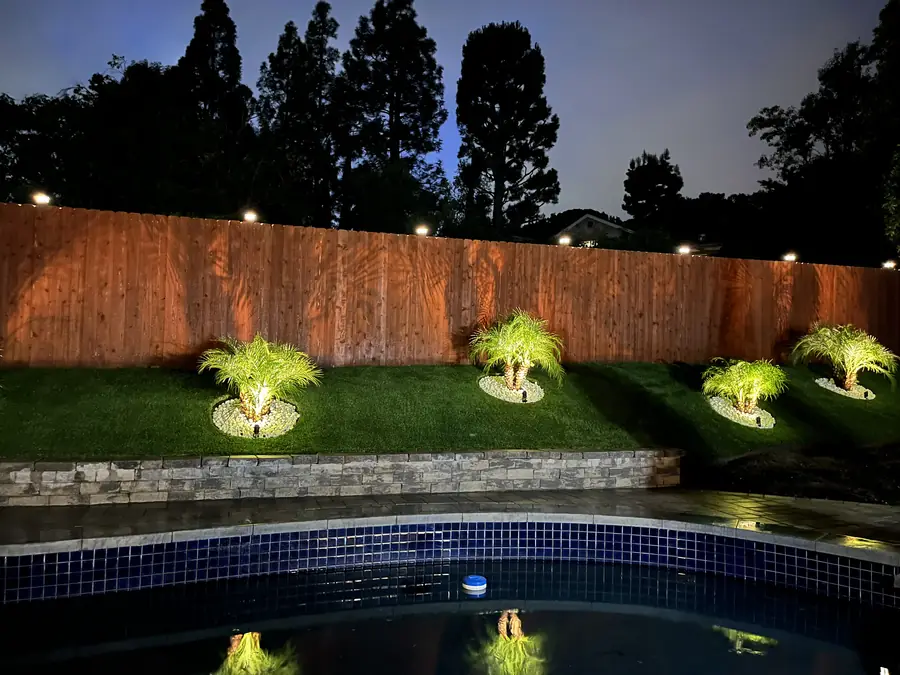
Both are ways to light a vertical surface, and they create very different moods. Washing floods a wall or fence with a smooth, even layer of light from a little distance, which is flattering on plain stucco and good for a broad backdrop. Grazing sets the fixture close to the base and throws light straight up the surface, so every ridge in stacked stone, brick, or a textured wall casts a shadow and the texture jumps out. On the stone and block walls around many Woodland Hills homes, grazing turns an ordinary surface into a feature.
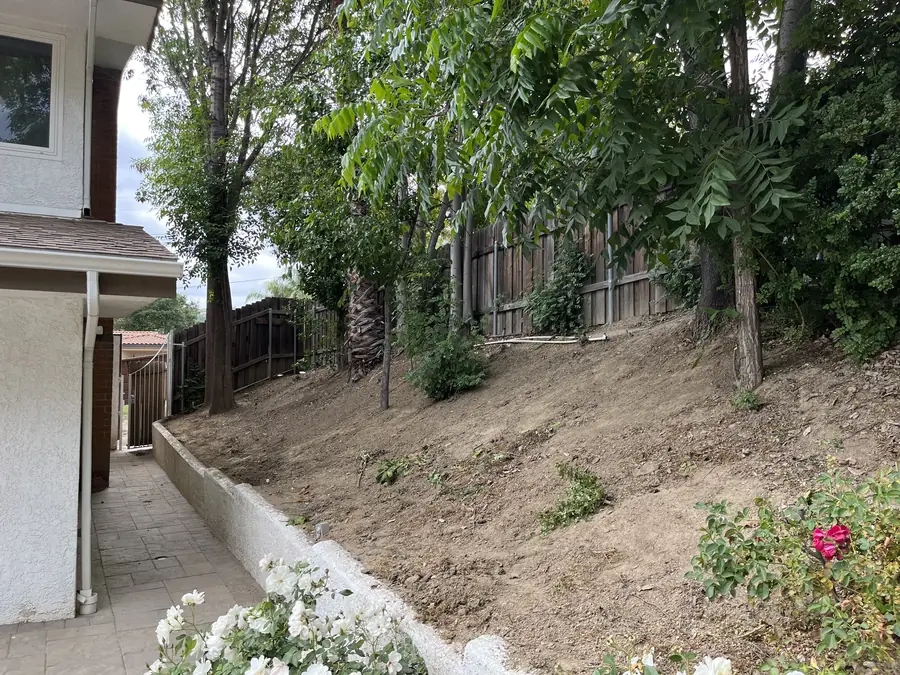
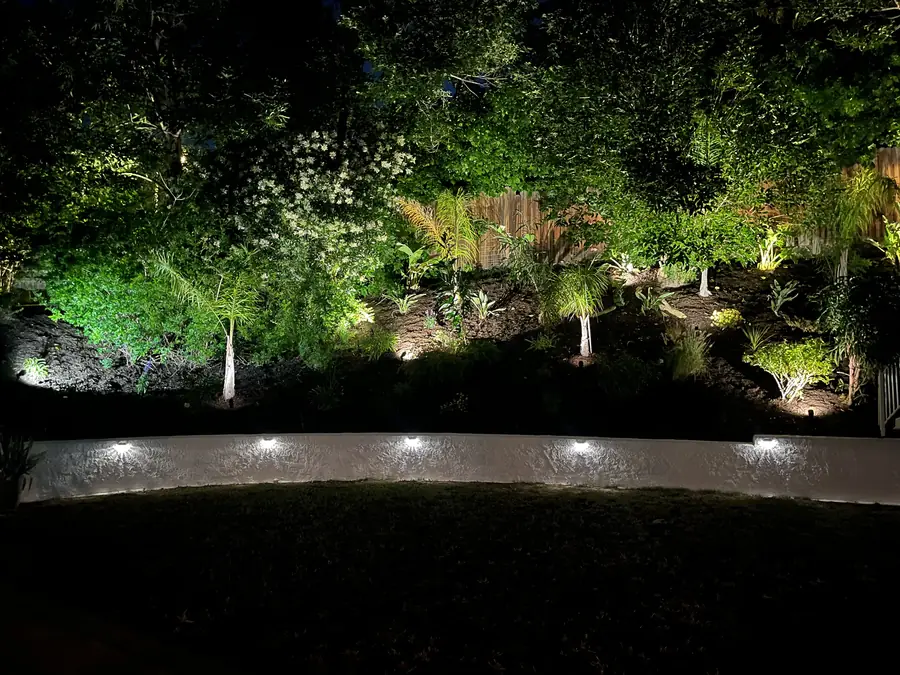
We do, and it is some of the most valuable lighting you can add on a hillside. The streets climbing toward Mulholland leave a lot of Woodland Hills homes with sloped yards, outdoor stairs, and raised decks that turn treacherous once the sun drops. Recessed step lights tuck into the risers or an adjacent wall and light each tread without glare in your eyes. Low fixtures along a sloped path keep the grade readable so nobody misjudges a step. On a graded lot, this is safety first and good looks second.
A well-lit property is far less inviting to anyone who would rather work in the dark. Good design removes the shadowed corners near entries, side yards, and gates where someone could stand unseen, and it lets you and your neighbors notice movement from inside or from the street. The goal is steady, even coverage rather than one harsh floodlight that blinds and casts deep shadows right beside it. We can pair the ambient lighting with motion-activated fixtures at key points, so your home looks lived in and cared for every night without feeling like a parking lot.
The transformer is the heart of a low-voltage system. It sits in a weatherproof housing near an outdoor outlet, steps your power down to twelve volts, and feeds the fixtures through buried cable. Sizing it correctly for the total load matters, and we leave room to add lights later. For control, a photocell can switch the system on at dusk and off at dawn, an astronomical timer can follow the seasons, and many homeowners in Woodland Hills prefer a smart controller they run from a phone app so the whole yard responds to a schedule or a tap.
That fading is voltage drop, and it is the most common flaw in a poorly planned system. As current travels down a long cable run, it loses voltage along the way, so the fixtures farthest out glow weaker than the ones near the transformer. The fix is in the design. We use the right wire gauge for the distance, split long runs into separate zones, and wire in a hub or loop layout so every fixture receives close to the same voltage. On the larger Woodland Hills lots with long cable pulls, this planning keeps the whole yard even.
The all-in-one kits from a big box store look tempting, but they tend to disappoint within a season or two. The plastic fixtures grow brittle and discolor, the connectors corrode where they sit in the soil, and the small transformer cannot carry more than a handful of lights, so you cannot grow the system. Beam control on those lamps is crude, which leads to glare and hot spots. Professional-grade brass and copper fixtures, properly sized wire, and a real design cost more at the start and then quietly do their job for many years.
A quality low-voltage LED system asks very little of you, though it is not entirely hands off. Every so often the lenses want a wipe so dust and hard-water spots do not dull the output, and growing plants may need a trim where they have started to block a beam. Fixtures sometimes shift after a heavy rain or a gardener bumps one, so an occasional re-aim keeps everything pointed where it should be. LED lamps run for years before they fade. We offer service visits to handle all of this if you would rather not fuss with it yourself.
For most homes we recommend warm light, in the range around twenty-seven hundred to three thousand Kelvin. Warm tones flatter stucco, wood, stone, and green foliage, and they feel inviting rather than clinical. Cool, bluish light tends to make a yard look stark and can turn plants an odd gray-green. There are moments for a slightly cooler beam, such as lighting a blue-toned agave or a modern white facade, but those are deliberate choices. Keeping the color temperature consistent across the whole property is what makes a system look professionally designed instead of pieced together.
It should not, and preventing that is part of doing the job right. The problems come from bare, unshielded fixtures aimed carelessly, which throw glare across a property line or into a bedroom window next door. We shield the sources, aim uplights so the beam catches the tree or wall and not the sky or the street, and we dial brightness down to what the scene actually needs. On the closer lots you find in parts of Woodland Hills and Tarzana, this courtesy matters, and a well-aimed system lights your yard while staying quietly out of the yards next door.
The right ones do, which is exactly why fixture quality is worth paying for out here. Summer temperatures in the west Valley are hard on cheap materials, and thin painted aluminum or plastic fades, warps, and grows brittle after a few seasons in that sun. Solid brass and copper fixtures shrug off the heat and only weather to a richer patina over time. Quality LED lamps are built with the heat sinking they need so they do not cook themselves and burn out early. We spec fixtures made to last in a Woodland Hills climate, not to fail in it.
In almost every case, yes. Low-voltage cable is buried only a few inches deep, so we can route it through established beds and lawns with minimal disturbance and tuck fixtures in among plants that are already grown in. Many of the larger, older properties in Woodland Hills have mature landscaping we would never want to disrupt, and thoughtful routing lets the new lighting look like it was always there. If you are planning fresh hardscape or planting, it is even easier to sleeve conduit while the ground is open, but existing yards are our everyday work.
It depends on the size of the design and the property, so the honest answer is that we scope it during the estimate rather than guess. A focused entry and pathway project moves quickly, while lighting a large lot with tree uplighting, wall lighting, several zones, and long cable runs is a bigger undertaking. Because one licensed contractor does the work, from trenching cable to setting and aiming each fixture, the schedule stays under our control and we control the schedule. We give you a clear timeline in writing before we begin so there are no surprises.
Yes on both counts. The quality fixtures we install carry manufacturer warranties, and we stand behind our own installation work, so if something is not right we come back and make it right. We also service and repair systems other companies put in. Voltage drop, corroded connectors, failed transformers, and fixtures knocked out of aim are the usual culprits, and often a tired old halogen system is a good candidate to convert to efficient LED. Whether we built it or inherited it, we can diagnose the trouble and get your Woodland Hills yard lit properly again.
The first step is a walk of your property. Call Daniels Landscaping at (818) 443-9300 and we will set a time to visit, look at your trees, walkways, walls, and grade, and learn how you want to use the yard after dark. From there you receive a written estimate at no cost, laying out the design, the fixtures, and the scope in plain terms. We are a licensed California contractor, number 1138709, and one licensed contractor stays accountable for the whole job start to finish. When you are ready to light up your Woodland Hills home, we are ready to help.