

FAQ
Landscape Lighting in Toluca Lake, answered
The questions we hear most from Toluca Lake homeowners.
The parts you notice are the fixtures. The parts that decide whether the system works are the transformer, the cable, and the connections. A properly sized transformer converts household voltage down to 12 volt, cable is buried out to fixture groups, and joints are made at hubs with waterproof connectors instead of a chain of splices strung along the run. Add a timer or photocell for control, LED lamps chosen for output and beam angle, and mounting hardware suited to soil, planter, or masonry. Design then sets placement and aiming, which is where the result lives or dies.
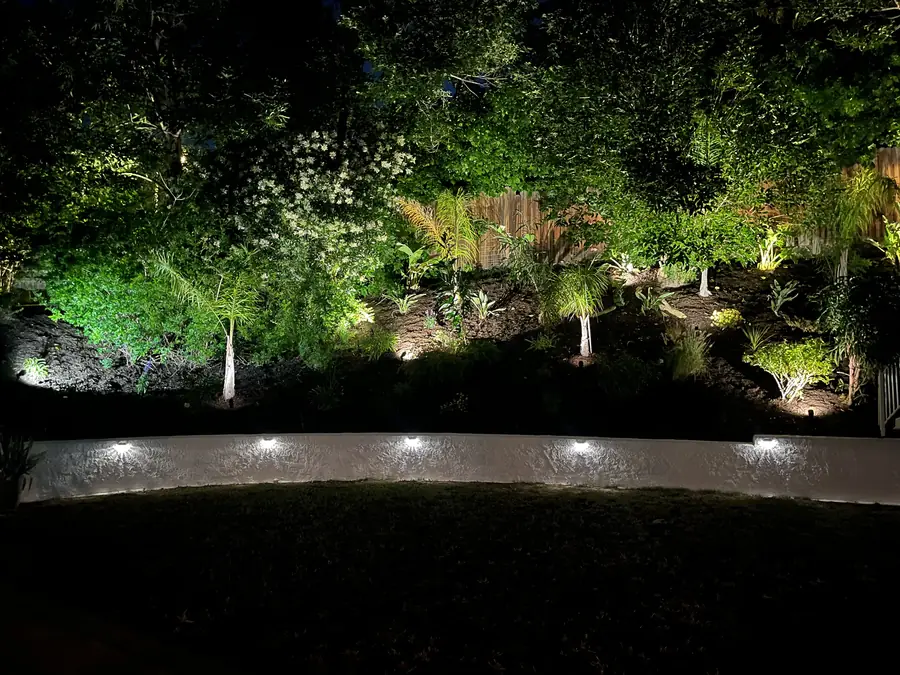
This is the best opportunity most properties here offer. Bullet or well fixtures go out away from the trunk, generally toward the drip line, so the beam rakes up through the branch structure instead of blasting the bark from six inches away. Two or three fixtures at differing distances build depth, revealing trunk, interior branching, and the underside of the canopy as separate layers. Beam angle is chosen for the tree, narrow for a tall straight trunk, wider for a spreading crown. Fixtures sit on stakes or in wells so they disappear during the day.
Yes. Low voltage cable is a genuine advantage here, since the runs are shallow and flexible, so routes can follow bed edges, walkways, and open ground rather than driving straight across a root plate. Inside a root zone we hand dig, ease roots aside instead of cutting them, and slip cable through rather than trenching. Where a run absolutely must cross, we pass underneath. There is no sense damaging a tree that took decades to fill out for a shorter cable route, particularly when that same tree is the reason we are lighting the yard.
It is the maintenance item nobody warns you about. Well lights set flush in a bed fill with leaves and vanish, path lights get buried at the base, and a lens under debris throws a fraction of its output. We design around it by favoring fixtures that sit slightly above the mulch line in heavy drop zones, choosing well lights with proper drainage and gravel beneath, and staying out of the natural collection pockets against walls and steps. Blowing the fixtures out a few times a year keeps the whole system looking new.
We total the connected load of every fixture, then leave meaningful headroom, generally loading a transformer well under its rating so it runs cool and so fixtures can be added later without replacing it. Larger properties often receive more than one transformer, each placed near the group it serves, which shortens cable runs and reduces losses. Multi tap transformers provide several output voltages so distant runs can be fed a little higher. Mounting location matters as well, near a suitable exterior circuit, off the ground, and somewhere the enclosure is not the first thing anyone sees.
Voltage drop is the loss that builds as current travels down the cable, and on large established lots with long runs it is the usual reason distant fixtures glow dim and yellow while the near ones look correct. LED fixtures tolerate a range, but they are not immune. We control it with adequate wire gauge, hub connections where several fixtures tie in at a single point instead of daisy chaining down one line, splitting the load across multiple runs, and using a higher tap for far groups. Then we measure voltage at the fixture itself.
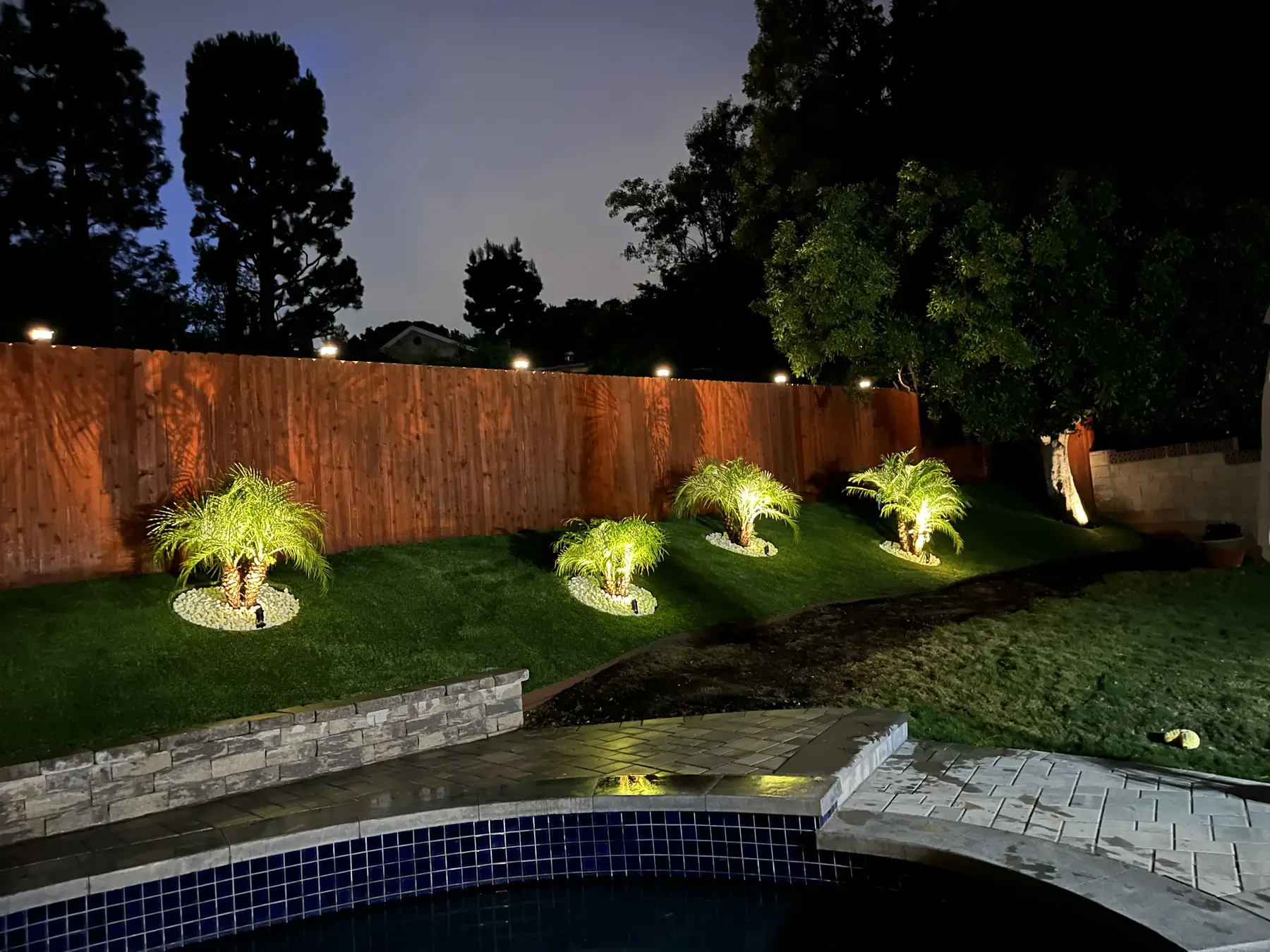
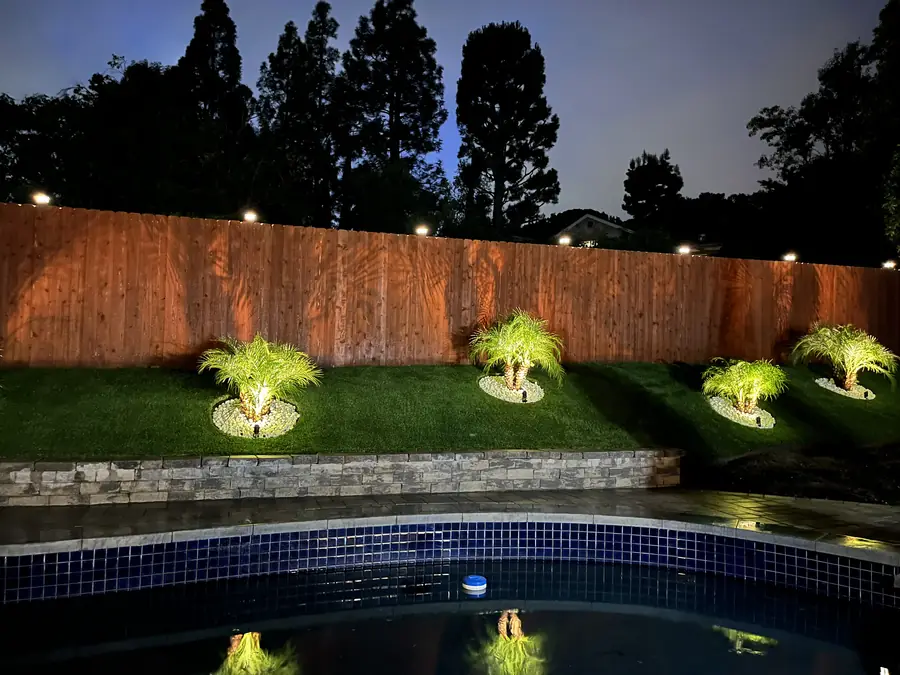
Homes sit close together in this enclave, so aiming is a matter of courtesy as much as design. Every uplight is aimed with the beam contained within the plant or surface it lights, and we add shrouds, glare guards, and hex louvers so the source stays invisible from the street and from next door. Fixtures tuck behind foliage or drop below grade wherever that works. After dark we walk the system from the sidewalk and from the neighboring sight lines, then adjust, because aiming looks like a different job in daylight.
Path lights spaced with restraint handle the walkway, staggered rather than lined up like runway markers, and set back into planting so each fixture reads as part of the bed. Steps are best served by recessed step lights, fixtures under a nosing, or low wall lights washing the tread, putting light exactly where a foot lands without a bulb in your eyes. Entry areas often work best lit from above out of a tree, since moonlighting down through branches covers the whole approach softly and conceals the source completely.
Restraint and layering. This street expects work that fits in, and lighting that shouts is the quickest way to look out of place. We pick a handful of focal points, usually a specimen tree, an architectural feature, and the entry, light those properly, and deliberately leave the space between them darker, because contrast is what produces depth. Output stays modest, since eyes adjust at night and a small amount of light reads as plenty. One consistent warm color temperature across the property keeps everything from looking assembled piece by piece.
Most systems use both ideas within one control. A photocell or astronomic timer brings the system up at dusk without you resetting anything as the seasons shift, and a timed off point shuts it down late at night. Splitting the system across circuits lets the front elevation run later while the back yard goes dark earlier. A dense canopy can fool a photocell into switching on early when the sensor sits in deep shade, so we mind where it is mounted. App control adds scenes and zoning if you want that level of adjustment.
Because a top tier fixture aimed badly, fed by undersized cable, and joined by a splice sitting in wet soil will look worse and fail sooner than a modest fixture installed correctly. Placement, beam angle, aiming, glare control, load calculation, connection quality, and cable routing account for nearly the entire result. Fixtures do matter for durability and serviceability, and solid brass or copper earns its cost outdoors. Even so, nobody standing in the garden sees a brand. They see whether the tree looks beautiful and whether light is in their eyes.
Three different jobs. An uplight, usually a bullet on a stake, is directional and adjustable, meant to be aimed at a specific target such as a trunk or a column. A well light buries flush with grade, ideal where a fixture would otherwise sit in the way or be visible, along a walk or at a lawn edge, at the cost of easy adjustment later. A wash or flood spreads a broad even sheet across a wide surface such as a fence, hedge, or wall. Most gardens end up using all three.
That is the normal situation on these lots, and low voltage work suits it well. Cable runs shallow and can follow bed edges, so we work with a narrow slit or a hand dug route through mulch, tuck runs behind existing planting, and put things back as we move along. Mature beds actually help, since foliage conceals fixtures and cable far better than a fresh install ever does. The heaviest part of the job is usually finding a suitable exterior circuit for the transformer and getting cable across a hard surface neatly.
Warm and consistent. Cooler light makes foliage look gray and gives a property a parking lot quality, while a warm tone flatters bark, stone, and stucco and makes planting look alive after dark. The larger error is mixing temperatures across one yard, which the eye catches instantly even when nobody can explain what looks wrong. We commit to a single temperature across the system and keep matching spare lamps on hand, so a replacement three years from now does not stand apart from everything around it.
Low, soft, and out of your line of sight. Light aimed across a seating area at eye level ruins the evening, so we work from below and from above instead, step and wall lights grazing the paving, a few small fixtures in surrounding planting, and downlights mounted up in a tree or under a structure to lay a gentle pattern across the space. Near water we keep fixtures back and let the planting and trees do the reflecting. The aim is to see faces and edges clearly with no visible bulb anywhere.
Low voltage cable buries shallow, deep enough to stay clear of routine gardening but nothing like the depth a line voltage circuit demands. Runs follow predictable lines, bed edges, walks, and fences, so a future shovel is less likely to find them, and cable is sleeved in conduit anywhere it passes under paving or crosses ground that gets dug. Connections use waterproof rated connectors at hubs, kept above the wettest soil where possible, and we note where everything runs so service later is a simple matter.
Our crew, and only our crew. Daniels Landscaping stays accountable for the work. The people digging the cable route, mounting the transformer, making the connections, and aiming every fixture after dark are Daniels Landscaping employees. Lighting rewards that arrangement more than almost any other trade, because the nighttime aiming session is where the design truly happens, and it needs the same hands that set the plan. If a fixture wants adjusting next season, the crew that placed it is the crew that returns.
Call (818) 443-9300 and we will come look at the property, ideally in daylight and again after dark, since those two visits tell you entirely different things. We identify the trees and features worth lighting, check where a transformer can be mounted and powered, and talk through how much light you actually want to live with. You receive a free written estimate listing fixture types and counts, transformer, cable, and controls. Daniels Landscaping is licensed in California under number 1138709, and the installation is handled under one licensed contractor.