
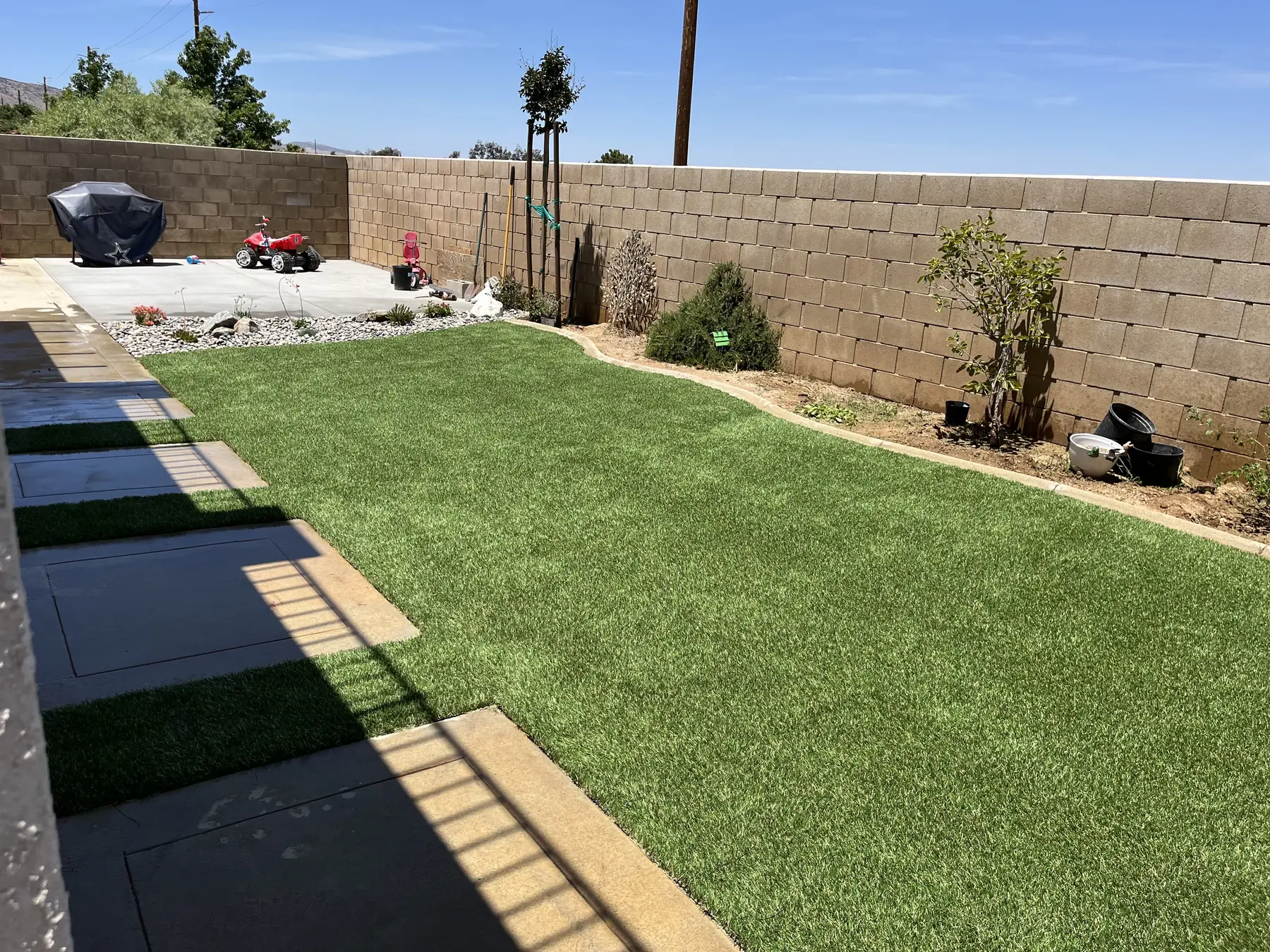
Hardscaping is the built, non-living part of a landscape: the patios, walkways, driveways, retaining walls, steps, and stone that give a yard its structure. The material you choose decides how it looks, how long it lasts, how much it costs, and how much upkeep it needs. This page walks through the main options and what separates them, so you can tell a paver from a slab and a good base from a cheap one before you talk to anyone.
What counts as hardscaping?
Hardscaping is everything in a yard that is built rather than grown. Patios, walkways, driveways, pool decks, retaining walls, seating walls, steps, pillars, and stone veneer all fall under it, along with looser materials like gravel and decomposed granite. The living side, the lawn and planting and trees, is the softscape. Most finished yards are a balance of the two, and the hardscape is the part that sets the shape everything else fits around.
Because it is structural, hardscape is the most permanent and usually the most expensive part of a yard. A plant can be swapped out in a weekend. A patio is there for decades, so the material and the way it is built matter more than almost any other decision you make outdoors.
Pavers, concrete, or natural stone?
These are the three families most patios and driveways come from, and they trade off cost against flexibility and looks.
Concrete pavers are individual units set on a compacted base. They flex with ground movement instead of cracking, a stained or damaged one lifts out and gets replaced, and they come in a wide range of colors and shapes. They cost more to install than poured concrete because every unit is placed and cut by hand.
Poured concrete is a single slab. It is the cheaper option and goes down fast, which suits driveways, side yards, and long straight runs. Its weakness is that it cracks, because it is rigid and the ground under it moves, so it relies on control joints to steer where the cracks land.
Natural stone, flagstone, travertine, and slate, is the premium look. Each piece is unique and it reads as the real thing because it is, but it costs the most and takes the most skill to set well on a proper base.
What are the main paver styles?
Pavers are where most of the design choices live, and the differences are mostly about shape, pattern, and edge.
Holland and rectangular pavers are the classic brick look, laid in running bond, herringbone, or basketweave. Herringbone is the strongest pattern for a driveway because it locks against the load of a vehicle.
Interlocking and I-shape pavers grip each other on all sides, which is why they hold up under heavy or turning traffic.
Large-format and plank pavers are the modern look, big rectangles with tight joints for a clean, contemporary feel. They suit modern homes and read as calmer than a busy brick pattern.
Tumbled and antiqued pavers have softened edges and a weathered surface, for an old-world or Mediterranean feel that suits a lot of California homes.
Cobblestone pavers give the rounded, historic look, usually on accents and borders rather than a whole field.
Is stamped concrete worth it?
Stamped concrete is poured concrete pressed with a texture mat and colored to imitate stone, brick, or wood plank. It is popular because it gives you a patterned surface over a large area for less than natural stone or pavers.
The trade-offs are worth knowing before you pick it. It is still a slab, so it still cracks along its joints, and a crack through a stone pattern is harder to accept than one in plain gray. The color is a surface treatment that needs resealing every few years to stay vivid. And a repair is very difficult to hide, because matching the stamp, the color, and the age of the surrounding concrete almost never lands perfectly.
It looks best on large open areas where the pattern reads as a whole, and where you accept the resealing as part of owning it. On a smaller patio, pavers often cost only a little more and are far easier to live with.
When should you use gravel or decomposed granite?
Loose materials are the budget-friendly, permeable side of hardscape, and they pair naturally with drought-tolerant planting.
Decomposed granite, or DG, compacts into a firm walkable surface that suits paths, seating areas, and open ground. It has a warm, natural look and costs a fraction of paving. It does need an edge to hold it in place and a refresh every few years as it wears.
Gravel and larger rock give texture and drain freely, which makes them useful in dry creek beds, borders, and areas where you want water to soak in rather than run off. Mixed sizes lock together and stay put, while uniform small gravel tends to migrate underfoot.
Both are the least expensive way to cover ground, and both read as intentional when edged cleanly rather than just poured into a gap.
Why does the base matter more than the surface?
This is the single most important thing to understand about hardscape, and it is the part you never see. Whatever goes on top, pavers, stone, or concrete, sits on a base of excavated and compacted material. That base is what the surface rides on for its entire life.
Most hardscape failures are base failures, not surface failures. Pavers go wavy because the base was thin or was never properly compacted. A slab settles and cracks because the ground underneath was not prepared. A retaining wall leans because there was no drainage behind it. The material on top was usually fine.
A base is built by excavating to real depth, laying crushed rock, and compacting it in layers rather than dumping it all at once and rolling over the top. On paver work, an edge restraint locks the perimeter so the field cannot spread. None of this shows in a photo, which is exactly why cheap installs cut it, and exactly why you should ask about it.
What about retaining walls and drainage?
Retaining walls are hardscape doing structural work, holding back soil that gets very heavy when it is wet. Past a certain height they need a permit and an engineered design, and every one of them needs drainage behind it, gravel backfill and a pipe to let water out, or the pressure eventually pushes the wall over.
Drainage matters for flat hardscape too. Every hard surface sheds water that the ground used to absorb, so a patio or driveway has to be graded to fall away from the house, with channel drains or a dry creek where the volume needs somewhere to go. Skipping this is how a new patio ends up sending water toward a foundation.
Where do we do hardscaping?
We install hardscaping across the San Fernando Valley. See the detail, local projects, and pricing for your city:
- Hardscaping in Arleta
- Hardscaping in Burbank
- Hardscaping in Calabasas
- Hardscaping in Canoga Park
- Hardscaping in Chatsworth
- Hardscaping in Encino
- Hardscaping in Granada Hills
- Hardscaping in Hidden Hills
- Hardscaping in Lake View Terrace
- Hardscaping in Mission Hills
- Hardscaping in North Hills
- Hardscaping in North Hollywood
- Hardscaping in Northridge
- Hardscaping in Pacoima
- Hardscaping in Panorama City
- Hardscaping in Porter Ranch
- Hardscaping in Reseda
- Hardscaping in San Fernando
- Hardscaping in Sherman Oaks
- Hardscaping in Studio City
- Hardscaping in Sun Valley
- Hardscaping in Sunland Tujunga
- Hardscaping in Sylmar
- Hardscaping in Tarzana
- Hardscaping in Toluca Lake
- Hardscaping in Valley Glen
- Hardscaping in Valley Village
- Hardscaping in Van Nuys
- Hardscaping in West Hills
- Hardscaping in Winnetka
- Hardscaping in Woodland Hills