

FAQ
Landscape Lighting in Porter Ranch, answered
The questions we hear most from Porter Ranch homeowners.
A transformer mounted near an exterior outlet takes 120 volt household power and steps it down to 12 volts before anything leaves the wall. Everything past that transformer runs on the low voltage side, which is why cable can be buried at modest depth and fixtures can be added or moved later without rewiring a circuit. Transformer capacity is sized to the total fixture load with headroom left for expansion, and multiple taps allow us to feed different runs at slightly different voltages to compensate for distance.
Because a fixture is only a housing. What you actually see at night comes from where the light sits, what angle it points, how wide the beam spreads, whether the source is hidden from where people stand, and whether every fixture on the run receives proper voltage. A premium fixture aimed into a bare fence or dropped into the middle of a hedge looks worse than a modest one placed thoughtfully. We have walked properties full of good hardware producing hot spots, glare and dark gaps, all of it layout rather than product.
Voltage drop is the loss that occurs as current travels along cable, and it grows with distance and load. Fixtures at the end of a long run receive less than 12 volts, which on LED shows up as inconsistent output and shortened driver life. Sloped Porter Ranch properties make runs long, since the transformer sits at the house while the lighting often continues down terraces or up a slope well away from it. We calculate load per run, increase wire gauge, split circuits and use transformer taps so the last fixture performs like the first.
Cable is buried below the surface along routes chosen to stay clear of future digging, and sleeved where it passes under paving or a driveway so it can be replaced without demolition. Rather than daisy chaining fixture to fixture, which starves everything past the first few, we generally pull home runs out to hub connections, so several fixtures share one junction at roughly equal distance from the transformer. Connections use waterproof gel filled or silicone connectors, because the usual failure point in a neglected system is a wire nut sitting in wet soil.
Fewer than most people expect. Path lights exist to graze the walking surface and reveal edges, not to line a runway with matching pairs. We stagger them, leave gaps where light from another source already reaches, and place them where a direction change, a step or a planting bed genuinely needs a cue. Fixture height and shield shape decide how wide the pool of light falls and whether you see the surface or the lamp. Overlapping soft pools read far better than a strict rhythm of identical bright points.
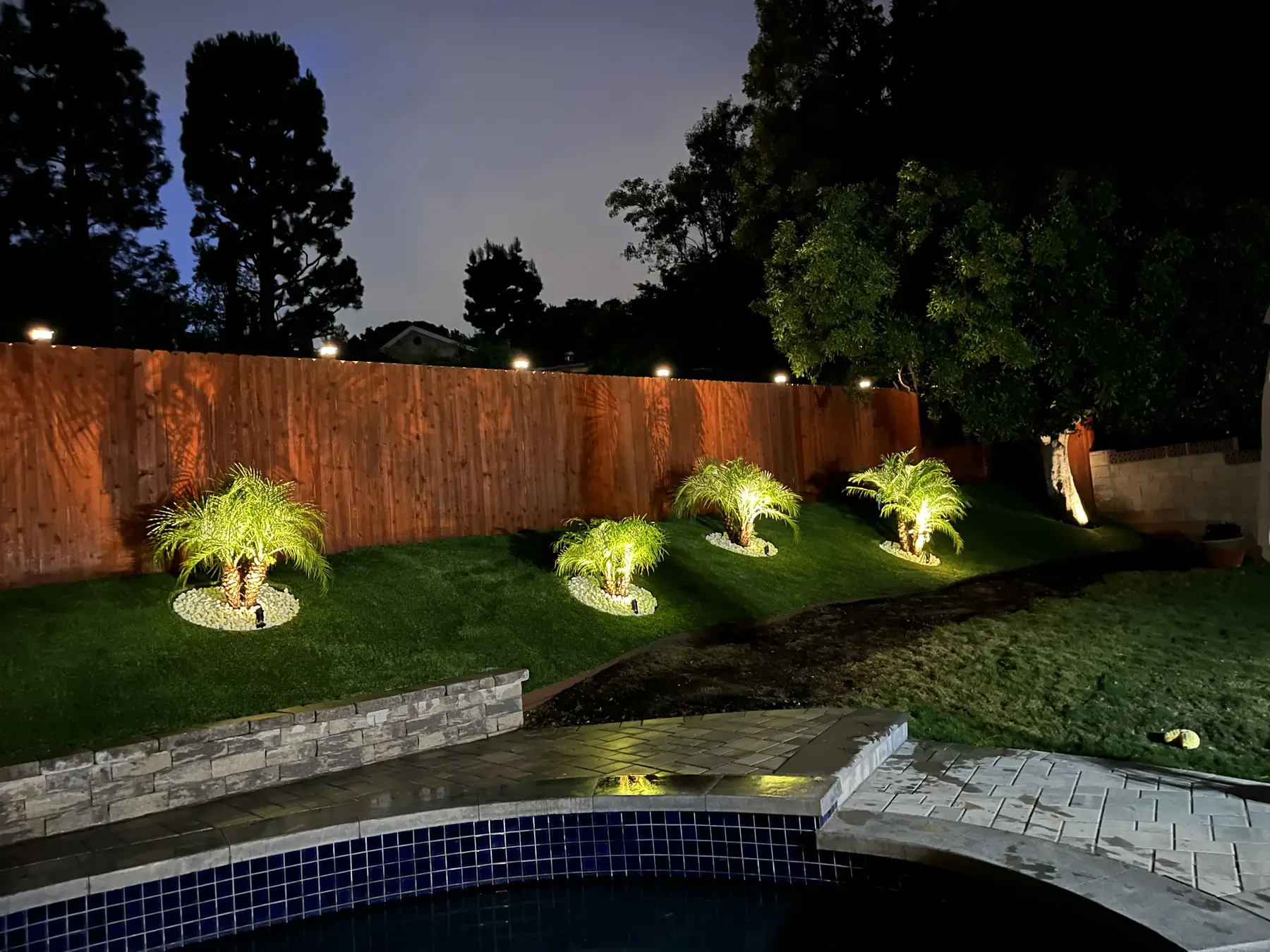
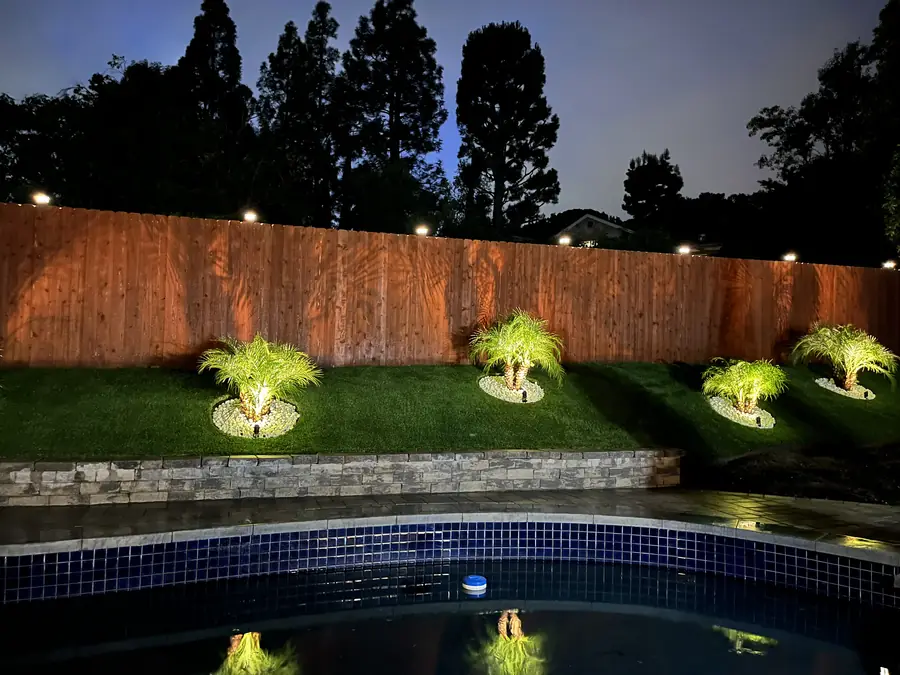
Bullets are directional fixtures with a narrow to medium beam, usually set at grade and aimed up at a tree, a wall, a column or an architectural feature. On a mature tree we often place more than one at different distances to build depth inside the canopy rather than flattening it with a single beam. Beam angle is a deliberate choice, tight for tall narrow subjects and wider for broad canopies or wall washing. Final aiming happens at night with the system running, since judging an uplight in daylight is guesswork.
Well lights sit flush in grade so the housing disappears, which is the right call in a lawn, alongside a driveway, within a patio surface, or anywhere a visible fixture would add clutter. They accept the same beam options as a bullet but give up some aiming range and are harder to adjust as a plant grows around them. Drainage beneath the housing matters, since a well light placed in a low spot fills with water. We reach for them where the clean look justifies the reduced flexibility later on.
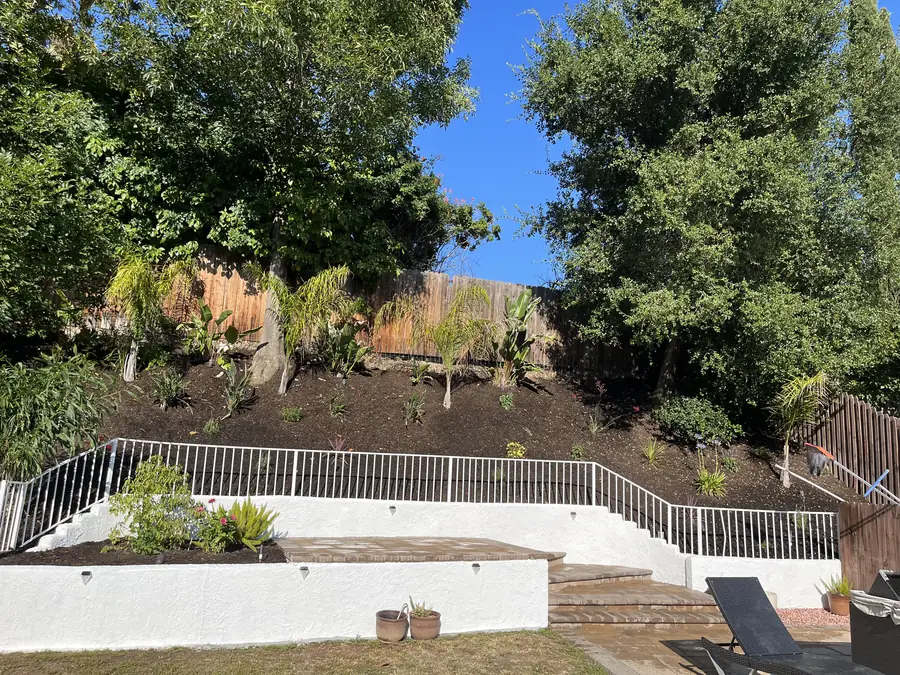
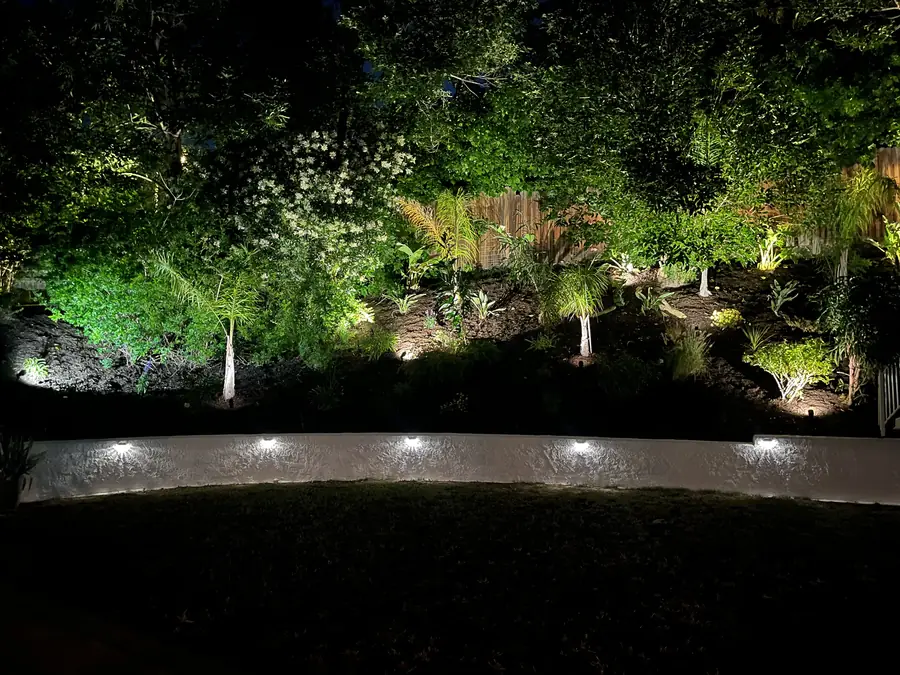
Terracing is everywhere on these hillside lots, and each grade change is both a safety issue and an opportunity. Recessed step lights set into risers or side walls put light exactly where a foot lands with no fixture standing in the way. Wall lights mounted under a cap or a bullnose wash the tread below and skim the wall face, which reveals the terrace structure after dark. The goal is enough light to read every edge, kept low and shielded, since a bright fixture at eye level on a descending path is worse than none.
Layering means lighting at more than one distance and more than one height, so the eye perceives depth instead of a flat wall of brightness. A typical composition includes something close in such as a low bed or path light, something at middle distance such as an uplit shrub or a wall wash, and something farther back such as a tree canopy. Wash and flood fixtures cover broad surfaces softly while narrow beams pick out specimens. Deliberate dark space between the layers is part of the design, because contrast makes lit areas register.
Glare comes from seeing the source instead of what it lights. We control it with shields, cowls, hoods and honeycomb louvers, by recessing the lamp deep inside the housing, and above all by positioning fixtures outside normal sight lines from seating, windows and walkways. Aiming angles are set to keep beams off eye level and out of neighboring windows. A yard that reads as softly lit with no visible bulbs is doing far more work than one where every fixture announces itself as a bright dot in the dark.
That is the central constraint on a view property, and it changes the whole plan. Bright light in the foreground makes the eye adapt to it, and the valley beyond vanishes behind glare and window reflection. We keep brightness near the viewing area low, push accents to the sides and into the middle ground, shield anything sitting within the sight line, and leave the section of yard framing the view intentionally dim. Dimming capability helps too, so the yard can be turned down on evenings when the view is the point.
LED is the standard now, drawing a fraction of the power halogen used and letting one transformer carry many more fixtures. The specifications that matter are color temperature, output and beam angle. Warmer color temperatures flatter stone, wood and warm toned houses, while slightly cooler light can make green foliage look more alive, and mixing temperatures at random across a yard reads as an accident. Solid brass and copper housings weather gracefully and last outdoors far longer than thin aluminum or plastic, which is exactly where inexpensive systems fail first.
Most transformers include a timer, and the practical setup pairs a photocell or an astronomic clock with a chosen off time. A photocell brings the system up at actual dusk, which drifts through the year, so lights do not switch on in daylight in June or come on an hour late in December. The off time is usually set for when the household stops looking outside, with a portion of the fixtures held later for security and safe footing. App controlled systems add scenes and dimming plus one more connection to maintain.
Frequently, yes. Fixture finish, mounting height and how much light spills toward neighbors or shared streets are exactly the sort of details a Porter Ranch architectural committee reviews, and lighting is usually submitted as part of the overall landscape plan before construction. Communities vary in how specific their standards are, so we ask early rather than assume. Because approval has to be in hand before work begins, we treat that review as a real phase of the schedule and prepare fixture information in whatever format your association requests.
It affects placement more than hardware. In a Very High Fire Hazard Severity Zone the planting near a house is deliberately spaced and kept clear, so a lighting plan here works with separated specimens rather than continuous massed foliage, and fixtures near the structure go where they will not end up buried in growth. We keep housings away from dry material, route cable through soil rather than accumulated debris, and give real attention to lighting the driveway, access paths and address numbers, which matters if anyone needs to find the property quickly at night.
Parts of it usually can. Original systems in the newer neighborhoods here tend to be minimal: a small transformer, one run of undersized cable, a handful of path lights near the entry, and nothing addressing the rear yard or the view. We test existing transformer capacity and cable gauge, keep whatever has real headroom, and rebuild the rest. Where the old cable was daisy chained or pulled too far, replacing it costs less than nursing a system that dims at the far end forever. Fixtures get evaluated one at a time.
No. Daniels Landscaping installs its lighting with one licensed contractor. The same people who dig the cable trenches, set the transformer and make the connections are the ones who return after dark to aim the fixtures. That continuity is the entire reason a finished system looks composed instead of assembled. It also means one company stands behind the wiring, the fixtures and the layout together, and you always know exactly who to call.
Call (818) 443-9300 and we will visit your Porter Ranch property, ideally walking it once in daylight and once after dark so we can see what the yard already does at night. We look at sight lines from inside the house, the view, the terraces and steps, the trees worth lighting, and where power is available. You then receive a free written estimate covering fixtures, transformer, wiring and controls. Daniels Landscaping holds California license 1138709, and the installation stays under one licensed contractor from trench to final aiming.