
FAQ
Landscape Lighting in Northridge, answered
The questions we hear most from Northridge homeowners.
Cost depends on the size of your property, the number of fixtures, the length of the cable runs, and the type of transformer and controls you choose. A compact front yard with a handful of path lights sits at the lower end, while a deep Northridge lot with tree uplighting, wall lighting, and a long driveway involves more materials and labor. Rather than quote a number blindly, Daniels Landscaping walks the property, listens to what you want to light, and hands you a free written estimate.
Low-voltage LED lighting runs on twelve volts instead of household current, which is why it is the standard for residential landscapes. A transformer steps line voltage down to a safe level, then feeds a network of LED fixtures through buried cable. The low-voltage design is safer to work around planting beds and irrigation, and LED lamps draw very little power while lasting far longer than old halogen bulbs. You get bright, controllable light, lower energy use, and fixtures that rarely need a lamp change.
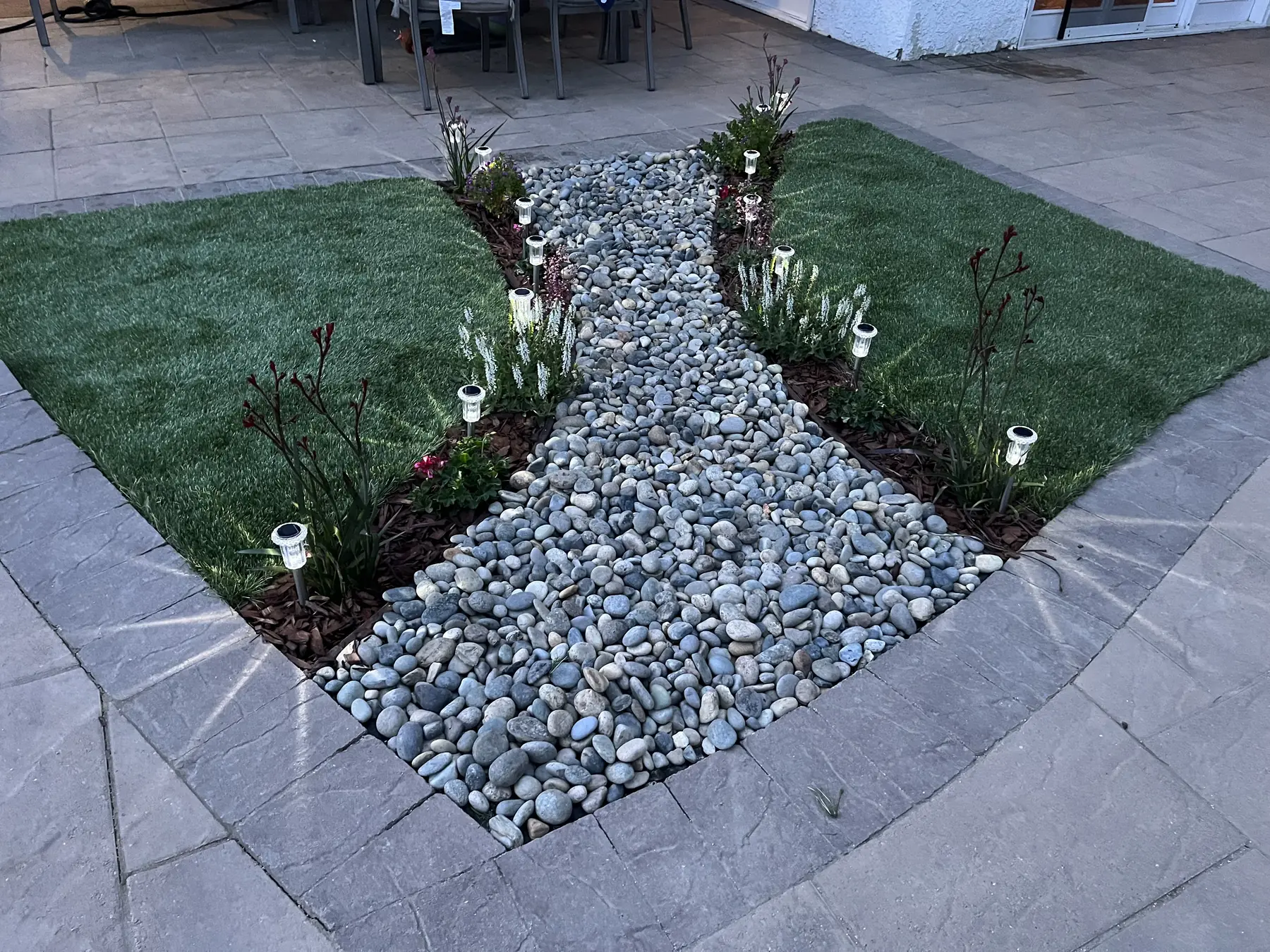
Path and walkway lights are spaced to create soft, overlapping pools of light rather than a runway of evenly spaced dots. The right distance depends on the fixture, its beam spread, and the width of the path, so a curving walkway through planting reads differently than a straight run to the front door. The goal is safe footing and a natural rhythm, with light guiding the eye without glare. We stagger fixtures, aim them down, and adjust on site until the walkway feels balanced.
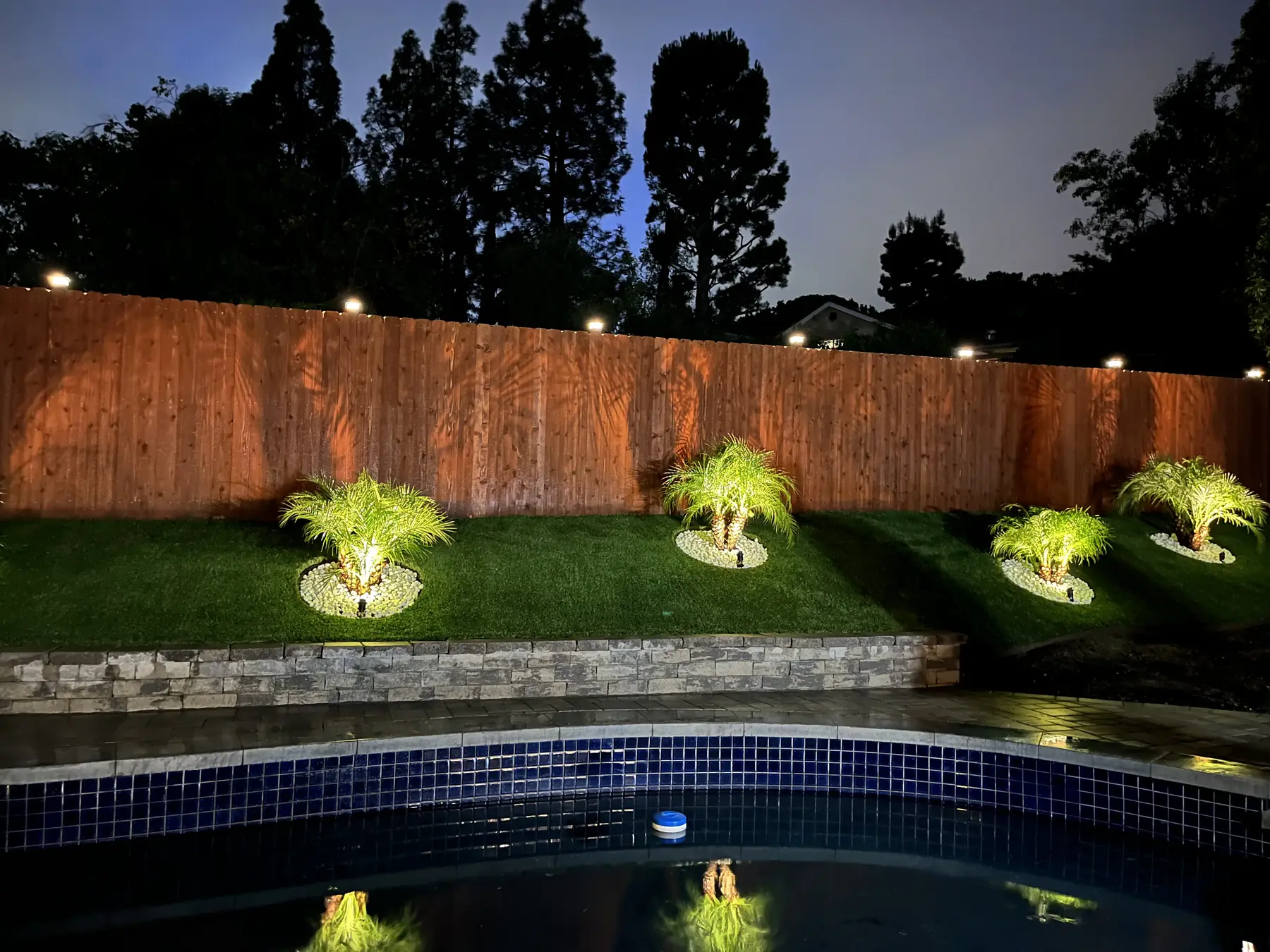
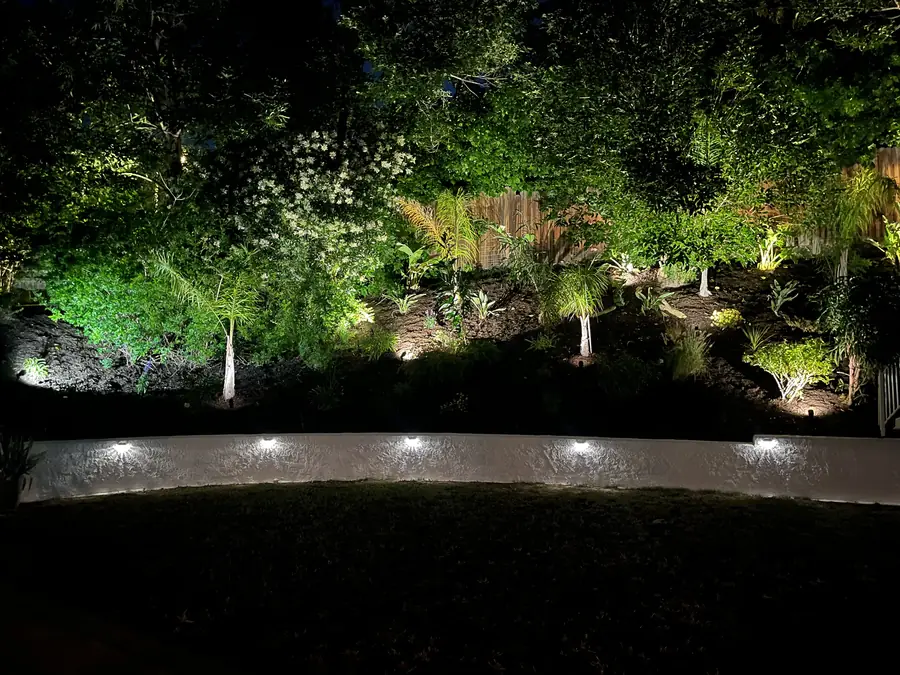
Northridge is full of mature trees, and that canopy is one of the best reasons to add lighting here. Large oaks, sycamores, magnolias, and old citrus respond beautifully to uplighting, where fixtures at the base wash light up through the branches and reveal the texture of the trunk and canopy. The same technique works on the house itself, grazing light across stucco, stone, or an entry to give the facade depth after dark. We aim each fixture to highlight structure while keeping stray light out of windows.
Wall washing and wall grazing are two ways to light a vertical surface, and the choice depends on the look you want. Washing places fixtures a short distance from the wall to spread even, soft light across it, which flatters smooth stucco and painted surfaces. Grazing sets fixtures close to the base and aims light straight up the face, so shadows exaggerate texture on stone, brick, or a board-formed wall. Both techniques add depth to a yard at night, and we often combine them with tree and path lighting for a layered result.
Yes. Steps, decks, and raised patios are common trip points after dark, and low-voltage fixtures solve the problem cleanly. Recessed step lights tuck into risers or adjacent walls to graze light across each tread, while deck lights mount under railings, caps, or benches to outline the edge without a harsh glare. Because the system is low voltage, we can integrate these fixtures into the same transformer and controls that run the rest of your lighting. The result is safer footing that still looks designed rather than utilitarian.
Good lighting is one of the simplest deterrents you can add. Dark yards give cover, while a property with lit paths, entries, and planted areas removes the hiding spots that make a home an easy target. The aim is not to flood the yard with harsh light, which creates deep shadows and annoys everyone nearby, but to provide even, purposeful illumination at doors, along walkways, and around the perimeter. Paired with a timer or smart control, your lighting comes on automatically at dusk, so the house never sits dark when you are away.
The transformer is the heart of the system. It converts household current down to low voltage and distributes it to every fixture, which is why sizing it correctly matters. Timers and controls decide when the lights run. A basic astronomical timer tracks sunset through the seasons and switches the system on at dusk and off at a set hour, while smart controllers let you adjust schedules, zones, and brightness from your phone. We size the transformer with room to spare and set controls around your routine, so the lighting simply works night after night.
That fading at the end of a run is voltage drop, and it shows up often on the deep lots and wide frontages common in Northridge. As current travels along a cable, resistance bleeds off voltage, so fixtures farthest from the transformer receive less power and glow dimmer than the ones near the start. The fix is proper design, meaning correctly gauged wire, smart layout of the runs, balanced loads, and tapping the transformer at the right voltage. Done right, the last fixture looks as bright as the first.
The big-box kits are tempting on price, but they tend to disappoint on a property of any size. Their thin wire and undersized transformers cannot handle long runs without voltage drop, the plastic fixtures fade and crack within a season or two, and the push-on connectors corrode where they meet soil and water. A professional install uses heavier cable, weatherproof connections, brass or copper fixtures, and a transformer sized for the load. You pay more at the start, and you avoid replacing a failed system not long after.
Low-voltage LED systems are low maintenance, though they are not zero maintenance. Fixtures need occasional cleaning as lenses collect dust and hard-water spots, and beams need re-aiming as trees and shrubs grow into the light. Connections and the transformer should be checked periodically, and a fixture knocked by a mower or a dog may need to be reset. Because quality LED lamps last for many thousands of hours, you rarely change a bulb. We can handle seasonal check-ups, or show you the simple steps to keep the system looking its best.
Color temperature sets the entire mood of a yard. Warm white, in the lower range on the Kelvin scale, casts an inviting amber-leaning glow that flatters stucco, wood, foliage, and skin tones, which is why most residential landscapes lean warm. Cool white reads crisp and modern but can look harsh or blue on plants and homes. A common approach is to keep the whole property in one warm range for consistency, then use a slightly different tone only where it serves the design. We help you see the options before committing.
Courtesy is part of good design, and glare is the most common complaint about a poorly aimed system. We control it in several ways. Fixtures are positioned and angled to light the target rather than the sightline, and we use shrouds, glare guards, and hoods to hide the lamp itself from view. Uplights are set close to trunks and walls, and beam spread is matched to the object being lit. The result is light you notice on the trees and the house, not bulbs glaring back at you or the neighbors.
Absolutely. The horse-keeping parcels north of Devonshire often have long driveways, wide setbacks, and dark stretches between the street and the house, and those are exactly the runs where cheap systems fail. We plan the layout to carry steady voltage the full length, mark the drive and any turns clearly, and light barns, gates, and trees without spilling glare toward the road or the animals. The same approach applies on similar acreage toward Granada Hills. You end up with a driveway that is safe to travel and a property that looks established at night.
There is no fixed count, because it depends on what you want to light and how the yard is laid out. A wide Northridge frontage with several trees to uplight, a long walkway, and lighting on the house will use more fixtures than a small yard, and that total load drives the transformer size. We add up the wattage of every fixture, add headroom so the transformer never runs at its limit, and split the property into zones on separate runs. Sizing it right at the start is what keeps the light even and the system reliable.
Material makes a real difference in how long fixtures survive outdoors. Brass and copper are the standard for quality installs because they resist corrosion, handle sun and sprinklers, and develop a natural patina rather than failing. Cast fixtures hold up to being bumped, and good gaskets keep moisture out of the lamp housing. Cheaper plastic and painted aluminum fixtures fade, crack, and rust at the sockets, which is why kit lights often look tired within a couple of seasons. Investing in solid fixtures is what lets a system last for many seasons.
Repairs and expansions are a frequent request from homeowners in Northridge and nearby Reseda who inherited a system or watched an old one fail. We start by testing the transformer, the cable runs, and each fixture to find weak connections, water damage, and voltage drop. From there, you can repair what is worth saving, swap failed fixtures for durable brass, and extend the system into areas that were never lit. Whether you want a small fix or a full upgrade, we work with what is already in the ground where it makes sense.
Getting started is straightforward. Call Daniels Landscaping at (818) 443-9300 and tell us what you would like to light, whether that is a front walkway, a stand of trees, the whole property, or a system that needs rescuing. We visit at a time that works for you, walk the lot after dark when possible to see it the way the lighting will read, and talk through techniques and options. You receive a free written estimate with the scope spelled out. One licensed contractor, licensed under California number 1138709, handles the install from start to finish.