

FAQ
Landscape Lighting in Van Nuys, answered
The questions we hear most from Van Nuys homeowners.
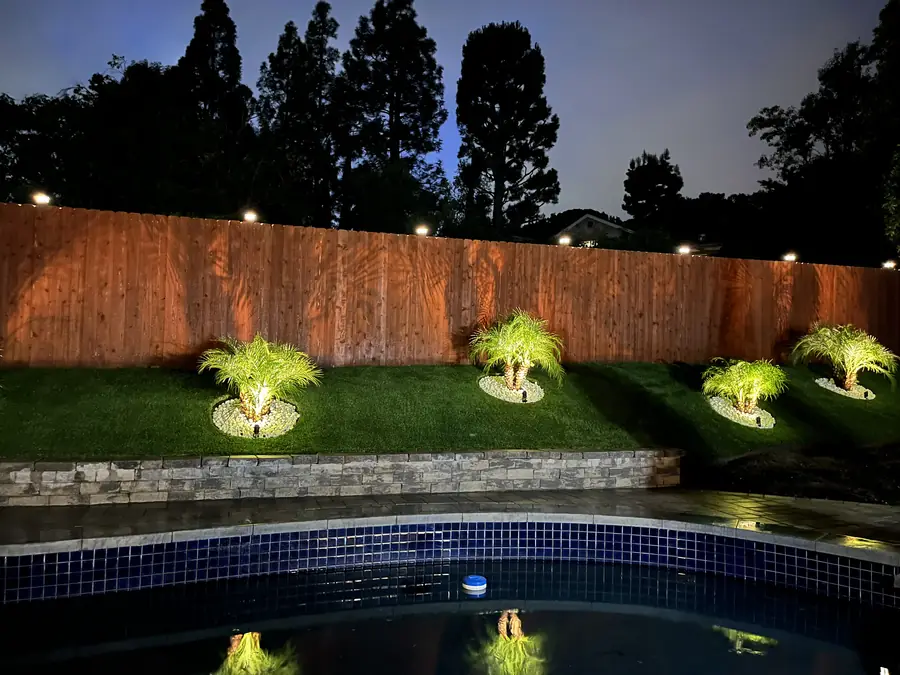
Path lights wash the ground along walkways and steps. Uplights, often called bullets, sit low and throw a narrow beam up into a tree canopy or across a wall. Well lights do the same job from inside a buried housing, so nothing shows during the day. Step and wall lights push a low, glare free pool of light onto treads and landings. Wash and flood fixtures spread a wide, soft field across a hedge, fence, or building face. A finished plan uses several of these together, because one type repeated everywhere reads flat.
A transformer drops the 120 volt supply to 12 volt, and everything past that point is a low voltage circuit. That makes the cable safer to work around, safer to bury at shallow depth, and far easier to modify later, because adding or moving a fixture does not mean rewiring a line voltage circuit. Low voltage LED fixtures also draw very little power, so an entire yard runs on a fraction of what an old halogen system consumed. The tradeoff is that voltage drop over distance becomes something the design has to manage.
By adding the wattage of every fixture on the system and leaving real headroom above that number, so the unit never runs at its limit and there is capacity for whatever you add later. Multi tap transformers matter as much as raw size, because taps at different output voltages let us compensate for long runs. The unit gets mounted where it can be reached and serviced, near a dedicated outlet, and it is the one component worth buying well. Undersizing a transformer is a mistake you discover slowly, as fixtures dim at the far end.
Voltage falls as current travels along a cable, so a fixture at the end of a long run receives less than one near the transformer. LEDs tolerate a range, but past it they shift color, dim, or flicker. Lot sizes vary widely from one part of Van Nuys to the next, and a deep property with lighting at the back fence puts real distance between the transformer and the last fixture. We plan for that with heavier cable, split runs, hub wiring, and the correct transformer tap, then verify voltage at the fixtures themselves.
Daisy chaining runs one cable from fixture to fixture, so everything downstream sees accumulated drop and the first fixture is always the brightest. Hub wiring instead carries a heavy cable out to a connection point and branches equal length leads to a small group of fixtures from there, so each one receives close to the same voltage. It also makes service simple, since a failure is isolated to a single lead rather than interrupting everything past it. The method is invisible when finished, and it separates an even scene from a fading one.
Cable runs in shallow trenches along bed edges and under mulch where it stays clear of future digging, and deeper where it crosses lawn or planting areas that get worked. Under paving and driveways it goes through sleeving. Every connection is made with a proper waterproof method rather than a twisted cap sitting in a wet trench, since a failed splice is the most common cause of a dead run. We plan cable paths against the irrigation layout, so a future sprinkler repair does not put a shovel through a lighting run.
Frequently yes, because a great many older Van Nuys systems went in years ago with halogen lamps, undersized cable, and buried connections that have long since corroded. LED draws a fraction of the power, runs cool, and lasts far longer, so a transformer that was maxed out under halogen suddenly has room to spare. What often cannot be reused is the wiring. If the cable is undersized or the splices are failing, swapping lamps only masks the real problem, so we test the existing runs before deciding what stays and what goes.
Housing material decides how long a fixture survives outdoors. Cast brass and copper weather to a patina and keep working for a very long time, while thin aluminum and plastic units chalk, crack, and let water into the socket. Gaskets, lens quality, and whether a lamp or driver can be replaced without discarding the whole fixture matter just as much as the label on the box. That said, a premium fixture aimed badly still looks bad. Buy solid hardware, then spend the attention on placement, because placement is what people actually see.
Most transformers include a timer, a photocell, or both. A photocell senses darkness and switches on at dusk, which keeps the system honest as sunset shifts through the year, while the timer decides how long it stays on afterward. Astronomical timers accomplish the same thing by calculating sunrise and sunset for the location. Some systems add app control or separate zones, so the front can run all evening while the rear shuts down at a set hour. The goal is that nobody has to remember to flip anything.
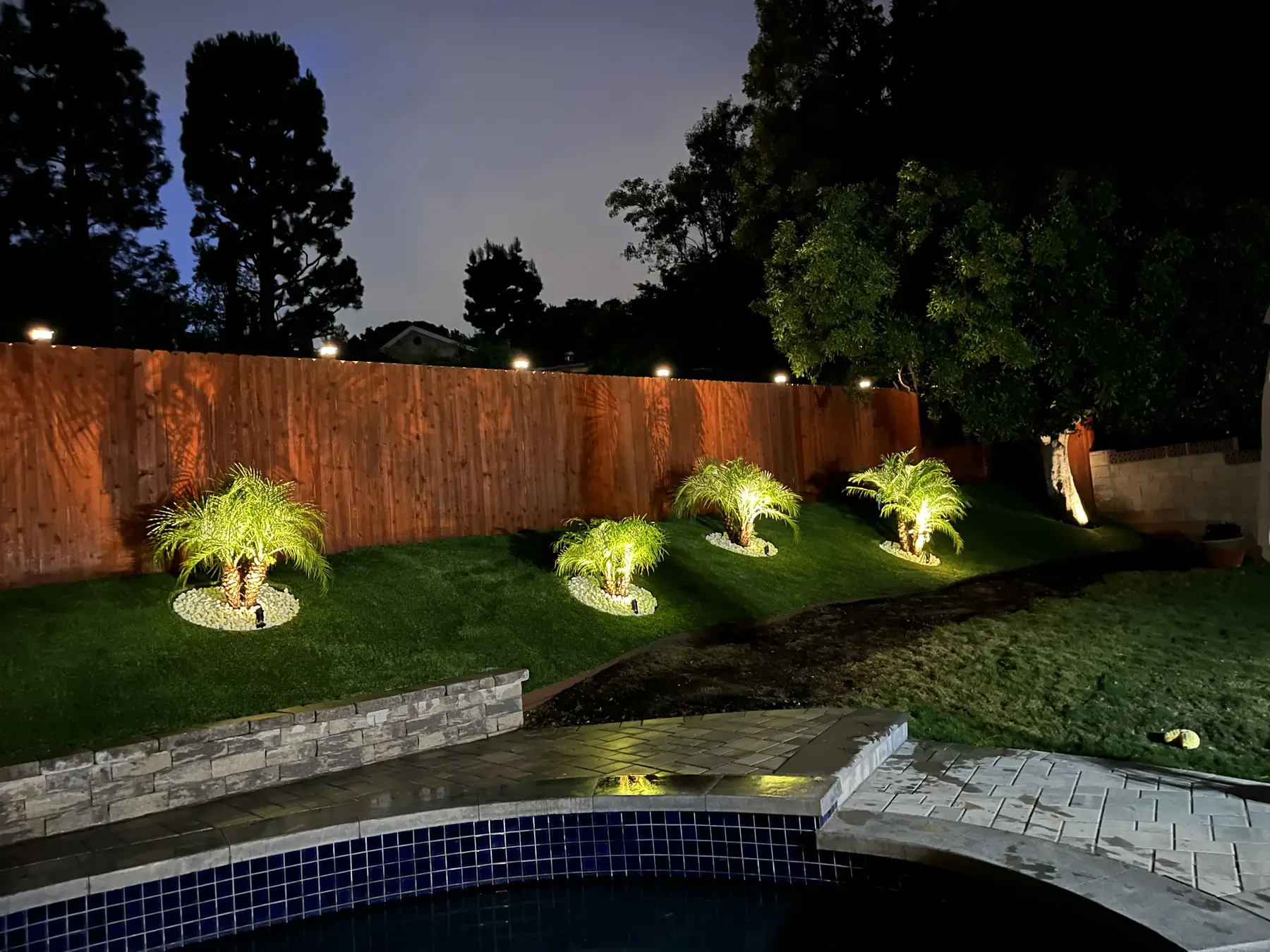
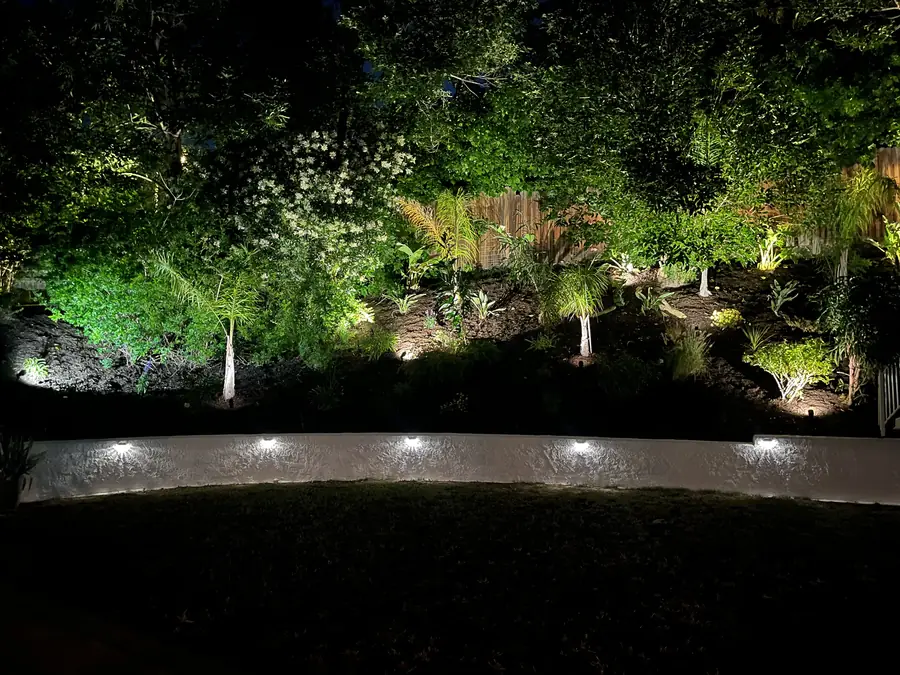
It means lighting at more than one height and distance, so the eye reads depth instead of a flat wall of brightness. A path light near the viewer, a low wash across a hedge in the middle, and an uplight in a tree at the back create three planes, and the dark space between them is what makes each one register. Leaving areas unlit is deliberate, not an oversight. A yard with a fixture every few feet and no contrast looks like a parking lot, while a layered scene has dimension.
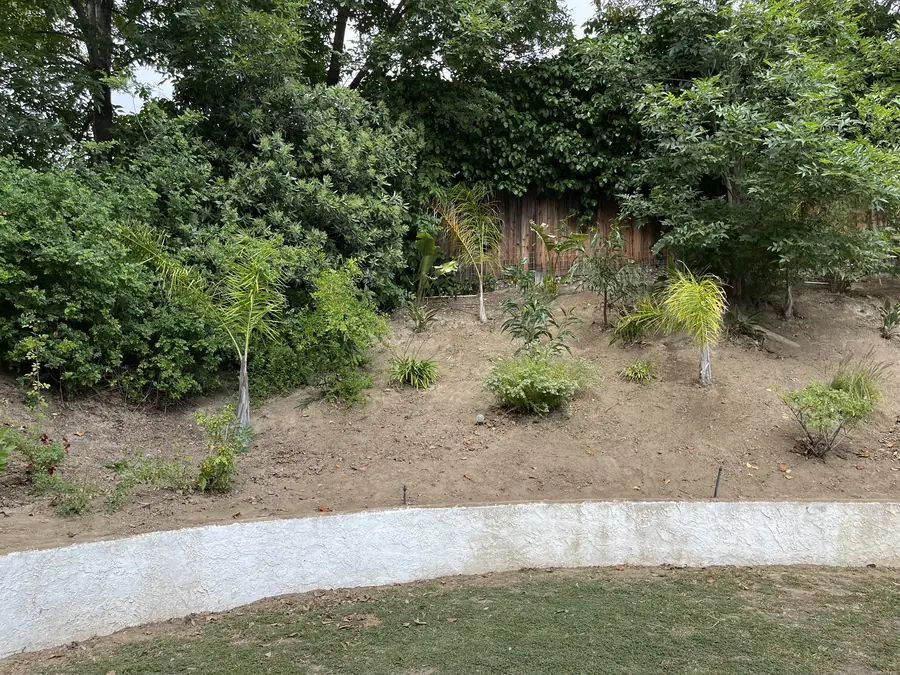
It changes the approach rather than limiting it. Hillside properties get drama for free, because elevation separates one lit element from the next. On level ground we build that separation ourselves, using tree canopies, wall washes, pergola posts, and taller planting to create high points, and varying beam spread and intensity so nothing sits at one uniform brightness. Grazing light across a textured wall or fence adds relief where the ground gives none. Flat ground is also easier to control, since very little light escapes into a neighboring window.
By hiding the source. Fixtures are aimed away from where people stand, sit, and drive, and they get set behind planting, tucked under an eave, or recessed into the ground, so you see the lit object rather than a bright dot. Shrouds, hoods, glare guards, and honeycomb louvers cut the direct view of the lamp. Beam angle matters too, since a narrow spot on a smooth wall creates a hot spot while a wider flood reads evenly. Final aiming always happens at night, with the whole system running.
Because a fixture only makes light, while the installation decides what that light does. Placement, aiming, beam angle, the balance between one area and another, the wiring method, and clean voltage at every unit are what separate a composed night scene from a collection of scattered bulbs. We have seen expensive brass fixtures set in straight rows at equal spacing, all cranked to full brightness, and the yard looked worse than it did unlit. Craft is the product here. The catalog is only parts.
Ambient light does raise the baseline, and it is a real consideration for Van Nuys properties near busy commercial corridors, where the front of a house never goes fully dark. The answer is contrast rather than brute force. We aim fixtures at surfaces that hold light, such as a stucco wall, a trunk, or dense foliage, so the lit object stands out against a brighter background, and we keep the rear yard, which is usually shielded, on a softer level. Turning everything up simply flattens the whole scene.
Full sun and long, hot summers are hard on outdoor gear. Ultraviolet exposure chalks plastic lenses and stiffens cheap cable jackets, heat cycles work connections loose, and fixtures sitting in dry, dusty beds collect a film on the glass that quietly cuts output. Quality housings, sealed connections, and proper burial handle most of that. The heat also shapes how a yard gets used, since evening is when people are outside during summer, and that is exactly the argument for lighting the patio, the steps, and the planting properly.
Yes, and it is a sensible way to work here, where practical budgets and staged projects are the normal way homeowners tackle a yard. The requirement is planning the finished system on the first visit, then sizing the transformer and the main cable runs for all of it, not merely for the first handful of fixtures. Sleeves under paving go in early for the same reason. Once that backbone exists, adding fixtures later is straightforward, whereas a system built only for what fits today usually needs replacing.
No. Daniels Landscaping installs with one licensed contractor. The same people who trench cable, set the transformer, mount the fixtures, and aim them after dark are Daniels Landscaping employees. That matters more than it sounds, because lighting is finished by judgment rather than by a checklist, and whoever adjusts a beam late in the evening should be the person who understood the design from the start. You get one accountable team from the first walk through to the final aiming.
Call Daniels Landscaping at (818) 443-9300 and we will walk the property, ideally once in daylight to see the structure and planting and once after dark to see what the yard already does at night. From there you receive a free written estimate covering fixture counts and types, transformer size, cable runs, and controls, so nothing stays vague. Daniels Landscaping is licensed in California under license number 1138709, and one licensed contractor handles the trenching, the wiring, the fixtures, and the final aiming.