

FAQ
Landscape Lighting in Valley Village, answered
The questions we hear most from Valley Village homeowners.
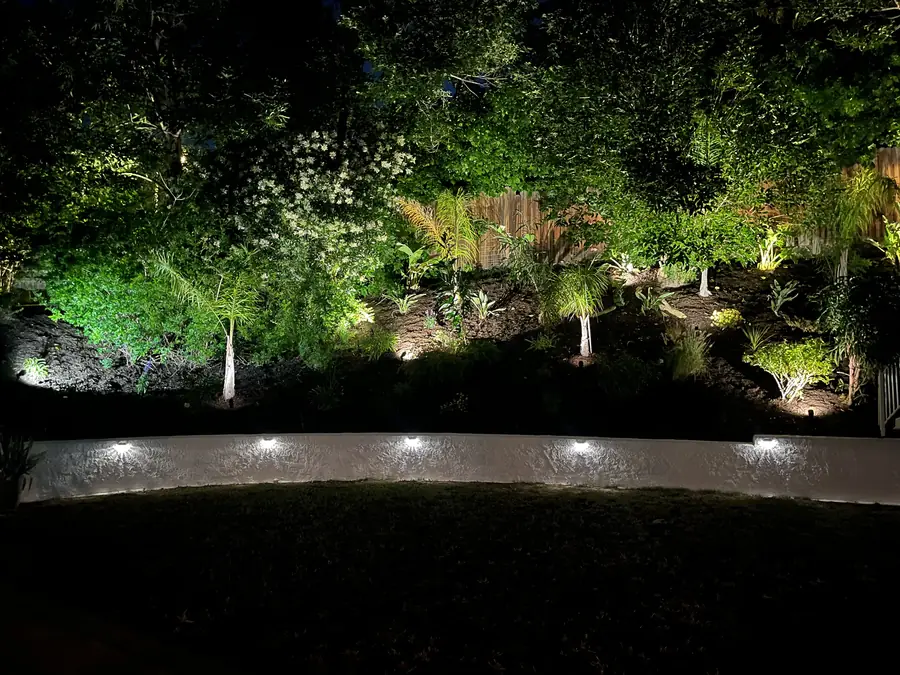
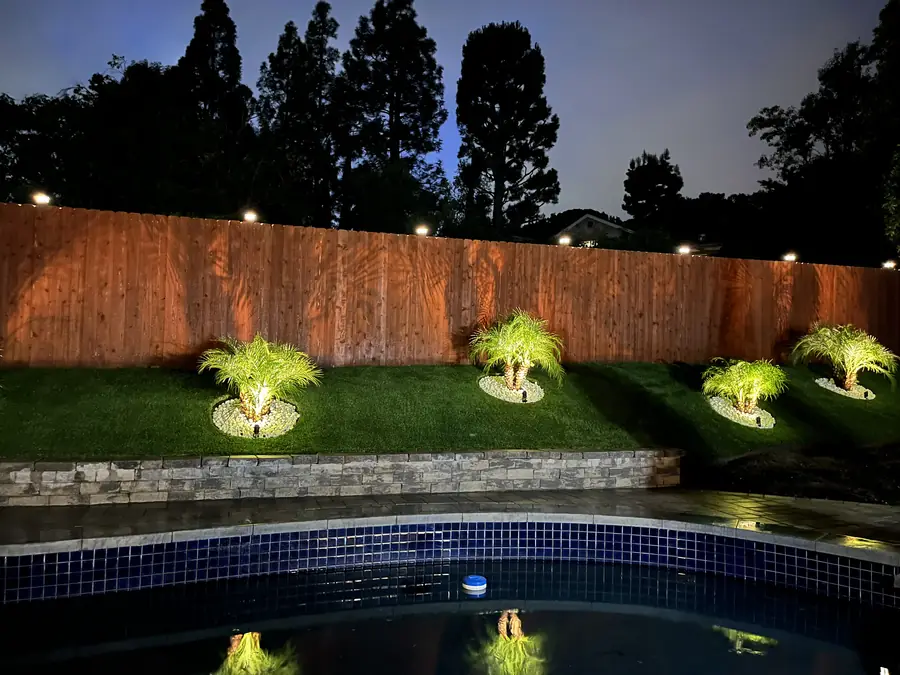
The trees, without much argument. This pocket is known for its canopy, and a large tree is the one element in a residential yard with real height, texture, and structure, which is exactly what light needs in order to be interesting. Uplighting a mature specimen gives you a lit ceiling instead of a dark void above the fence line, and it works from the street, from the patio, and through the windows all at once. Beds, paths, and the house facade fill in around it. Start with the canopy and the rest of the plan gets easier.
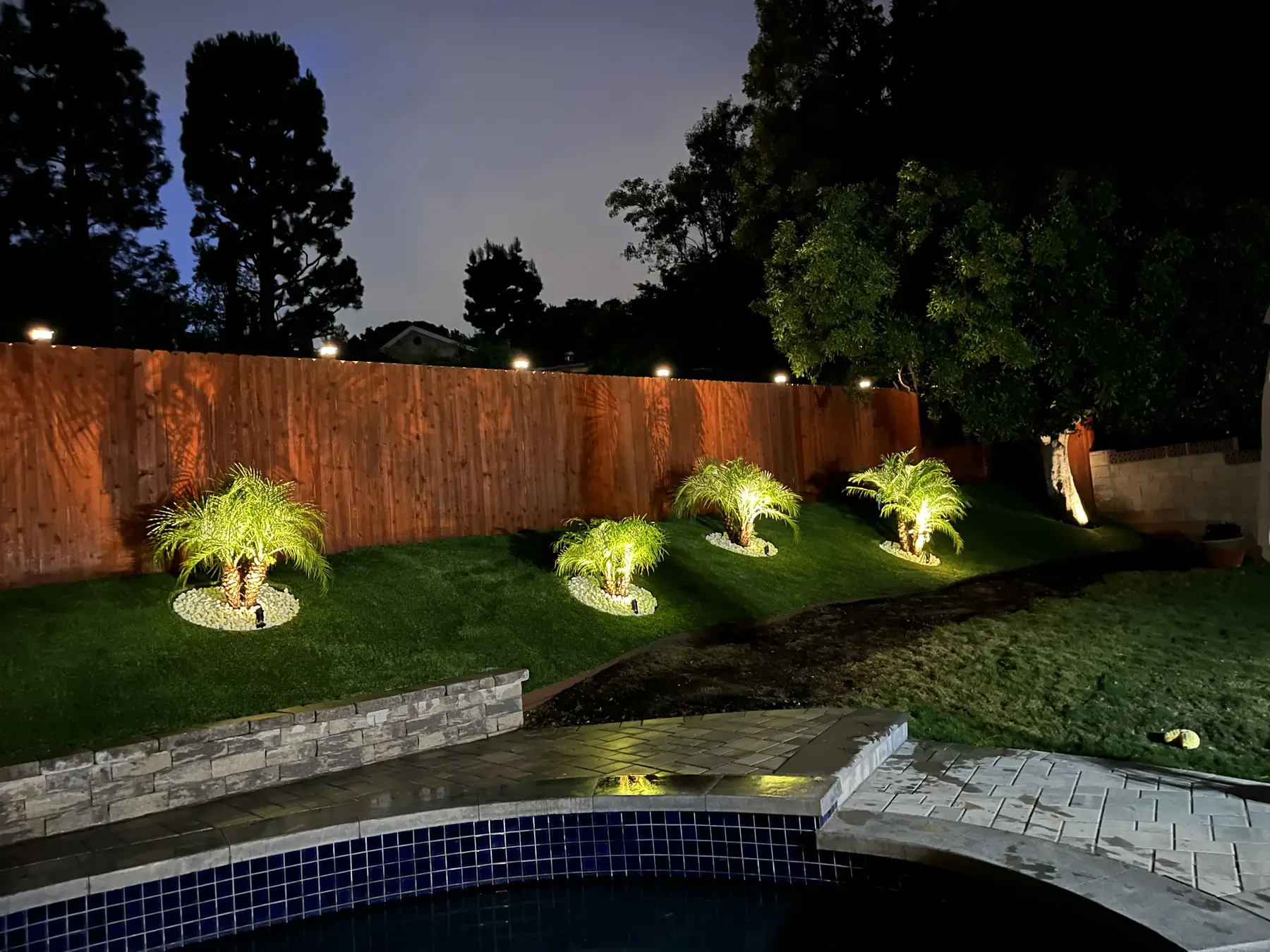
By using several modest fixtures rather than one bright one, and by aiming them properly. Two or three lights set out from the trunk at different distances graze the bark and carry light up into the canopy in layers, which reads like moonlight instead of a floodlit monument. Beam spread is chosen for the shape of the tree, narrow for a tall trunk, wider for a spreading crown. Fixtures get set back and shielded so nobody standing on the patio looks straight into a lens. Aiming happens at night, on site, with the system running.
Along the edges, staggered, and in smaller numbers than most people assume. Path lights exist to show the surface and any change in level, not to line a walk like a runway, so we alternate sides and space them so the pools of light just meet instead of overlapping into a continuous strip. Front walks here are short, and a modest lot only needs a few. Height and shielding matter as much as spacing, because a fixture throwing light sideways into the eye ruins the effect and irritates the neighbors across a narrow street.
It can, provided the route respects them. Low voltage cable sits shallow, which helps, but a straight trench across the root plate of an established tree still severs roots the tree cannot spare. We route cable around the outside of the root zone, follow bed edges and existing trenches where possible, and hand dig or work beneath larger roots instead of cutting through them. Since uplights usually belong at the base of those very trees, the last few feet are almost always dug by hand. No part of a lighting plan justifies damaging the tree it exists to show off.
It affects fixture choice more than anything else. Well lights sit flush in the ground and fill with leaves quickly under a canopy, which blocks the output and traps moisture around the lamp, so we use them selectively and keep them out of the heaviest drop zones. Above grade bullet uplights on a stake or a mount stay clear and can be blown off in seconds. Lenses need occasional wiping wherever debris falls, and fixtures placed in beds are set slightly proud of the mulch line so they do not disappear under it by autumn.
By layering it, since the ground offers nothing to work with. Level lots have no natural elevation change, so depth has to come from lighting objects at different distances and different heights, a low path light in front, a shrub grazed in the middle, a tree crown lit at the back, perhaps a wall washed beyond that. The eye reads that sequence as space. Lighting everything at one brightness and one height flattens a yard further. We also leave deliberate dark areas, because contrast is what makes the lit parts register at all.
It takes 120 volt household power and steps it down to roughly 12 volt, which is what makes the rest of the system safe to bury shallow and safe to service. The transformer is sized with headroom over the total fixture load so it is not running at its limit, and it is mounted on an exterior wall or a post near a suitable outlet, ideally out of sight but reachable. Multiple taps let us feed different runs at slightly different voltages. On a larger property, two smaller transformers in separate corners often beat one big unit.
Voltage drop. Every foot of cable and every fixture on a run consumes a little voltage, so the last light on a long daisy chain receives less than the first and reads visibly yellower and weaker. LEDs tolerate a range better than the old halogens did, but the problem still appears on long runs and undersized wire. The remedies are heavier gauge cable, splitting the load across more runs, using the correct transformer tap, and wiring in hubs rather than one long chain. We calculate the loads instead of guessing at them.
Because a hub gives every fixture on it a nearly equal run of wire, which keeps brightness consistent and makes the system far easier to service later. One heavy cable goes out to a central point, then individual leads fan out to each fixture from there. Compare that with a daisy chain, where each fixture is spliced into the line as it passes and the last one receives whatever voltage is left. Hubs also mean a failed connection affects one light rather than everything downstream of it. All connections get waterproof housings.
Both together is the usual answer. A photocell senses actual darkness and brings the system on as the sky changes through the year, which beats a fixed clock time that drifts out of season. A timer or an astronomical function then handles when it shuts off, whether that is late evening or sunrise. Under heavy canopy, photocell placement takes a little care, because a sensor sitting in permanent shade can trigger early. Many current transformers include both functions plus phone control, which is useful when you want the yard lit while you are away.
Yes, for practical reasons. LEDs draw a fraction of the power, which means more fixtures per transformer and per cable run, and they last long enough that relamping stops being a seasonal chore. Color temperature is the part worth caring about, since warm output reads natural on bark, stone, and foliage, while cooler output makes planting look gray and clinical. We keep the temperature consistent across a property so it does not look patched together over time. Solid brass and copper bodies survive irrigation, mulch, and moisture far better than thin aluminum does.
Because you never actually see a fixture at night, you only see what it does. Expensive brass aimed badly produces glare, hot spots, and a tree lit like a billboard, while a modest fixture placed and aimed with intent looks beautiful. Everything that determines the result is site work, meaning where each light sits, how far off the trunk, at what angle, with what beam spread, how well shielded, and how it layers with the lights around it. Add correct wire sizing and waterproof connections and the system keeps working. Hardware is a component, not a plan.
That is where lighting earns its keep for safety rather than for looks. Older houses in this neighborhood often have a raised porch, a short flight of front steps, and mature planting that has grown over whatever light the entry once had. Recessed step lights, low wall lights, or a shielded downlight from above put illumination on the tread itself instead of into the face of whoever is climbing it. The aim is seeing the edge of each step clearly. We hide the source so the steps read brightly and the fixture disappears.
Well lights are the right pick where a fixture must not be visible at all, such as in a narrow bed against the house, in a lawn area that gets mowed, or at a point in a walkway where nothing should stick up. They sit flush and vanish during the day. Bullets on stakes or mounts win nearly everywhere else, because they can be aimed precisely, adjusted later as a plant grows, and kept clear of the leaf drop that fills an in ground housing. On a canopy lot that final point carries real weight.
With wash fixtures rather than narrow spots. A wash uses a wide beam placed close to the wall and aimed upward, so light spreads evenly across the surface instead of leaving bright circles and dark gaps between them. Older homes here carry texture, whether stucco, brick, siding, or trim detail, and grazing light brings that out nicely. Symmetry helps on a traditional facade, with matched fixtures at equal spacing. We keep the brightness below the level of the canopy lighting so the house sits comfortably in the picture rather than shouting over the trees.
Yes, and most of what we install goes into established yards. Low voltage cable is buried shallow and can be worked into existing beds along edges with minimal disturbance, tucked under mulch in places, and slipped beneath a walkway where a crossing is needed. The main constraints are locating a suitable exterior power source for the transformer and routing around tree roots, both of which get resolved during the walk. Systems are also sized with capacity to spare, so fixtures can be added later without replacing the transformer or pulling new wire.
Our own people. Daniels Landscaping works under one licensed contractor. The same employees who lay out the fixture positions, dig the cable routes around your trees, mount the transformer, make the connections, and return at night to aim every light are ours. Aiming in particular is what separates a good system from an ordinary one, and it is not something we would hand to somebody who did not design the layout. You deal with one company throughout the job and one company afterward.
Call Daniels Landscaping at (818) 443-9300 and we will walk the property, ideally in daylight and again after dark. We look at which trees deserve uplighting, where paths and steps genuinely need light, what the house facade can take, where power is available, and how cable can be routed without disturbing roots. You then get a free written estimate covering fixture counts and types, transformer sizing, cable runs, and controls. Daniels Landscaping holds California license 1138709, and the installation stays under one licensed contractor and the final aiming.