

FAQ
Landscape Lighting in Sunland-Tujunga, answered
The questions we hear most from Sunland-Tujunga homeowners.
Three parts working together. The transformer takes 120 volt power from the house and drops it to 12 volt, which is safe to run out through a yard. Buried cable carries that power to hubs, where individual fixtures connect on their own leads instead of being spliced along one long line. Then come the fixtures, chosen by the job they do rather than by catalog page. A timer or photocell decides when everything switches on. Getting all three right separates a system that lasts from one that fails in a season.
Yes, and it is the most common reason lighting looks uneven on the big properties here. Voltage falls as it travels, so fixtures at the far end of a run receive less than the ones nearest the transformer, and LEDs respond by dimming, shifting color or flickering. We calculate the load on each run, use heavier gauge cable where the distance calls for it, place hubs so fixtures share a similar distance back to the source, and set the transformer taps to land every fixture in its proper range.
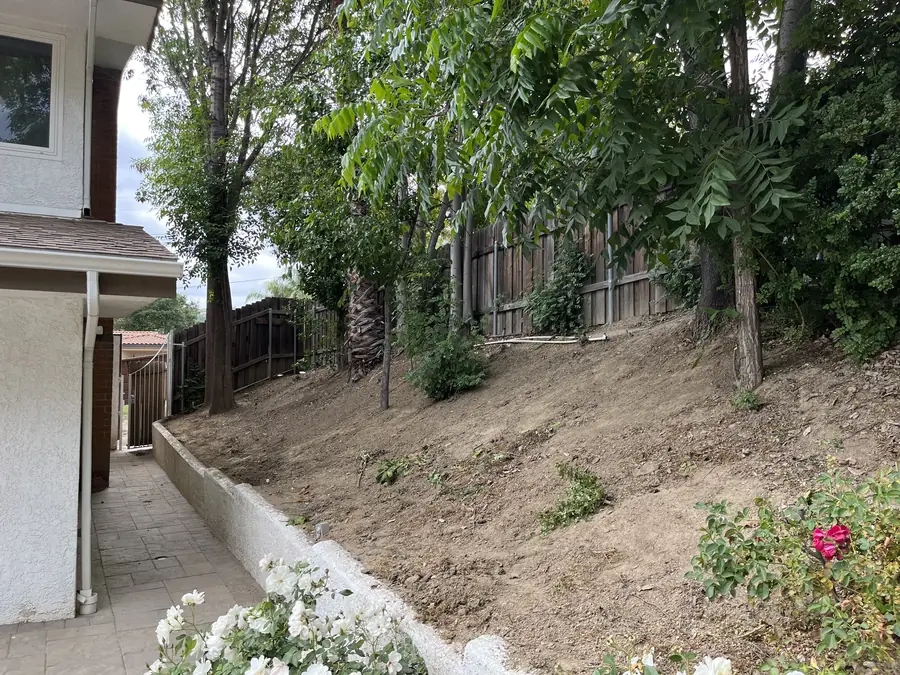
Carefully, and rarely in a straight line. The decomposed granite up here is full of buried rock, so a trench that starts clean often runs into something that will not move. We route around it, hold the cable at a consistent depth wherever the ground allows, and sleeve it where it crosses under paving or a driveway so it can be pulled later without digging anything up. Cable routes get mapped as we go, which matters on a big property when somebody wants to plant a tree three years from now.
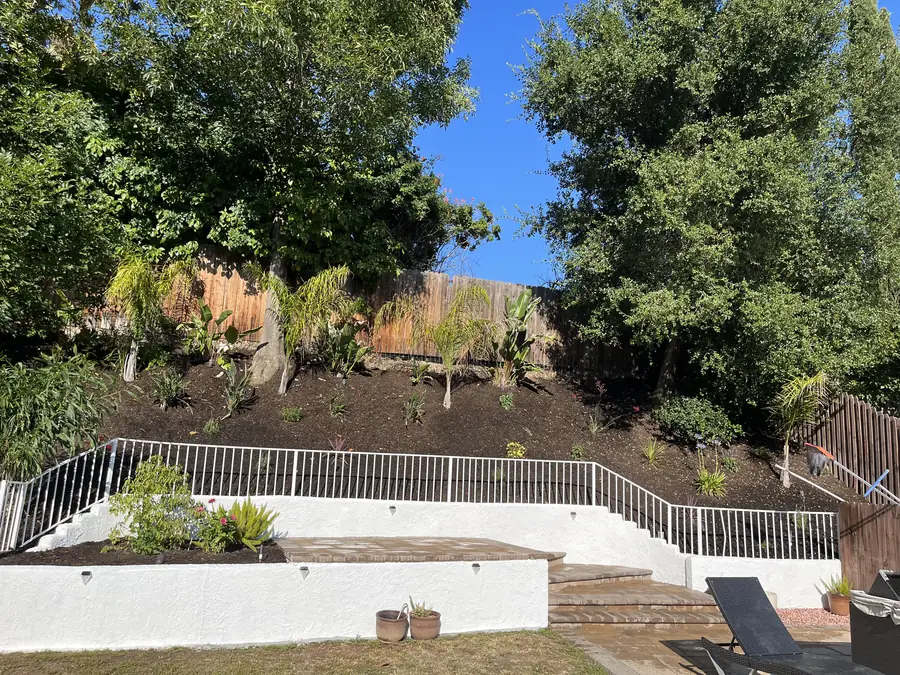
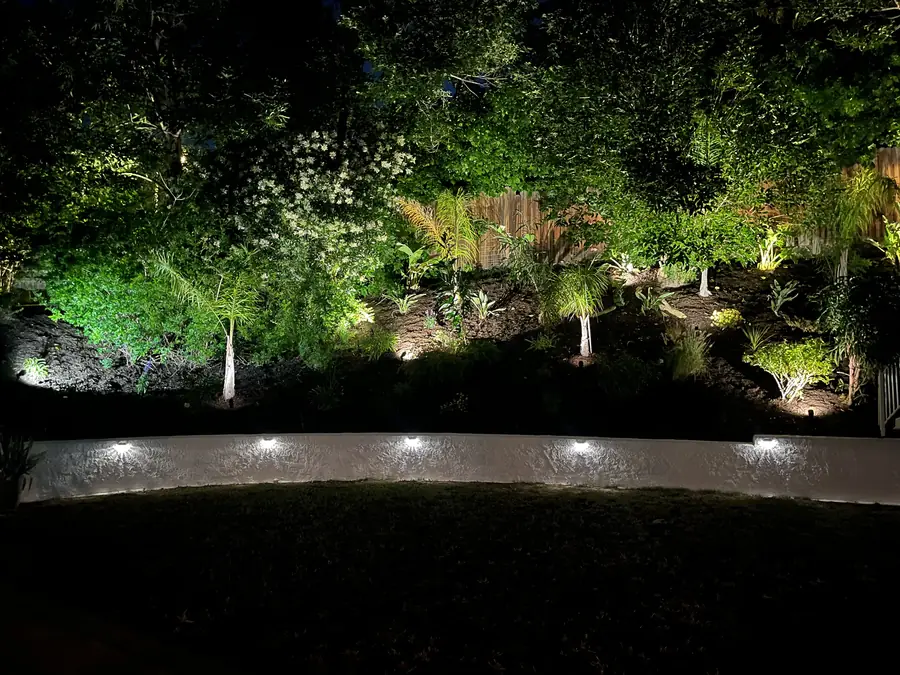
Grade changes are where people actually get hurt, so they get lit first. Step lights recessed into a riser or the adjacent wall wash the tread without putting a glare source at eye level. Low wall lights do the same along a terrace. On the steeper lots here that means treating every flight, not only the front entry, since the walk from a driveway down to a back terrace can drop a considerable distance. The goal is enough light to read the edge of each tread, not to flood the hillside.
Along walks, at changes of direction, and wherever the edge of a surface needs defining. What they are not is a runway. Lining both sides of a path with evenly spaced fixtures looks like an airstrip and flattens everything around it. We stagger them, space them wider than most people expect, and let the pools of light overlap softly with darkness between. Fixtures with a solid shade that pushes light downward do more for the walking surface and keep glare out of your eyes on the approach.
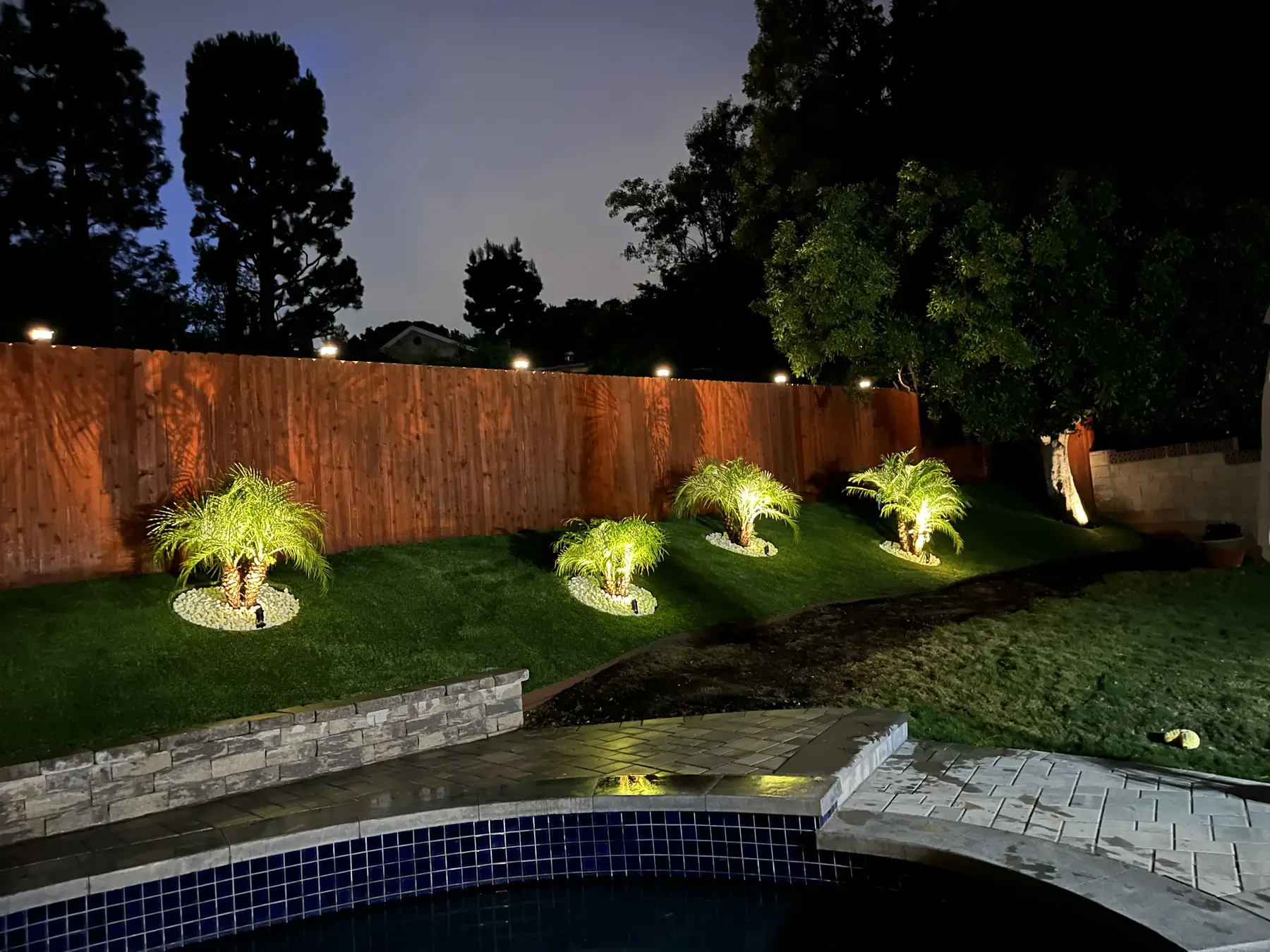
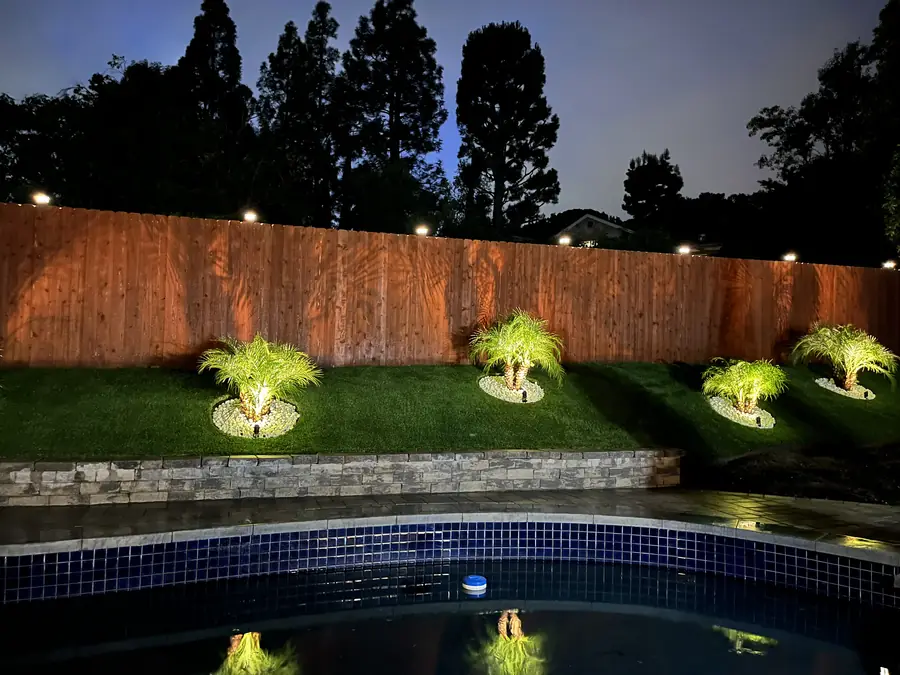
Trees are usually the best thing to light in a foothill yard, because the canopy gives you height and texture that nothing at ground level can match. Bullet fixtures set back from the trunk graze the bark and carry light up into the branches, and a wider beam fills the canopy itself. On a large lot, two or three well aimed trees accomplish more than a dozen small fixtures scattered through the beds. We aim after dark, on site, since a beam never lands quite where it appears to by day.
A well light sits flush with grade and buries its own body, so the source disappears and only the effect shows. That makes it right for a lawn, at the base of a wall you want to graze, or anywhere a standing fixture would be in the way or would be the first casualty of a mower. They need a drainage bed underneath, which the fast draining ground here provides readily, and a good lens seal, since they sit exactly where water wants to collect.
When the subject is broad rather than tall. A long stone wall, a stucco elevation, a hedge or a wide garage face takes a wash, meaning a soft even spread from a fixture placed close and aimed shallow. Flood is the same idea with more output and a wider beam, useful across a large blank surface. The mistake is treating flood as general yard lighting. Pointed outward at nothing in particular it produces glare and destroys the contrast that makes everything else in the yard read.
Sizing follows total fixture load with headroom left over for adding fixtures later, because almost everyone eventually does. Multi tap models let us feed a longer run at slightly higher voltage to compensate for the drop out to the far end. Placement counts just as much. We mount it near an exterior outlet on a wall or post, above grade, somewhere reachable for service but outside the sight line from the patio. On a large property, two smaller transformers in separate locations often beat one big one.
Because a daisy chain punishes everything downstream of it. Splice fixtures one after another along a single line and each one sees slightly less voltage than the last, so the end of the run goes dim, and one bad connection takes out everything past it. A hub gives every fixture its own lead from a common point, so distances stay similar and voltage stays even. Service gets simpler too. A failed fixture is isolated right at the hub instead of hidden somewhere along a trench.
They are what we install. LEDs draw a fraction of the power old halogen did, which means many more fixtures on a single run and less voltage drop to manage over the long distances up here. Beyond that, quality varies enormously. Solid brass or copper bodies stand up to weather and to sprinkler water, while cheap aluminum corrodes at the base within a few seasons. Color temperature matters as well. Warm output flatters plants and stone, and cool white makes a garden look like a parking lot.
Usually both ideas at once. A photocell senses dusk and brings the system on as light actually fades, which tracks the seasons with nobody touching anything, and that helps in a foothill setting where the sun drops behind the ridge well before true sunset. A timer or astronomical clock then decides when things shut down, and it can stage that, leaving path and step fixtures on later than the accent lighting. Modern transformers handle all of this internally, frequently with phone control included.
It means lighting at more than one distance so the yard gains depth instead of a lit foreground with a black wall behind it. Something close, something in the middle, something far back. On the deep properties here that might be step lights at the patio, a wash across a seat wall past it, and an uplit tree at the rear of the lot. The eye reads the distance between those layers and the space feels larger at night than by day. Even coverage everywhere does the opposite.
Restraint, mostly. Nights are genuinely dark out at the edge of the foothills and eyes adjust to that, so it takes far less output to read a path than people assume. We use lower lumen lamps than a suburban yard would call for, hide the source behind a shroud or a plant, and aim so no bare lens points toward a window, a seating area or a neighboring property. Contrast is what makes a landscape look good after dark. Leaving areas unlit is part of the design.
It helps considerably. Long private driveways are common up here, and lighting the edges, the turns and any pull out makes the approach usable at night for you and legible for anyone arriving. That clarity matters at a wildland interface property, where the band right around the structure is kept clear of heavy fuel anyway. Lighting that band gives you a defined, visible perimeter without adding anything flammable to it. We also keep fixtures and cable clear of future clearance work.
Because a good fixture wired badly still fails. Most systems we are called out to repair have decent hardware and poor execution: undersized cable, gel filled twist connectors corroding underground, wire buried an inch down and cut by the first shovel, transformers loaded past their rating. Meanwhile the aiming, which costs nothing at all, was never done. Cable sizing, hub layout, connection quality, burial depth and a proper night walk to aim every fixture determine whether the system still looks right in five years.
One licensed contractor, from the transformer out to the last fixture. Daniels Landscaping stays accountable for the work. The same people who lay out the design pull the cable, set the hubs, mount the transformer and return after dark to aim everything. On lighting that continuity is the whole job, because whoever aims a fixture needs to know why it was placed where it was. You deal with one company and one team for the design, the installation and anything that comes up afterward.
Call Daniels Landscaping at (818) 443-9300 to set up a visit. We look at the property in daylight for layout and cable routing, then talk through how you want the yard to feel after dark, which trees matter, where you walk, where the grade changes. You will get a free written estimate listing fixture counts and types, transformer size, cable runs and the aiming visit. Our California license number is 1138709, and the estimate carries no obligation whatsoever.