

FAQ
Landscape Lighting in San Fernando, answered
The questions we hear most from San Fernando homeowners.
A layout first, meaning what gets lit, what stays dark, and where a person needs to see their footing. From there the work is a transformer mounted near an exterior outlet, buried cable running out to the areas being lit, hub connections where several fixtures gather, and the fixtures themselves set, staked, or mounted. The last step happens at night, when we walk the yard with the system live and aim each head, adjust glare, and swap lamp output where a fixture is doing too much or too little. Daytime installation with no night visit is guesswork.
It depends on what the job touches. Low voltage cable on the yard side of a transformer is a different matter from the 120 volt circuit feeding it, and any new electrical work is reviewed under the San Fernando municipal code with the application going to the City of San Fernando. Because this is an independent city surrounded by Los Angeles, Los Angeles Building and Safety has no part in it even though your neighbors a few blocks away deal with exactly that department. We check with the city before quoting anything that involves new circuits.
It gets assessed rather than assumed. Properties in this city run older than most of the region, and what we find is often decades old: cracked fixture housings, cable insulation gone chalky, corroded connections, and a timer nobody has been able to program in years. Full 120 volt lighting in a yard carries risk once the wiring has aged, particularly where irrigation soaks the ground around it. Replacing it with a low voltage system is safer to work on, cheaper to extend later, and gives you far more fixture choice than the old gear ever did.
It converts household 120 volt power down to 12 volt, which is what makes the buried cable in your yard safe to work around. Physically it is a weather rated box mounted on an exterior wall near a suitable outlet, usually along a side yard where it stays out of sight but remains reachable. Sizing matters, because a transformer loaded to its limit leaves no room to add a fixture in two years. We size with headroom and use multiple output taps so different cable runs can be fed at the voltage each one needs.
They help enormously, and it is one of the quiet advantages of building here. Voltage drop is what happens when current travels down a wire and arrives weaker than it left, which shows up as fixtures near the end of a run glowing dim and yellow while the ones near the transformer look correct. Compact yards keep runs short, so the problem is far easier to control than it would be on a large property. We still size wire generously and split loads across hubs, because doing it right costs almost nothing at installation.
Cable goes into a trench deep enough to stay clear of shovels and edging, and it runs alongside irrigation lines where the routes coincide so the ground gets opened once. Under a walkway or driveway it goes through a sleeve rather than being wedged into a saw cut. Connections are made at hubs using waterproof connectors, not by twisting wires and hoping. Every splice is a future failure point, so we keep them few, keep them accessible, and keep them out of standing water. Good burial and good connections are why a system still works years later.
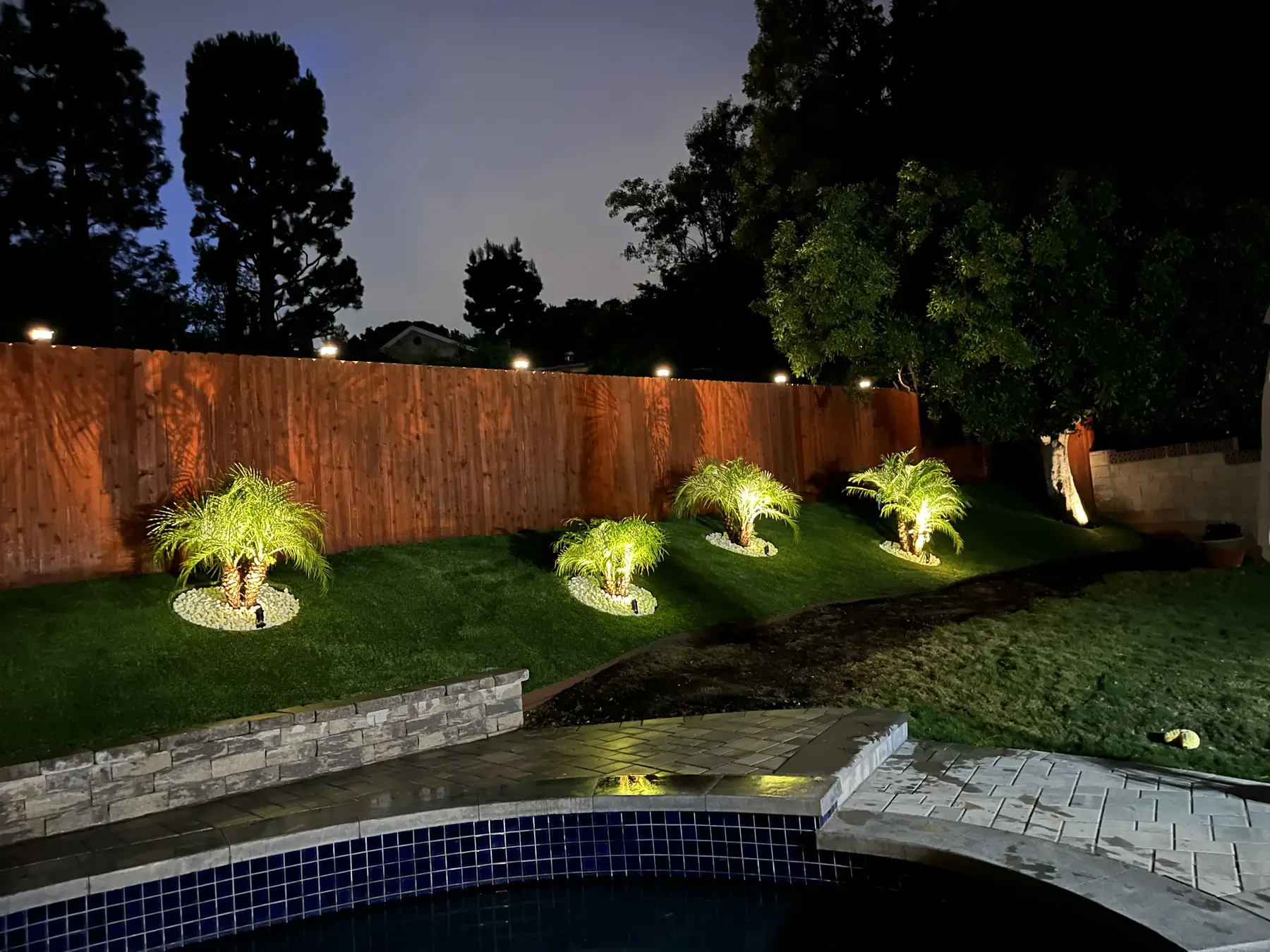
By layering light at different distances and heights instead of washing everything evenly. Level ground gives no natural foreground and background, so we build them: a low path light close in, an uplight into a tree at mid distance, a soft wash on a wall at the back. The eye reads that separation as depth. Leaving deliberate dark gaps between lit elements matters just as much, because a yard lit uniformly flattens out and looks like a parking lot no matter how nice the fixtures are.
Fewer than a catalog would suggest. On a modest frontage, path lights along the walk handle safety, a pair of uplights on a specimen tree or the corner of the house creates the vertical interest, and a shielded wall or step light covers a level change at the entry. Well lights set flush work where a stake would be in the way of mowing or foot traffic. Budgets stretch further when the money goes into placement and aiming on a handful of fixtures rather than into a long row of identical ones.
The source is visible when it should not be. A path light exists to put a pool of light on the ground, so the lamp needs to sit up inside a shielded hat where you never see it directly from standing height. Fixtures set too tall, aimed poorly, or built without a proper shield turn into small floodlights pointed at your face, and the glare actually makes it harder to see the walk. The same principle governs uplights, which get positioned and shielded so the beam goes into the tree rather than into a window.
Yes, for practical reasons rather than fashion. LEDs draw a fraction of the power older lamps did, which means a single transformer and a single cable run can carry many more fixtures than used to be possible. They also last long enough that relamping stops being an annual chore. What matters more than the label is beam angle and color temperature. Warm output flatters planting, stone, and stucco, while cool white makes a yard look clinical. Beam spread is what separates a tight uplight on a trunk from a wash across a wall.
Most systems use both together. A photocell senses when daylight has gone and turns the system on without you resetting anything as the sunset shifts across the year, which is the failure mode of a plain clock timer. The timer half then handles when everything goes off, whether that is a set hour or late at night. Many transformers include this control built in, and some can be operated from a phone. What we avoid is a setup that requires the homeowner to think about it, because nobody ever does.
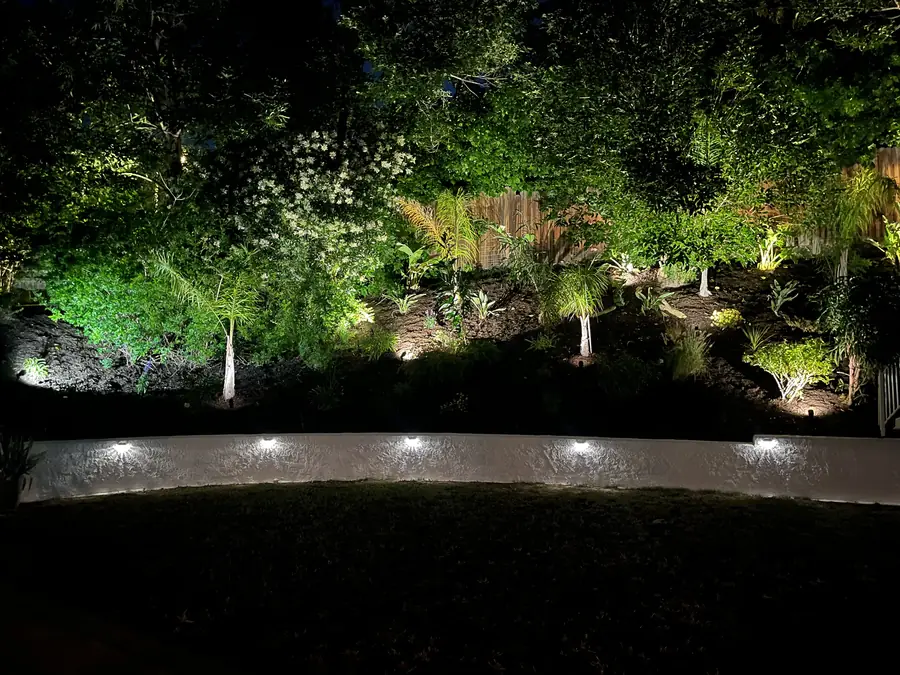
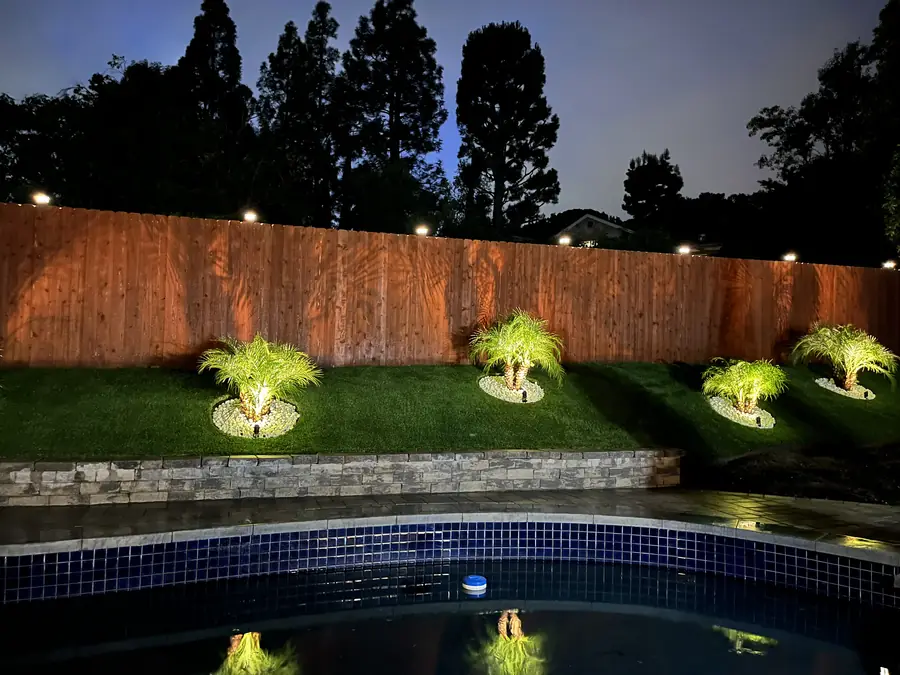
With grazing rather than flooding. A fixture placed close to the base and aimed steeply up the face rakes light across the surface, so every joint and every irregularity in the stone throws a small shadow and the texture becomes the feature. Pull the same fixture back and the light flattens the wall into a blank panel. Beam spread is chosen for the height of the wall, and spacing is set so the pools overlap into a continuous wash. On smooth stucco the effect is softer, so fixtures get pulled back deliberately.
The installation matters more, and it is not close. A well made fixture aimed at nothing, fed by undersized wire, spliced with a connector that fills with water, and left glaring at the sidewalk will disappoint you every single night. A modest fixture placed at the right distance, shielded, aimed after dark, and wired on a properly sized run looks intentional for years. Quality hardware is worth buying, but it is the part of the job you can replace later. Wire size, burial depth, and connections are the part you cannot.
That is the ideal sequence, and it saves real money. Once ground is already open for irrigation or before a patio surface goes down, running lighting cable and setting sleeves under future paving adds very little to the day. Retrofitting later means cutting into finished planting, lifting mulch, or boring under hardscape that was poured without a thought for it. Even if the fixtures themselves are a phase down the road, we will place the sleeves and stub the runs now, so the future job is a matter of pulling wire.
Good equipment does, but the failures we see are heat and water related rather than mysterious. Long stretches of hot dry weather with direct overhead sun break down cheap plastic lenses and fade thin painted finishes, so solid brass or copper fixtures earn their cost outdoors here. The other enemy is irrigation, since a sprinkler striking a hot lens or filling a poorly sealed connector will end a fixture quickly. We coordinate fixture placement with head placement for that reason, and keep connections up out of the wet zone.
Aiming and shielding, decided on site at night. Lots here sit close together, so a beam that overshoots a tree canopy carries straight into the house next door. We choose beam spreads that match the target rather than oversized floods, use shields and glare guards on anything near a property line, and set uplights at angles that keep spill inside the canopy. Where a tree simply sits too close to the fence, moving the fixture in tighter and steeper solves it. Being a considerate neighbor is part of a good design.
One licensed contractor does the entire job. Daniels Landscaping stays accountable for the work. The same people who plan the layout dig the trenches, run and connect the cable, mount and wire the transformer, set the fixtures, and come back after dark to aim them. There is no handoff between one company that sells the design and another that installs it, which is where most lighting jobs go wrong. When you call about a fixture two years later, you are calling the people who put it in the ground.
Call Daniels Landscaping at (818) 443-9300 and we will walk your property, look at what deserves lighting and what is better left dark, and check where power is available. You receive a free written estimate listing fixture types and counts, the transformer, cable runs and burial, hub connections, controls, and the night aiming visit. Daniels Landscaping carries California license 1138709. If any part of the work requires review by the city, the estimate says so up front, and nothing gets scheduled until you have read it and approved it.