
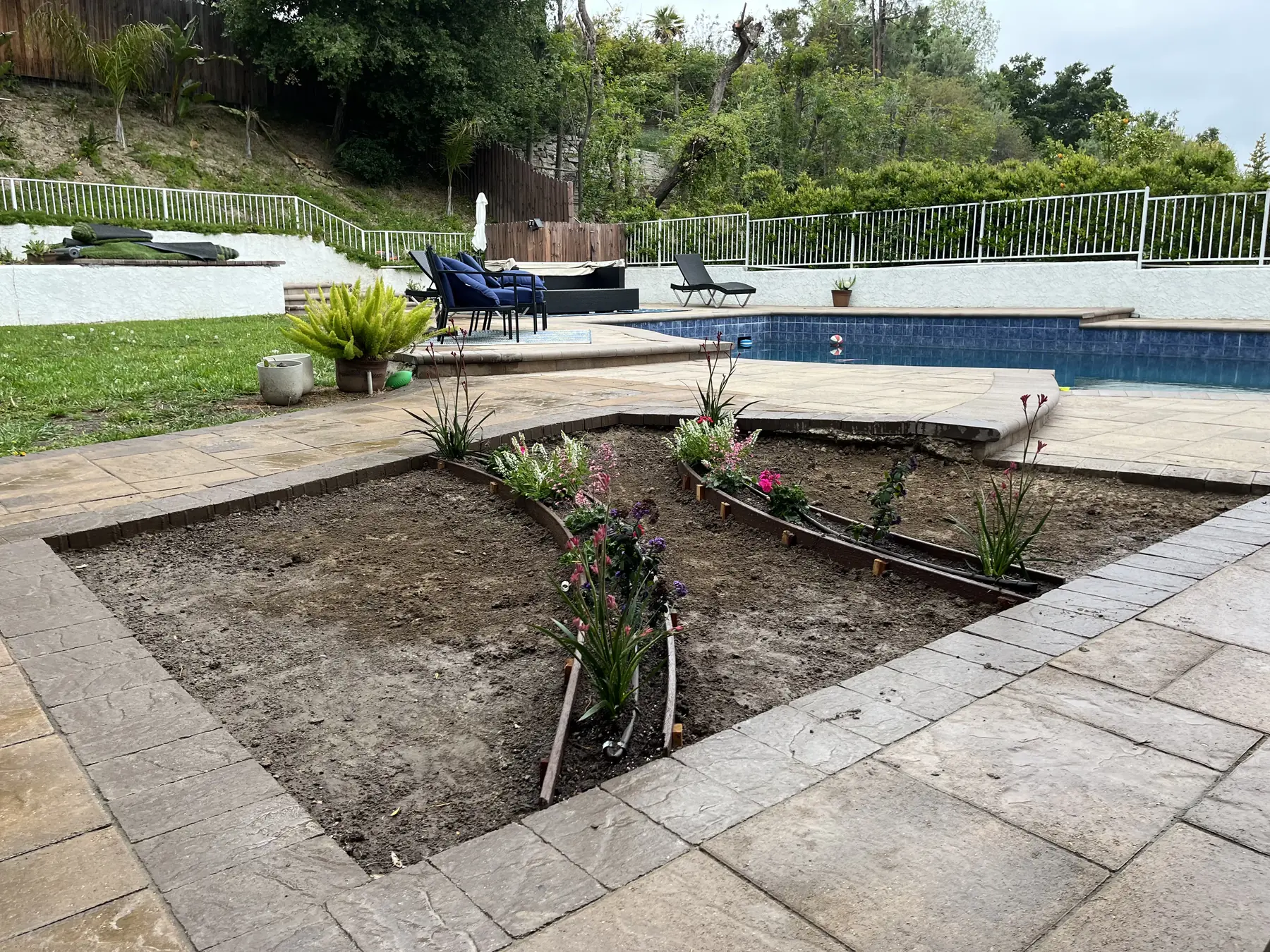
Irrigation is the plumbing that keeps a landscape alive: the sprinklers and drip lines you see, and the valves, pipe, controller, and pressure regulation you do not. Done well, it is invisible. Done poorly, it shows up as brown patches next to soggy ground, water sheeting down the driveway, a bill that climbs every summer, and plants that die slowly for reasons nobody can pin down. The common thread in almost every failing system is not the amount of water, it is the delivery. Water landing in the wrong place, at the wrong rate, on the wrong schedule, for plants with different needs sharing one zone. This page covers how an irrigation system is put together and what separates one that saves water from one that wastes it.
What does an irrigation system actually include?
A system has five working parts. The water source and backflow preventer connect it to your supply and keep irrigation water from flowing back into the drinking line. Valves, usually grouped in a manifold box, open and close each zone. Pipe carries water underground to where it is needed. Emission devices put water into the ground, whether spray heads, rotors, or drip. The controller decides when each zone runs and for how long.
Every one of those parts can be sized correctly or incorrectly, and a weakness anywhere shows up as a problem everywhere. A perfect controller cannot fix bad head layout, and premium nozzles cannot fix a zone with not enough pressure behind it.
Sprinklers, rotors, or drip: what goes where?
Spray heads throw a fixed fan of water over a short distance and put it down fast. They suit small, level lawn areas and tight strips. Rotors turn a stream slowly across a larger radius, covering big lawns more evenly and applying water more slowly, which matters on soil that absorbs poorly. Rotary nozzles sit between the two, delivering multiple slow streams at a low precipitation rate, and they are often the best retrofit for a zone that runs off.
Drip is different in kind. It releases water slowly right at the soil surface near each plant, with almost nothing lost to wind or evaporation. For shrubs, beds, hedges, and trees, drip is usually the most efficient choice available.
Why zones and hydrozoning decide everything
A zone is a group of heads that run together off one valve, and it is the single most consequential design decision in a system. Everything on a zone gets exactly the same runtime, so everything on that zone must want the same amount of water. Lawn and shrubs on one valve guarantees failure: run it long enough for the lawn and you drown the shrubs, run it for the shrubs and the lawn goes brown.
Hydrozoning means grouping plants by water need, sun exposure, and soil, then giving each group its own valve. Sun and shade are separated. Lawn, beds, and trees are separated. Slopes are separated from flat ground. Get the zoning right and scheduling becomes simple.
Why water runs off, and how cycle and soak fixes it
Every soil has a rate at which it can absorb water. Clay soils, common across the San Fernando Valley, absorb very slowly. When a sprinkler applies water faster than the ground can take it in, the excess has nowhere to go but sideways, off the lawn and down the hardscape. The frustrating part is that the yard can be losing water to the gutter while the root zone a few inches down stays dry.
Cycle and soak solves it. Rather than one long run, the controller runs the zone in several shorter cycles with a soak period between them, letting each application absorb before the next. Same total water, far less runoff. On slopes it is essential.
What a smart controller does, and what it does not
A smart controller adjusts watering to conditions instead of repeating a fixed schedule. Using local weather data or an on site sensor, it accounts for temperature, rainfall, and seasonal demand, then shortens or skips runs automatically. It will not water through a rainstorm, and it scales back in cool months when a fixed timer keeps running as though it were August. Most also allow zone by zone setup for soil, slope, plant type, and sun, and let you check and adjust from your phone.
What it cannot do is compensate for bad hardware. A smart controller on top of mismatched heads, poor zoning, or a leak simply automates the same waste more precisely.
Leaks, pressure, and coverage: the quiet failures
Three problems account for most wasted water. Leaks are the most expensive because they hide. A cracked lateral or a valve that fails to seal can run underground for months, showing up only as a rising bill and a patch of ground that never dries.
Pressure is the second. Too little and heads fail to reach; too much and spray atomizes into mist that drifts away before it lands. Pressure regulating heads hold the correct output. The third is coverage. Sprinklers are designed so each head throws to the next, and when spacing, arcs, or nozzle sizes are mismatched, the result is the classic pattern of dry rings next to saturated ground.
How irrigation cuts water use under California restrictions
California water rules have made efficiency a permanent requirement rather than a drought season reaction. The largest savings come from a few changes. Converting spray zones in beds to drip removes evaporation and overspray losses. Correcting zoning stops entire areas being overwatered to satisfy one thirsty plant. A weather based controller trims runtime automatically as seasons change. Repairing leaks and broken heads recovers water that was never reaching a plant at all.
Local water agencies sometimes offer rebates toward efficient equipment such as smart controllers and rotary nozzles. Programs and eligibility change, so treat any rebate as a possible bonus and confirm the current terms with your agency before counting on it.
Where do we do irrigation?
We install irrigation across the San Fernando Valley. See the detail, local projects, and pricing for your city:
- Irrigation in Arleta
- Irrigation in Burbank
- Irrigation in Calabasas
- Irrigation in Canoga Park
- Irrigation in Chatsworth
- Irrigation in Encino
- Irrigation in Granada Hills
- Irrigation in Hidden Hills
- Irrigation in Lake View Terrace
- Irrigation in Mission Hills
- Irrigation in North Hills
- Irrigation in North Hollywood
- Irrigation in Northridge
- Irrigation in Pacoima
- Irrigation in Panorama City
- Irrigation in Porter Ranch
- Irrigation in Reseda
- Irrigation in San Fernando
- Irrigation in Sherman Oaks
- Irrigation in Studio City
- Irrigation in Sun Valley
- Irrigation in Sunland Tujunga
- Irrigation in Sylmar
- Irrigation in Tarzana
- Irrigation in Toluca Lake
- Irrigation in Valley Glen
- Irrigation in Valley Village
- Irrigation in Van Nuys
- Irrigation in West Hills
- Irrigation in Winnetka
- Irrigation in Woodland Hills