
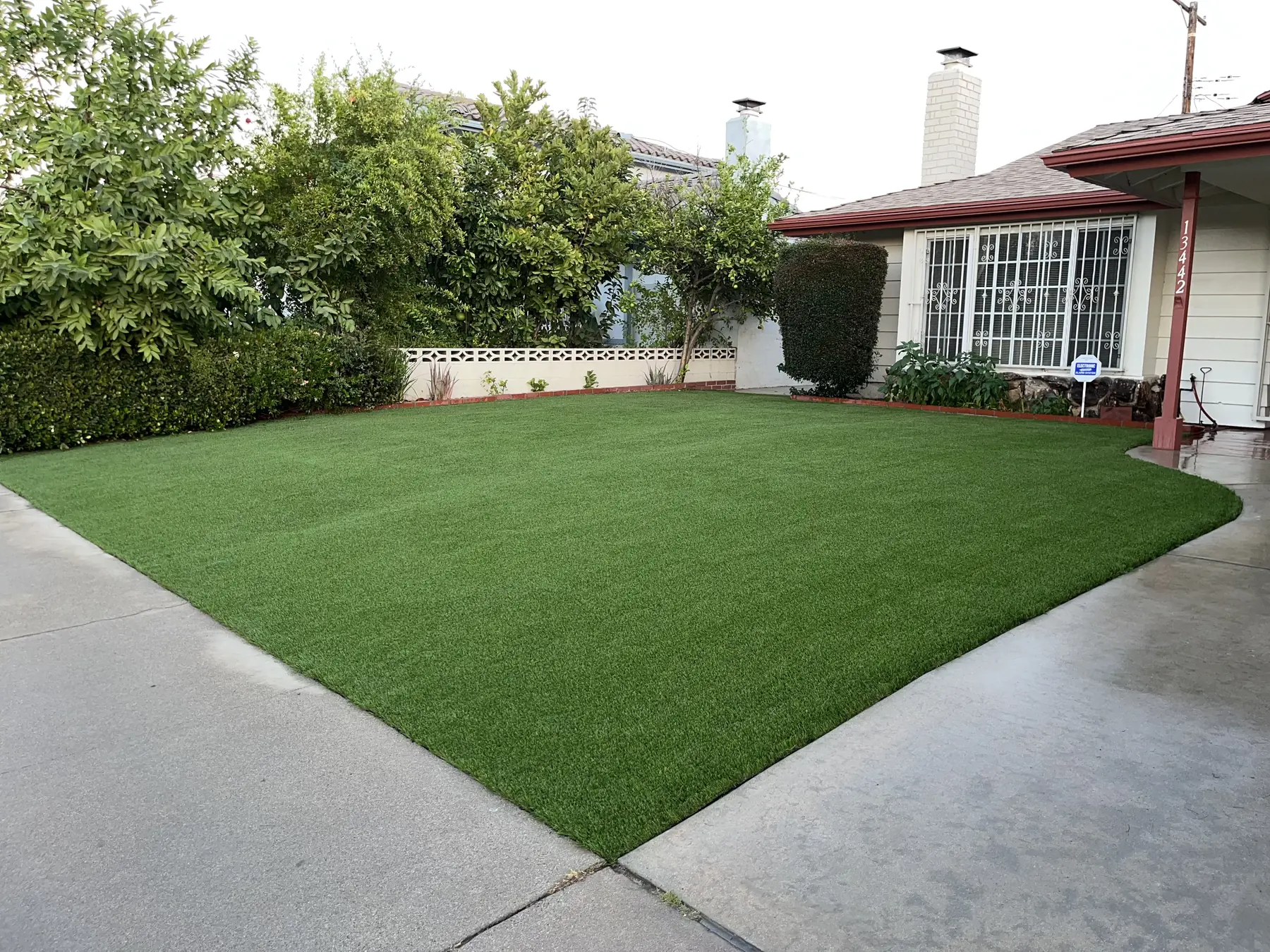
Artificial turf is a synthetic grass surface built to look and feel like a real lawn while needing no mowing, no water, and almost no upkeep. Not all of it is the same, though. Face weight, pile height, blade shape, backing, and infill are what separate turf that still looks real in year eight from turf that mats down and goes shiny in two. This page explains what those specs mean and which turf suits which use, so you can read a sample instead of just taking a salesperson's word.
What is artificial turf made of?
Modern artificial turf is built in layers. The blades are strands of polyethylene or polypropylene tufted into a backing, usually with a curled, crinkled layer at the base called thatch that mimics the brown undergrowth of a real lawn and helps the blades stand up. The backing is a perforated sheet that holds the blades and lets water drain through. On top, once it is installed, a granular infill is brushed down between the blades.
That is the whole product: blades, thatch, backing, and infill. The quality of each, and the base underneath, is what decides how it looks and how long it lasts.
What do face weight and pile height mean?
Face weight is how much yarn is packed into the turf, measured in ounces per square yard, and it is the single best indicator of quality. Higher face weight means denser, fuller turf that resists matting and holds up to traffic. Cheap turf skimps here, and it shows within a year as the blades lie flat and the base shows through.
Pile height is how tall the blades are. Taller is not better. Blades that are too long fold over under their own weight and look flat and fake, while a moderate pile stands up and reads as a real, mown lawn. For most yards a mid-range pile with a high face weight is the combination that looks right.
Why does blade shape matter?
The cross-section of each blade decides whether it stands up or mats down. Flat, ribbon-shaped blades are cheapest and mat fastest. Blades with a spine or a shaped profile, described as S-shaped, C-shaped, W-shaped, or with a raised central rib, are stiffer and spring back after they are walked on.
That stiffness is what keeps a turf lawn looking upright and full over years of foot traffic. It is worth running your hand across a sample and pressing it down: good turf pops back, cheap turf stays flat.
What is infill, and why is it not optional?
Infill is the granular material brushed down into the turf after it is laid. It does three jobs: it weighs the turf down so it lies flat, it holds the blades upright, and it protects the backing from the sun. Leaving it out to save money is a false economy, because the turf mats and wears far faster without it.
The type depends on the use. A standard lawn gets a rounded silica sand. Pet areas get an antimicrobial or zeolite-based infill that traps the ammonia in urine, which is what keeps a dog yard from turning sour in the heat. Play areas can add a shock-absorbing infill under the surface.
How is turf actually installed?
The turf is the last and easiest step. Almost everything that decides the result happens underneath, in the base. The old lawn and a few inches of soil come out, the ground is regraded to drain, then crushed rock goes in and is compacted in layers until it is genuinely solid. A weed barrier goes down, the turf is rolled out, seamed with the blade grain running the same direction so joints disappear, fastened at the edges, and the infill is brushed in.
That base is the part cheap installs skip, and it is exactly why those lawns go wavy and puddle within two summers. The diagram below shows the layers.
What are the different types of turf?
Turf is made in grades for different uses. Landscape turf is the all-purpose lawn grade, tuned to look like real grass. Pet turf uses a more open, fully perforated backing so urine drains straight through, paired with odor-controlling infill. Play turf is softer and often laid over a shock pad for safety under play equipment. Putting green turf is short, dense, and very smooth for a true roll, usually with a separate fringe turf around it.
Using the right grade for the use matters as much as the quality. A beautiful landscape turf makes a poor pet run, and a pet turf looks too utilitarian for a front lawn.
How long does artificial turf last?
Good turf on a properly built base lasts fifteen years or more, and its manufacturer warranty usually reflects that. What shortens it is rarely traffic. It is sun on a low-grade product, or a base that was never compacted, or missing infill letting the blades mat. Spend on face weight, fibre that is UV-stabilised through the strand rather than sprayed on, and a real base, and the turf outlives the warranty rather than embarrassing it.
Where do we do artificial turf?
We install artificial turf across the San Fernando Valley. See the detail, local projects, and pricing for your city:
- Artificial Turf in Arleta
- Artificial Turf in Burbank
- Artificial Turf in Calabasas
- Artificial Turf in Canoga Park
- Artificial Turf in Chatsworth
- Artificial Turf in Encino
- Artificial Turf in Granada Hills
- Artificial Turf in Hidden Hills
- Artificial Turf in Lake View Terrace
- Artificial Turf in Mission Hills
- Artificial Turf in North Hills
- Artificial Turf in North Hollywood
- Artificial Turf in Northridge
- Artificial Turf in Pacoima
- Artificial Turf in Panorama City
- Artificial Turf in Porter Ranch
- Artificial Turf in Reseda
- Artificial Turf in San Fernando
- Artificial Turf in Sherman Oaks
- Artificial Turf in Studio City
- Artificial Turf in Sun Valley
- Artificial Turf in Sunland Tujunga
- Artificial Turf in Sylmar
- Artificial Turf in Tarzana
- Artificial Turf in Toluca Lake
- Artificial Turf in Valley Glen
- Artificial Turf in Valley Village
- Artificial Turf in Van Nuys
- Artificial Turf in West Hills
- Artificial Turf in Winnetka
- Artificial Turf in Woodland Hills