
FAQ
Landscape Lighting in Winnetka, answered
The questions we hear most from Winnetka homeowners.
Low-voltage LED is the standard for residential landscape lighting because it runs on twelve volts stepped down from your household power through a transformer, which is far safer around soil, water, and children than line-voltage wiring. LED fixtures draw very little electricity, stay cool to the touch, and last for years before the diodes dim. For a Winnetka yard, this means you can add several fixtures without a meaningful jump in your monthly bill, and the low voltage keeps buried connections safe.
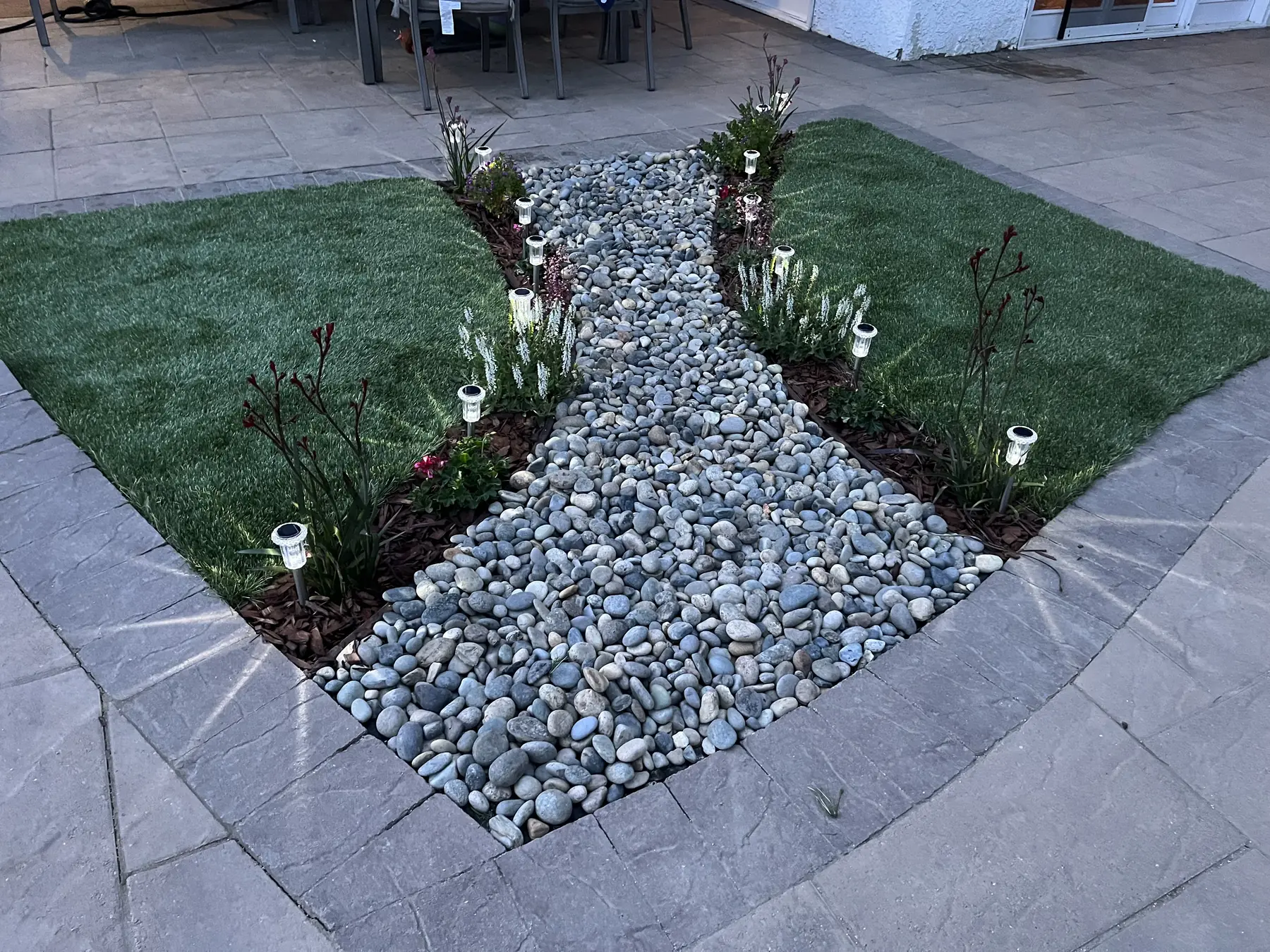
Path and walkway lights sit low to the ground and cast a soft pool of light onto the surface you walk on, so steps, edges, and turns stay visible after dark. They guide guests from the curb to your door and keep the trip from the driveway safe when your hands are full. On the narrow walkways common in Winnetka tract homes, spacing matters, since fixtures set too far apart leave dark gaps and fixtures set too close look busy. We plan the layout so the light feels even and natural.
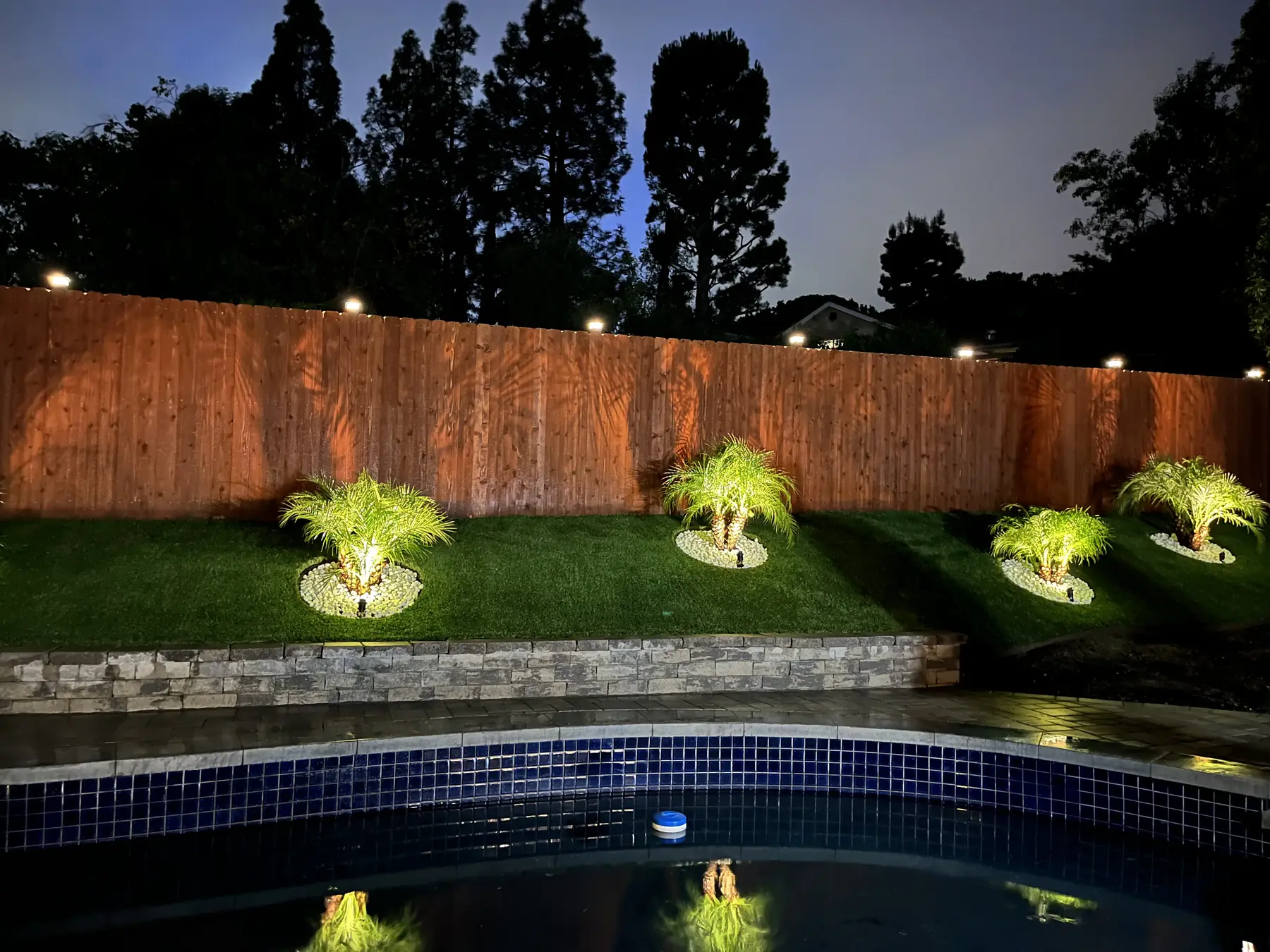
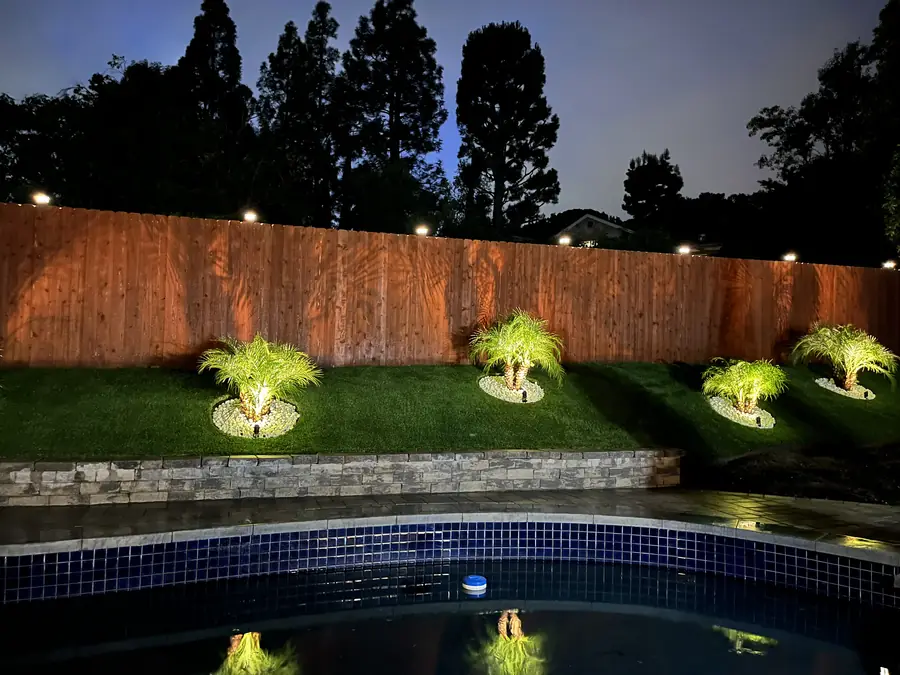
Uplighting places a fixture at ground level aimed upward, so the beam travels up a trunk, a wall, or an architectural feature and draws the eye to it. On a mature tree it highlights the branch structure and canopy, and on the front of the house it adds depth and shadow that flat porch bulbs cannot. Because so many Winnetka lots are compact, a couple of well-aimed uplights on a single specimen tree or the entry can transform how the whole front reads from the street at night.
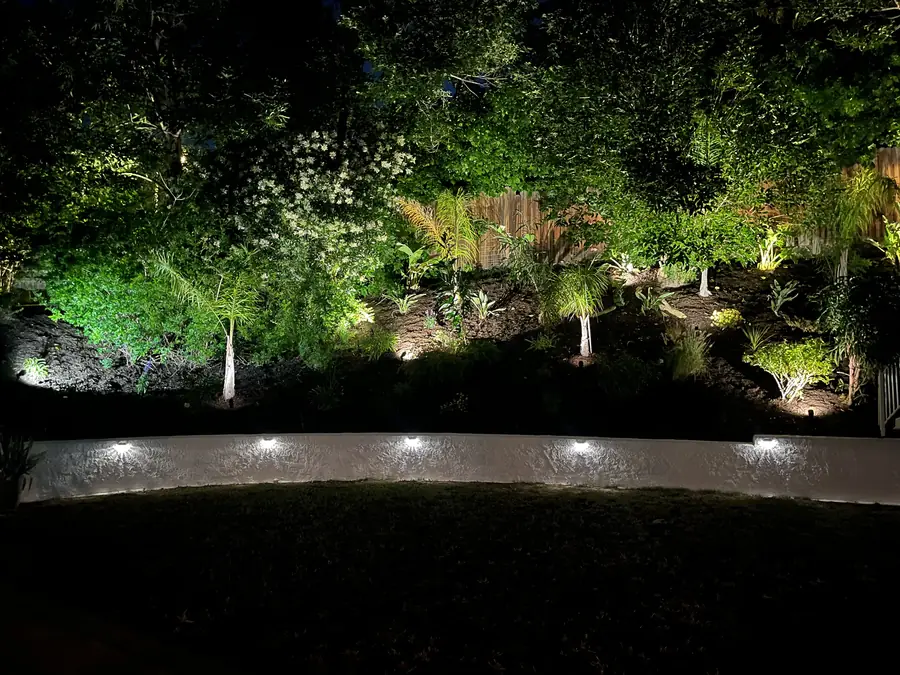
Both techniques light a vertical surface, but they create different effects. Wall washing places the fixture a short distance out and spreads a smooth, even layer of light across the surface, which is flattering for stucco, fences, and privacy walls. Grazing sets the fixture very close to the wall and rakes light along it, so texture in stone, brick, or board-formed concrete stands out in relief. On the block walls that ring many Winnetka backyards, washing softens the boundary while grazing turns a plain surface into a feature.
If your yard has a raised patio, a deck, or any change in level, step and deck lights are worth adding for safety alone. Recessed fixtures set into risers, posts, or the sides of stairs mark each edge so nobody misjudges a step in the dark. They also add a finished, architectural look to an outdoor living area. Many Winnetka homes have a rear slab or a low deck off the back, and a few small step lights there make evening use comfortable without lighting up the entire yard.
Yes, a well-lit exterior removes the dark corners and shadows that make a property easy to approach unseen. Rather than a single harsh floodlight, a layered landscape system spreads gentle light across the front, the side yards, and the path to the door, so the whole lot stays legible at night. This matters on the tightly spaced Winnetka streets where houses sit close together and a dark side yard can go unnoticed. Good lighting also prevents trips and falls, which is the more common everyday safety benefit.
The system runs from a transformer mounted near an outdoor outlet, usually on a garage or exterior wall, which steps household current down to low voltage and feeds the fixtures. Control is up to you. A basic timer switches the lights on at dusk and off at a set hour, while a photocell responds to daylight automatically. If you prefer, a smart controller lets you adjust schedules, brightness, and zones from your phone. For most Winnetka homeowners, a dusk-to-set-time schedule covers daily use, and the smart option adds convenience when you travel.
Voltage drop is the gradual loss of power that happens as electricity travels along a wire, and it is the reason a poorly planned system leaves the fixtures farthest from the transformer looking dim. The longer the run and the more fixtures on a line, the more the voltage falls off. We account for this by choosing the right wire gauge, splitting the yard into sensible zones, and connecting fixtures so each one receives close to its rated voltage. That way the light stays consistent from the first fixture to the last.
The inexpensive kits sold at home centers can work for a handful of lights, but they tend to use thin wire, weak transformers, and fixtures with sealed bulbs that fail as a unit. As you add lights, voltage drop and connection problems show up quickly. A professional install uses heavier wire, proper connectors, a correctly sized transformer, and fixtures built to be serviced. You also get a design that suits your specific lot rather than lights scattered evenly. For a system you want to last, the difference in quality is worth it.
These systems are low maintenance, but they are not maintenance free. Over time, fixtures can settle out of aim as soil shifts, lenses collect dust and mineral film, and plant growth blocks a beam that was clear when it was installed. A yearly once-over to clean lenses, re-aim fixtures, trim back foliage, and check connections keeps everything looking sharp. Quality brass and copper fixtures hold up well outdoors and only improve in appearance as they weather, which is why we favor them over plastic.
For homes and gardens, warm light almost always looks better. Warm white has a soft, inviting tone that flatters stucco, wood, foliage, and skin, and it reads as welcoming rather than clinical. Cool white can look harsh and blue on a house, more like a parking lot than a home, though it occasionally suits very modern architecture or blue-gray plantings. We generally steer Winnetka clients toward a consistent warm tone across the whole system, because mixing temperatures makes a yard look patched together rather than designed.
Not if the system is designed with courtesy in mind, which matters a great deal on the close-set Winnetka lots where houses sit only a short distance apart. We aim fixtures so the light lands on your yard, your walls, and your plantings rather than spilling across the property line. Shrouds, glare guards, and careful placement keep the source of light hidden from view, so you see the effect and not the bulb. The goal is a warm, comfortable glow that improves your home without becoming a nuisance next door.
This is one of the most common reasons Winnetka homeowners call. A flat, open, full-sun lot can look great at midday and then disappear entirely once the sun goes down, so the yard you paid for goes unused every evening. Landscape lighting brings it back to life after dark by shaping the space with pools of light, highlighted trees, and a lit path or patio. Instead of a black rectangle behind the house, you get an outdoor room you can actually enjoy on warm California nights.
It is not a problem, because a low-voltage landscape system does not run on the interior circuits inside your home. We install a dedicated transformer that plugs into or is wired to a single exterior outlet, and everything past that point is separate twelve-volt wiring we install ourselves. That keeps the load off aging original wiring and avoids overtaxing panels that were sized for a smaller mid-century house. If the outdoor outlet itself is old or lacks proper protection, we will point that out so you can have it addressed.
Exterior lighting is one of the more cost-effective ways to lift how a home presents, especially in the evening when a dark house recedes and a lit one stands out. On a dense Winnetka street where homes sit shoulder to shoulder, a thoughtfully lit facade, entry, and front tree give your property a distinct, cared-for presence that neighbors and passersby notice. Buyers respond to it as well, since a home that looks inviting at a nighttime showing leaves a strong impression. Good lighting reads as a finished, well-kept property.
Lighting is one of the few improvements you can add to a mature, planted yard with very little disruption. The low-voltage wire is shallow and can be tucked into bed edges, along fences, and under mulch, so there is no need to tear up an established lawn or garden. We route the runs to follow existing lines in the landscape and keep digging to a minimum. Most Winnetka yards, even ones with established plantings and hardscape already in place, can be lit without undoing the work you have done.
Along with Winnetka, we install landscape lighting in neighboring communities such as Reseda and Canoga Park, so a project near the edge of town is no trouble. As for price, there is no single number, because it depends on the size of your lot, how many fixtures you want, the fixture quality you choose, the length of the wire runs, and the type of control. We walk the property, listen to what you are after, and put a clear written estimate in your hands before any work begins.
Getting started is simple. Call Daniels Landscaping at (818) 443-9300 and tell us a little about your Winnetka property and what you would like your yard to feel like after dark. We will set a time to walk the lot with you, look at the trees, walls, paths, and entry worth lighting, and talk through options and control. From there you receive a free written estimate with the design laid out. One licensed contractor handles the install, and we are fully licensed under California number 1138709.