

FAQ
Landscape Lighting in Hidden Hills, answered
The questions we hear most from Hidden Hills homeowners.
Expect it to. Lighting gets particular attention here because it is visible at night across open, rural feeling property, and the review process looks at fixture finish, mounting height and how much light escapes beyond where it is aimed. That means the plan needs to state what fixtures are proposed, in what finish, at what height, and how spill is being controlled. We prepare that documentation before ordering anything, so approval comes first and installation follows. Choosing fixtures on your own and installing them ahead of review is how homeowners end up pulling them back out.
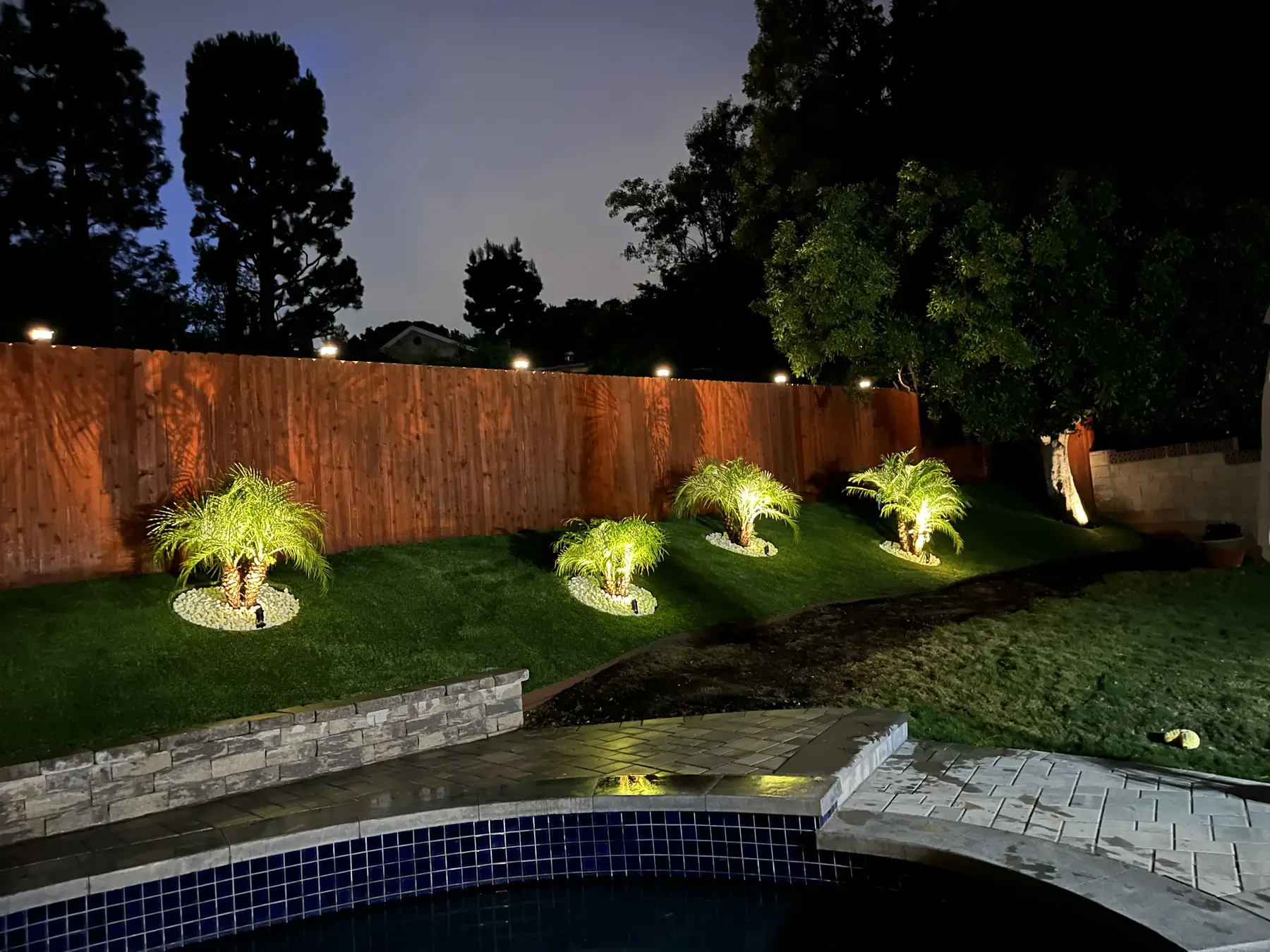
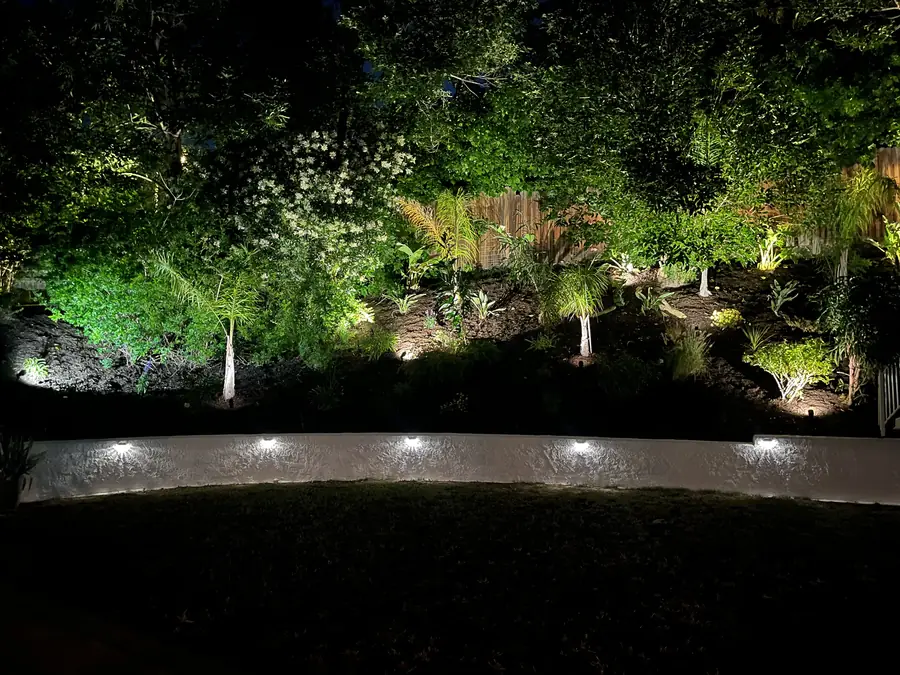
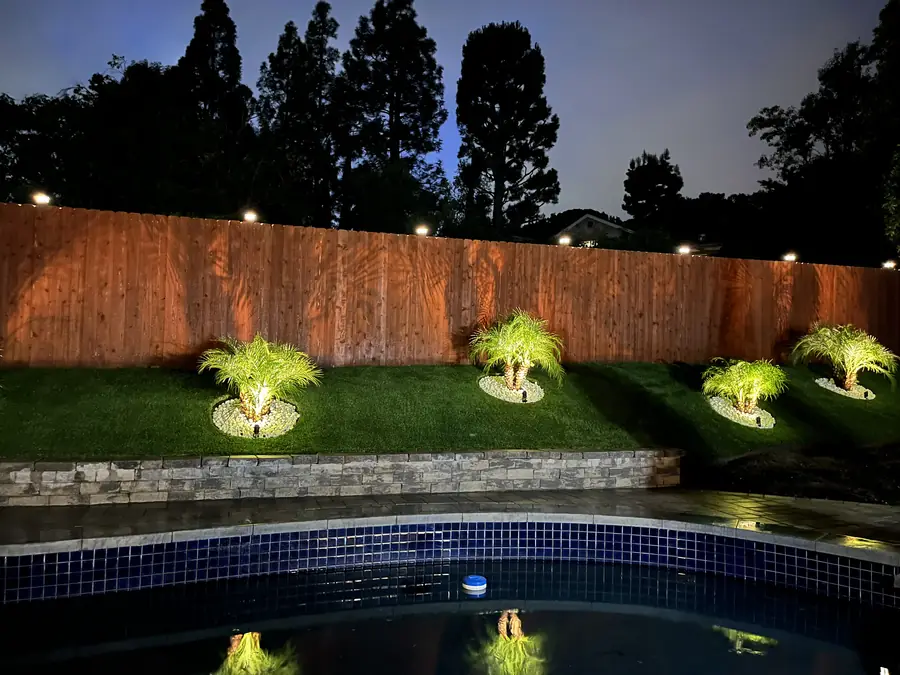
By lighting objects rather than areas, and by using far less output than people assume. The approach is a small number of deliberate targets, a specimen tree, a stone wall face, a set of steps, a gate, each at the lowest lumen level that reads well, with everything else left dark. No floodlights washing across open ground, no fixtures blasting up into the sky past the canopy. Shielded housings, tight beam spreads, careful aiming and glare control keep light on the subject. Done properly the property looks quieter at night, not brighter.
Because of distance and load. A transformer can only feed so much wattage, and low voltage current loses voltage as it travels, so a single unit at the house cannot properly serve fixtures a long way out at the barn, the arena approach or the far gate. On parcels this size the sensible layout is multiple transformers placed near the groups they serve, each with its own runs, rather than one overloaded unit and impossibly long cable. It also means a fault in one area does not take the whole property dark.
Voltage drop is the loss that occurs as current travels down a cable, and it is the single most common reason a low voltage system looks uneven. Fixtures near the transformer run bright while distant ones go dim and shift color, and over time the underfed ones fail early. Long runs are unavoidable on lots like these, so the design compensates: heavier gauge cable, hub style wiring so each fixture gets a similar path length rather than daisy chaining, transformers with multiple voltage taps, and loads calculated on paper before any trenching starts.
Buried at proper depth, in planned routes, with connections made to last. We trench rather than tuck cable under mulch, sleeve beneath any driveway, walkway or paved area so nothing has to be cut later, and keep runs clear of areas that will be dug or planted. Connections happen at waterproof hubs in accessible locations instead of scattered twist connectors buried at random, which is what fails first in older systems. On horse property we route cable away from paddocks and hoof traffic wherever the layout allows.
Yes, and it wants a gentler hand than people expect. Horses react to sharp contrast, glare and sudden pools of brightness, so the goal along a barn approach or riding path is low, even, shielded light that shows the footing without throwing beams into an animal's eyes. Downward directed path fixtures at modest height, step lights at grade changes, and soft wash on a wall do that job. Bright overhead floods create hard shadows that read as holes in the ground to a horse and are worth avoiding.
Muted, natural ones. Finish is specifically part of what gets looked at here, and fixtures that disappear during the day generally fare better than anything bright or reflective. Bronze, weathered brass that patinas toward brown, matte black and natural copper all recede into planting and against stone. Solid brass and copper bodies also survive irrigation and weather far longer than thin aluminum or plastic, so the durable choice and the approvable choice usually point the same direction. We submit the actual specification rather than a generic description.
Kept low and consistent, which is both a design preference and a review consideration. A path fixture exists to put a soft circle on the walking surface, and the taller it stands the more the source itself becomes visible from a distance, which is exactly the spill the city cares about. We use low profile fixtures with hats or louvers that cap the light downward, space them so the pools overlap gently rather than reading as a runway of identical dots, and set them just off the edge of the path.
Yes. Daniels Landscaping performs this work with one licensed contractor. The same people who lay out the plan trench the cable, set the transformers, mount the fixtures and come back at night to aim them. That matters more in lighting than in almost anything else we build, because a system is only as good as the aiming, and the person adjusting a beam should be the person who knows why that fixture was placed there in the first place.
Because a good fixture aimed badly looks worse than a modest one aimed well. Beam angle, distance, height, tilt and shielding decide whether an uplight grazes a trunk beautifully or throws a glaring hot spot into a bedroom window. Cable sizing decides whether the system stays even. Connection quality decides whether it survives five winters of irrigation. Everything that separates a landscape that looks composed at night from one that looks like scattered lamps happens during design and installation, not on the fixture box.
Beam shape and mounting, mostly. A bullet uplight sits above grade on a stake, easy to aim and easy to move, which suits trees whose canopy changes. A well light is buried flush so nothing shows in daylight, ideal at a driveway edge, in paving, or anywhere a stake would be in the way. Wash and flood fixtures spread a wide, soft field across a broad surface such as a stone wall or a hedge. Most properties use all three, chosen per target rather than repeated everywhere.
Control at the fixture, not just at the aim. Glare shields, hoods, honeycomb louvers and recessed lamp positions keep the bright source hidden from normal sightlines while the light still reaches its target. Beam spread gets narrowed to the object so nothing is thrown past it, and uplights on trees are placed and tilted to catch the canopy rather than continuing into open sky. We then walk the property after dark from the neighboring vantage points and adjust anything visible from where it should not be.
It affects placement and coordination. Fire risk is real here, and the cleared band around structures needs to stay clear, so fixtures and cable are routed to work with that clearance rather than encouraging dense planting up against a wall. Buried cable and sealed hub connections are the right practice in any case, and they keep hardware out of surface fuel. Lighting the driveway and approach also has a practical safety value, since a clearly readable entry helps anyone who needs to find the property in the dark.
A photocell senses when daylight fades and turns the system on, while the timer or astronomical clock in the transformer decides when it shuts off, whether that is a set hour or a period after sunset that adjusts through the year. That combination avoids the two annoyances of manual control: fixtures burning at noon, and a schedule that drifts out of step as sunset moves through the seasons. On a property with multiple transformers we keep the settings matched so the whole place does not come on in pieces.
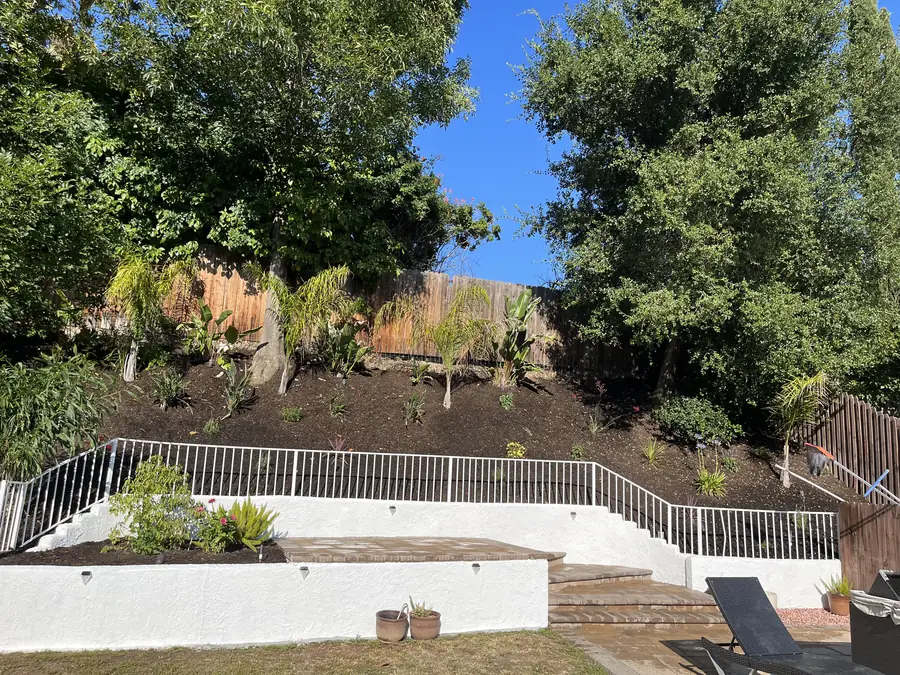
It means giving the eye something at several depths instead of one flat plane. A near layer might be low path lighting and step lights, a middle layer the grazed face of a stone wall or a lit specimen shrub, and a far layer a single uplit oak that anchors the back of the view. Because parcels here are deep, that far layer is what keeps the property from ending in darkness ten feet past the patio. Very little wattage is needed, only placement at different distances.
Yes, and we set it up in advance as part of scheduling. Entry to this city is controlled, so crew access, fixture and transformer deliveries and any trenching equipment are cleared ahead of the start date rather than sorted out at the gate. Lighting work also involves at least one return visit after dark for aiming and adjustment, so that evening access gets arranged too. Owners are often surprised by the night visit, but it is the step that makes the difference in how the system finally looks.
In most cases, yes. Cable can be routed through bed areas with narrow trenching that planting closes over quickly, and sleeves can often be pushed beneath a walkway rather than cutting it. Existing conduit and transformer capacity get checked first to see what can be reused. The parts that are difficult are crossing finished paving with no sleeve in place and reaching outbuildings that no circuit was ever run toward. We map those constraints during the walk so the design works with what is already built.
Call Daniels Landscaping at (818) 443-9300 and we will arrange gate access to walk the property, ideally in daylight and again after dark. We identify the targets worth lighting, measure the runs that drive cable sizing and transformer placement, and note what the architectural review will want regarding finish, height and spill. You receive a free written estimate covering fixtures, transformers, cable, trenching and controls. Our California license number is 1138709, and the crew that designs the system is the crew that installs and aims it.