

FAQ
Landscape Lighting in Lake View Terrace, answered
The questions we hear most from Lake View Terrace homeowners.
A transformer, buried cable, and fixtures selected for the job each one has to do. The transformer takes household current and reduces it to twelve volts, which is what makes the rest of the system safe to bury at shallow depth and safe to work on later without shutting the house down. From there, cable feeds path lights, uplights, well lights, step lights and wash fixtures. Low voltage also means adding a fixture years from now is straightforward, provided the original design left capacity on the transformer and reserve in the wire.
Voltage drop, and on parcels this size it is the single biggest thing separating a good system from a disappointing one. Every foot of cable resists current, so a fixture at the end of a long run receives less voltage than one near the transformer, and LEDs answer by going dim and shifting color. The corrections are heavier gauge wire for the long carry, hub connections that feed several fixtures from one point instead of daisy chaining down a line, and loads balanced across runs so no single leg is asked to reach too far.
Sizing follows the total fixture load with headroom left over, because a transformer running at its limit leaves no room for the additions people always want later. Placement is a balance between reaching a suitable exterior circuit and staying reasonably central to the property, since starting from a far corner means every run is longer than it needs to be. On acreage more than one transformer often makes sense. The twelve volt side is the landscape work, while any new line voltage circuit falls under City of Los Angeles electrical requirements.
Carefully, and slower than most people expect. This ground is alluvial and full of cobble, so a trench that opens easily in soft valley soil stops repeatedly on rock here. Cable goes below the surface at a depth that keeps it clear of ordinary digging and away from anything sharp, sleeved where it passes under a walkway, a driveway or anywhere equipment crosses. Routes are planned along logical lines rather than the shortest one, so future work does not go straight through the run, and slack gets left at every fixture.
Yes, and that is one of the most useful lighting projects out here. Equestrian properties need access routes readable at night when a trailer is backing, a gate is being opened or feed is arriving, and headlights alone do a poor job of showing edges. Low, shielded fixtures along the drive define the pavement without shining into a driver or an animal. Turnarounds, gate posts and pinch points get more attention than straight stretches. Long routes bring wire sizing back into the conversation, since a driveway run leaves the transformer far behind.
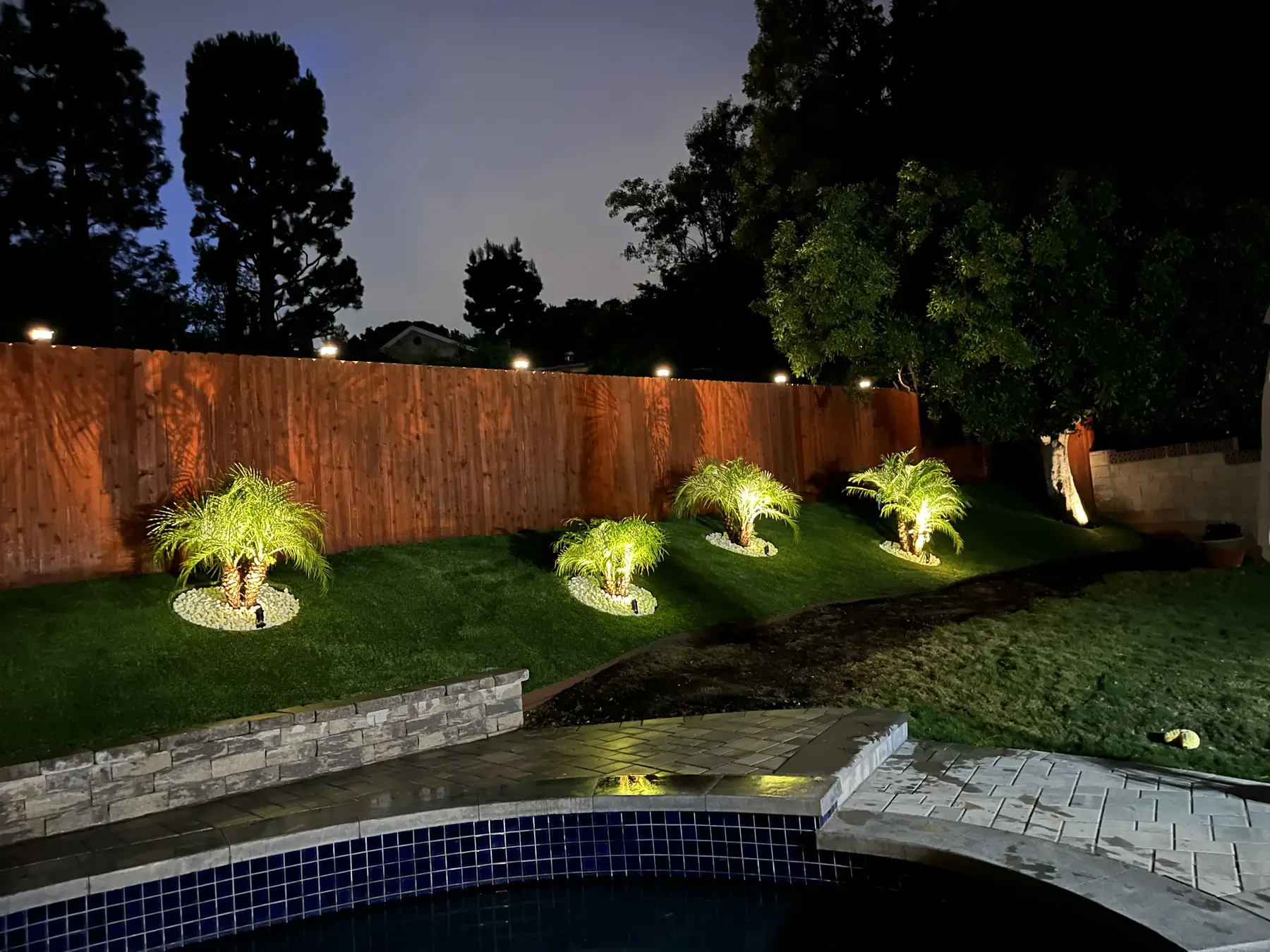
With uplights and bullets placed out from the trunk and aimed up through the canopy, so the branch structure catches light rather than the trunk glowing like a post. Larger parcels below the hills carry big established trees, and they are the best thing to light because the surroundings behind them are dark, which turns a lit canopy into the visual anchor of the whole property. Narrow beams reach tall canopies, wider ones fill lower spread. Two fixtures at different angles usually beat one bright fixture head on.
Well lights sit in the ground with the housing buried and only the lens near grade, so the fixture itself disappears and you see only the effect. They suit open areas where anything above ground would be in the way, meaning lawn, gravel, driveway edges and spots where equipment or animals move through. The trade off is drainage and debris, since a buried housing collects both, so on ground that drains fast we still set them with gravel below and keep the lens clear of settling material.
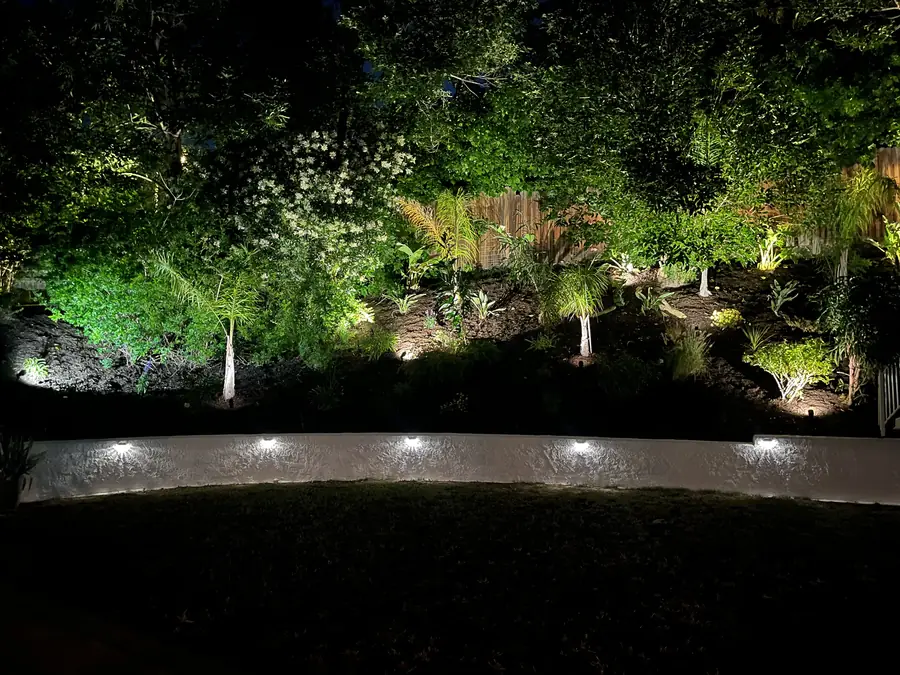
Anywhere the ground changes level, which on properties built into rising ground is more places than an owner tends to notice. Step lights recess into a riser or a side wall and throw down onto the tread, so the edge is visible without a glaring source in anyone eyes. Wall lights mounted low graze along a surface and give shape to a seat wall or a retaining wall after dark. Both work best when the light lands on the walking surface and the fixture itself stays out of the sight line entirely.
Fewer than most catalogs suggest. Path lights are meant to place pools of light where the walking surface needs definition, at turns, at level changes and at junctions, not to line a walk evenly like runway markers. Spacing them too closely produces a monotonous row and a lot of glare at eye height. Shielded heads that push light downward keep the source hidden and the surface lit. On longer walks across open ground, a few well placed fixtures with dark stretches between them read far better than a continuous line.
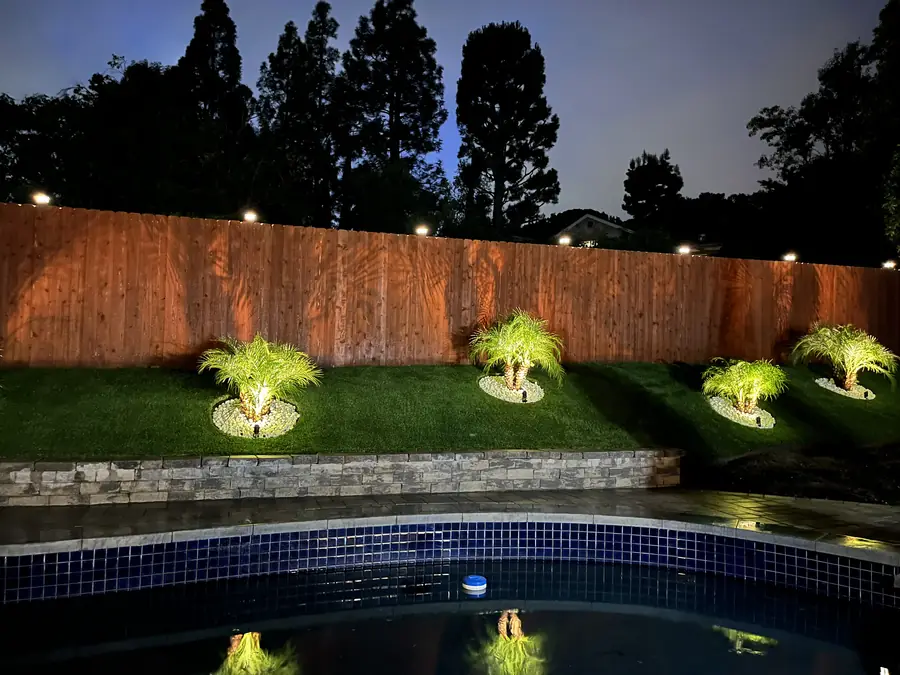
Broad coverage where a narrow beam would look like a spotlight. Wash fixtures spread light evenly across a wall, a fence, a stone face or a mass of planting, giving a background surface presence instead of leaving it as a black void behind the lit foreground. Floods cover working areas where usable light matters more than mood. On large properties the trick is restraint, because washing everything flattens the whole scene. We generally wash one or two surfaces and let the rest of the property fall away into darkness.
By lighting at several depths and leaving gaps between them. Something close to the viewer, something at middle distance, something far out near the property edge, and darkness in between is what creates the sense of depth. If every fixture sits at the same distance and brightness, the property reads as a wall of light with no dimension. Varying intensity matters as much as position, so a few brighter focal points carry the composition while everything else supports quietly. Large parcels give you far more room to work this way.
Through shielding, aiming and placement, in that order. A fixture with a recessed lamp and a cowl or a glare guard hides the source so what you notice is the lit surface. Aiming happens after dark with the system running, because a fixture set in daylight is a guess. We walk the property, adjust each one, look back from the driveway, from the windows and from wherever people actually sit, and keep adjusting. Fixtures also get positioned so nothing points straight at a seating area, a neighbor or a road.
No, and it is worth saying plainly. Good fixtures installed poorly look bad, while modest fixtures aimed and wired properly look excellent. What decides the result is placement, aiming, shielding, correct wire gauge for the run and connections that survive being buried. That said, housing material and sealing do matter for lifespan, and consistent color temperature across fixtures matters for appearance, because a system mixing warm and cool sources looks unintentional. Buy sound fixtures, then spend the attention on how and where they go in.
Usually a timer at the transformer, a photocell, or a combination of both. A photocell senses darkness and switches the system on as light falls, which keeps pace with the seasons automatically. A timer handles the off, so the property is not lit at three in the morning for nobody. Astronomical timers calculate sunset for your location and shift through the year without adjustment. Zones can be split so an access route and a driveway stay on later while decorative lighting shuts down earlier, which is worth doing on working properties.
Most often a connection rather than a fixture. Buried splices that were never made watertight corrode, a run gets cut by digging or a fence post, or the transformer trips because a damaged cable is shorting. Because a single hub can feed several fixtures, one bad connection takes out a group at once, which is actually useful for tracing the fault. Diagnosis starts at the transformer and works outward run by run. Systems built with proper hub connections and quality splices give far less trouble than daisy chained ones.
It is worth factoring in. At the wildland interface, what is planted near a structure and how clear that zone is kept are real considerations, and lighting sits right in that area. That argues for keeping fixtures out of dense growth against a building, running cable along clean routes where clearance work will not chop through it, and choosing placements that stay serviceable when planting near the house is thinned or maintained. Lighting is not a fire measure, but it should not fight the clearance you are trying to keep.
One licensed contractor stays accountable for all of it. Daniels Landscaping stays accountable for the work. The same people who lay out the design dig the cable routes, make the connections, mount the transformer, set every fixture and come back after dark to aim them. Lighting rewards that arrangement more than most trades, because the person who chose where a fixture goes is the one standing behind it at night deciding whether the effect is right. If something needs adjusting a year later, the same company shows up.
Call Daniels Landscaping at (818) 443-9300 and we will walk the property, discuss what you want lit and where power is available, and take the distances that drive wire sizing. You then receive a free written estimate covering fixture types and counts, transformer capacity, cable runs, controls and the aiming visit after dark. We hold California license 1138709. Nothing gets ordered or scheduled until you have gone through that estimate and told us to proceed.