
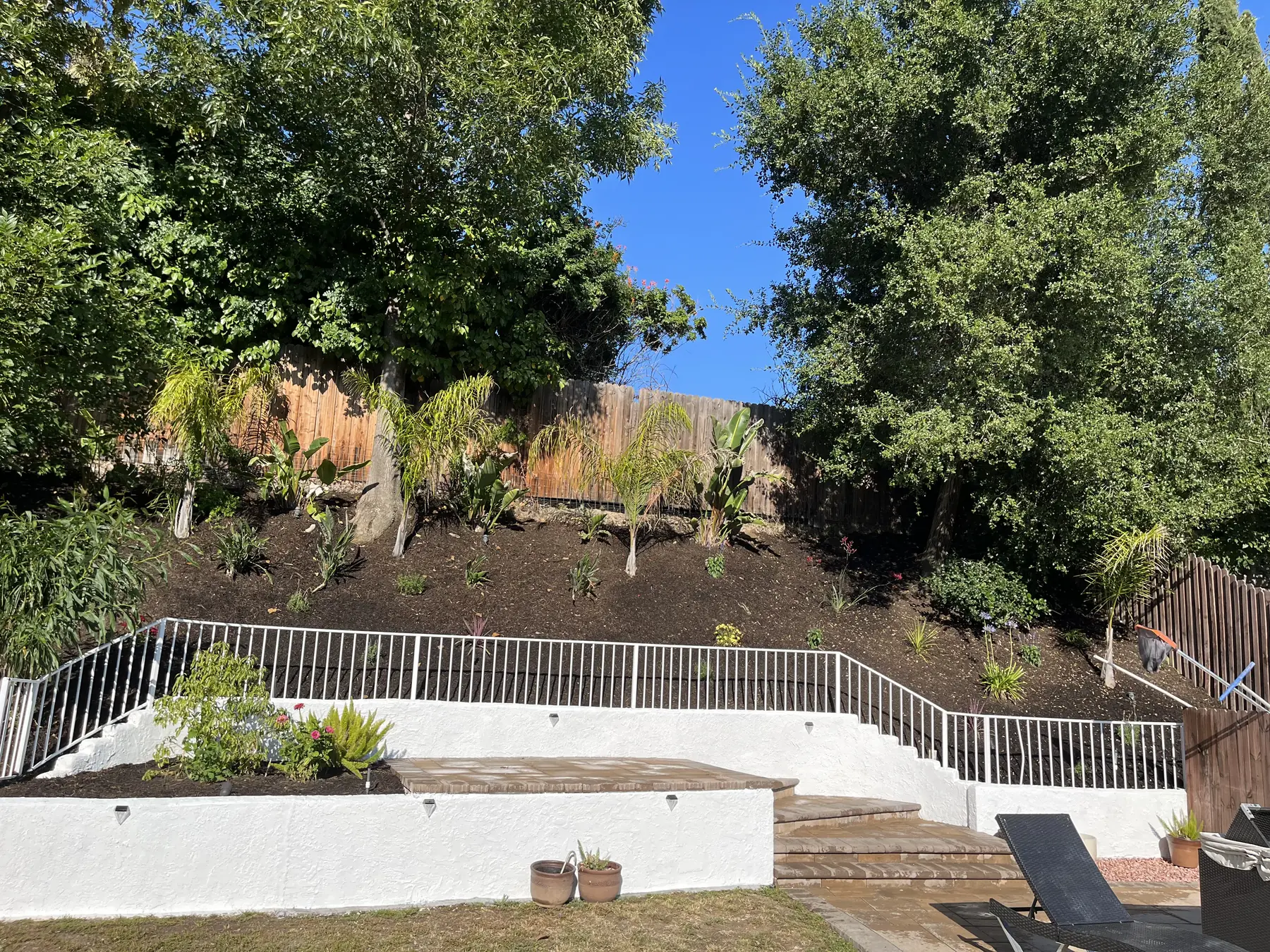
Landscaping is everything that turns a bare or worn out yard into a finished one. It is the grading and drainage under the surface, the soil that plants actually grow in, and then the planting, sod or turf, borders, mulch or gravel, and irrigation on top. This is the living, growing side of a yard. The built side, the pavers, walls, and concrete, is hardscaping, and most real yards need both planned together so the grades, drainage, and materials work as one.
What does a full landscaping job include?
A full job runs in layers, from the ground up. First is grading, shaping the dirt so water runs away from the house and toward where you want it, not into a foundation or a low corner that turns to mud. Then drainage, the pipes and channels that carry off the two or three real storms a year. Then soil preparation, because native ground is often compacted clay that roots cannot push through.
On top of that comes the part you see: planting, a lawn of real grass or artificial turf, mulch or gravel over the bare soil, borders and edging, pathways, and an irrigation system sized to keep all of it alive. A renovation does the same work on part of a yard while leaving the rest in place.
What is the difference between landscaping and hardscaping?
Landscaping is the soft, living side: soil, plants, lawn, and the water that feeds them. Hardscaping is the built side: pavers, retaining walls, concrete, stone, and gravel. A patio is hardscaping. The planting bed beside it is landscaping.
Most yards are a mix, and the split matters for planning, because the two are installed in a set order. You do not want to plant a bed and then trench through it a week later to build a wall. When both are in the plan, the work is sequenced so nothing finished gets torn up to reach something else. If your project leans toward the built side, our hardscaping page covers pavers, walls, and concrete in detail.
Which plants suit a hot, dry inland climate?
Inland Southern California is hot and dry for a long stretch of the year, and the plants that do well are the ones built for it: drought tolerant natives, Mediterranean shrubs, ornamental grasses, succulents, and low water ground covers. The trick is grouping plants by how much water they want, so a thirsty bed and a dry bed sit on separate irrigation rather than fighting each other on one valve.
A yard planned for a cooler coastal lot, full of lawn and plants that want steady summer water, tends to look tired and cost a fortune to keep alive once it is inland. Choosing plants that belong here is the single biggest thing that keeps a yard looking good and a water bill sane.
Lawn, artificial turf, or drought tolerant planting?
This is the choice most yards come down to. A real grass lawn is soft and cool underfoot, but it wants regular water and mowing, and through a hot inland summer that adds up fast. Artificial turf stays green with no water and no mowing, at a higher cost up front, and it suits pets, play areas, and small yards especially well. Our artificial turf page goes into the types and the base underneath.
Drought tolerant planting replaces lawn with layered beds of low water plants, gravel, and boulders, which reads fuller than a lawn once it grows in and often qualifies for a water district rebate. Plenty of yards use a mix: a small patch of turf where the kids play, drought tolerant beds around it.
Why does the work under the ground matter most?
The parts of a yard nobody sees, the grading, the drainage, and the soil, decide whether everything on top survives. Plants set into compacted clay with nowhere for roots to go will struggle no matter how healthy they looked at the nursery. Water that pools against the house because the grade runs the wrong way will rot plants and, worse, find the foundation.
This is why a cheap job that skips straight to planting looks good for one season and falls apart in the second. Getting the base right costs more at the start and saves the whole yard later.
What order does a landscaping project run in?
It starts with a walkthrough and a plan, so the layout, the grades, and the plant choices are settled before anyone digs. Then the yard is cleared of whatever is going. Grading comes next, shaping the ground, followed by drainage and the rough plumbing for irrigation.
If there is hardscape, pavers or a wall, most of it goes in around this point, while access is still open. Then soil is prepared and amended, irrigation is finished, and planting goes in, from trees down to ground cover. Mulch or gravel goes on last, along with edging and any lighting. Done in this order, nothing finished has to be dug up to reach something underneath.
Where do we do landscaping?
We install landscaping across the San Fernando Valley. See the detail, local projects, and pricing for your city:
- Landscaping in Arleta
- Landscaping in Burbank
- Landscaping in Calabasas
- Landscaping in Canoga Park
- Landscaping in Chatsworth
- Landscaping in Encino
- Landscaping in Granada Hills
- Landscaping in Hidden Hills
- Landscaping in Lake View Terrace
- Landscaping in Mission Hills
- Landscaping in North Hills
- Landscaping in North Hollywood
- Landscaping in Northridge
- Landscaping in Pacoima
- Landscaping in Panorama City
- Landscaping in Porter Ranch
- Landscaping in Reseda
- Landscaping in San Fernando
- Landscaping in Sherman Oaks
- Landscaping in Studio City
- Landscaping in Sun Valley
- Landscaping in Sunland Tujunga
- Landscaping in Sylmar
- Landscaping in Tarzana
- Landscaping in Toluca Lake
- Landscaping in Valley Glen
- Landscaping in Valley Village
- Landscaping in Van Nuys
- Landscaping in West Hills
- Landscaping in Winnetka
- Landscaping in Woodland Hills