

FAQ
Landscape Lighting in Valley Glen, answered
The questions we hear most from Valley Glen homeowners.
A transformer, buried cable, connections, and fixtures. The transformer mounts near a power source and drops 120 volt house current to a safe 12 volt. Cable leaves it in one or more runs, buried below grade, feeding fixtures through waterproof connections. From there it is a matter of what you light: trees, the front of the house, a walkway, a seating area, a specimen plant. Everything downstream of the transformer is low voltage, which is why it can run through a planted yard safely and be adjusted later without tearing anything up.
By layering, since there is nothing else to work with. On a sloped property you can light from above or below and the terrain does half the work. Here the ground is level, so we build the illusion deliberately: something close and low near the house or patio, something at mid distance like a shrub mass or a wall grazed with light, and something tall and far, usually a tree uplit at the back of the lot. Your eye reads those three distances as depth. Skip a layer and the yard goes flat and dark behind whatever is nearest.
Usually fewer than people expect. Path lights along the walkway, spaced generously and staggered rather than lined up like runway markers. One or two uplights on whatever tree or architectural feature the front actually has. A soft wash on the house number and entry so guests can find the door. These postwar homes have simple, low horizontal facades, and lighting them gently along that horizontal line flatters them far more than a bright even blast across the whole front elevation does.
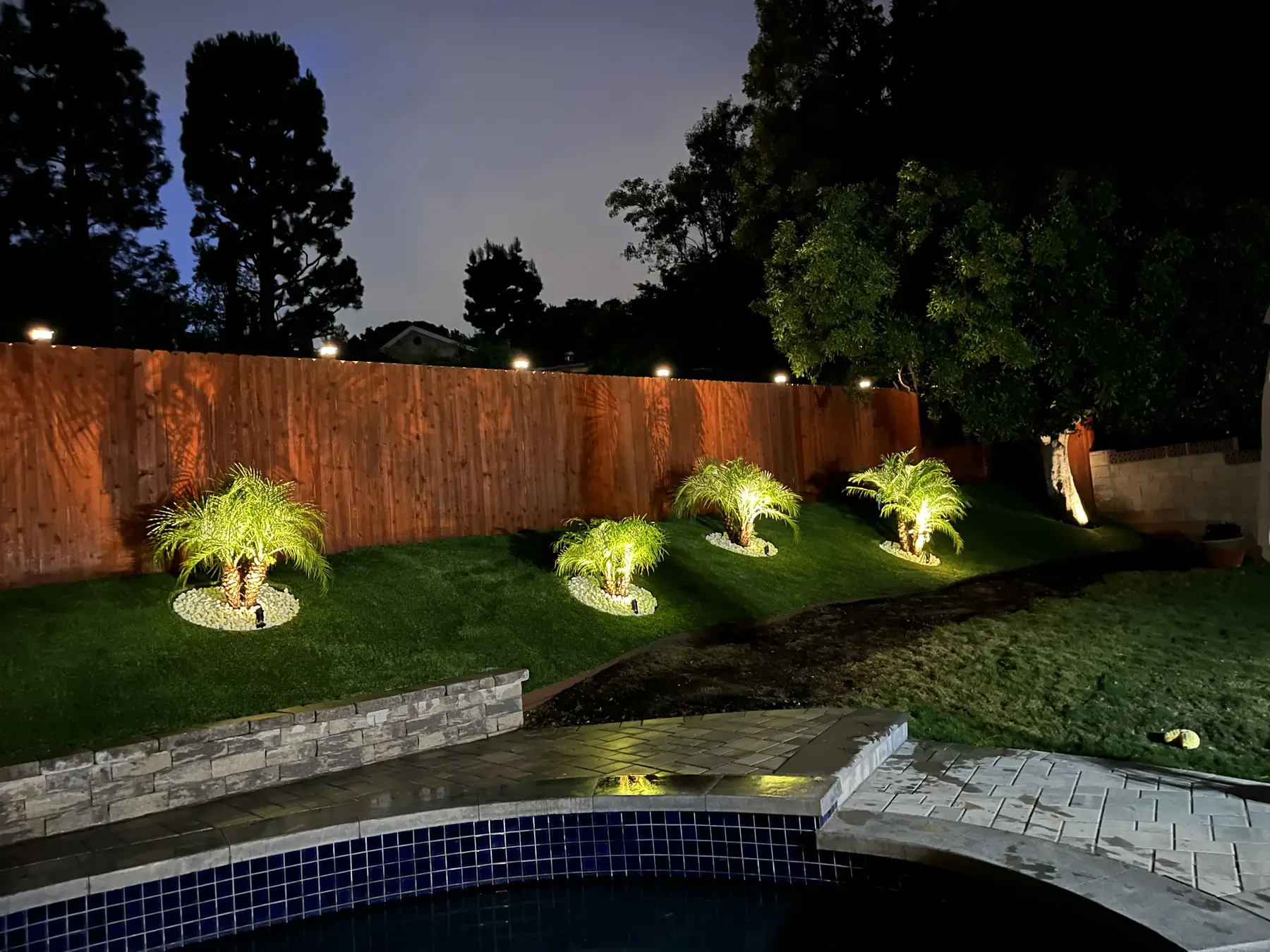
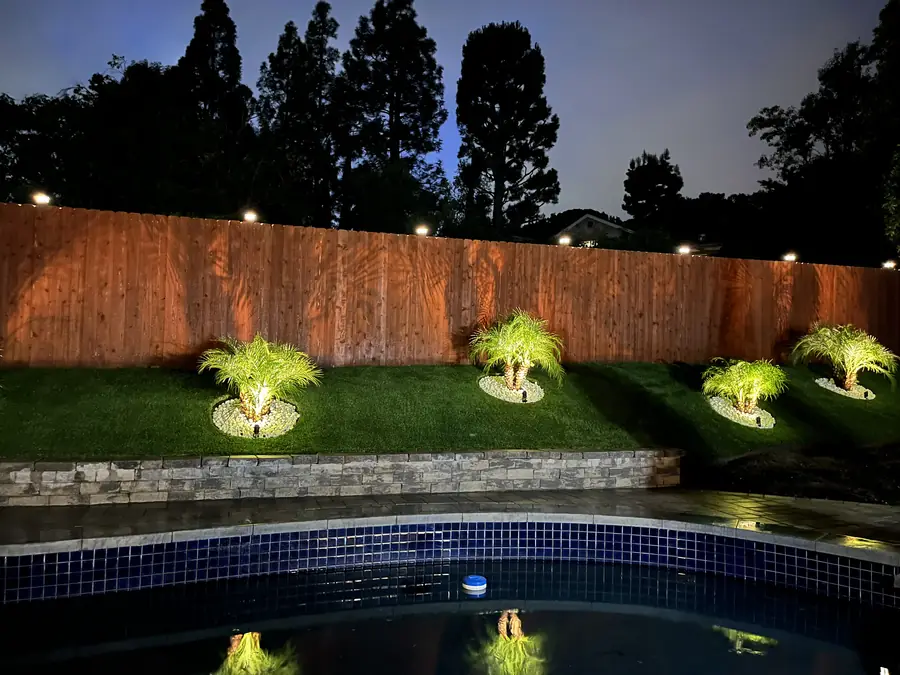
Carefully, because the neighbors are close and the lot is not big. We set bullet fixtures at the base, generally two or three around a mature tree rather than one, angled up into the canopy from outside the drip line so the beam catches structure and leaf rather than throwing straight past into the sky. Beam spread gets chosen for the tree, narrow for a tall trunk, wider for a spreading canopy. Fixtures are placed where foliage or a shrub hides the housing, so what you see at night is a lit tree, not a lamp on the ground.
Any time the hardware itself has to vanish from view. A well light sits in a housing sunk flush with grade, so nothing stands above the ground line. That is the right answer in a narrow side yard, along a driveway where a mower or a car passes, in a turf or gravel area where a staked fixture would be in the way, and anywhere the daytime look matters as much as the night one. Bullets stay easier to aim and re aim, so we use those where the target is a growing plant that will change shape.
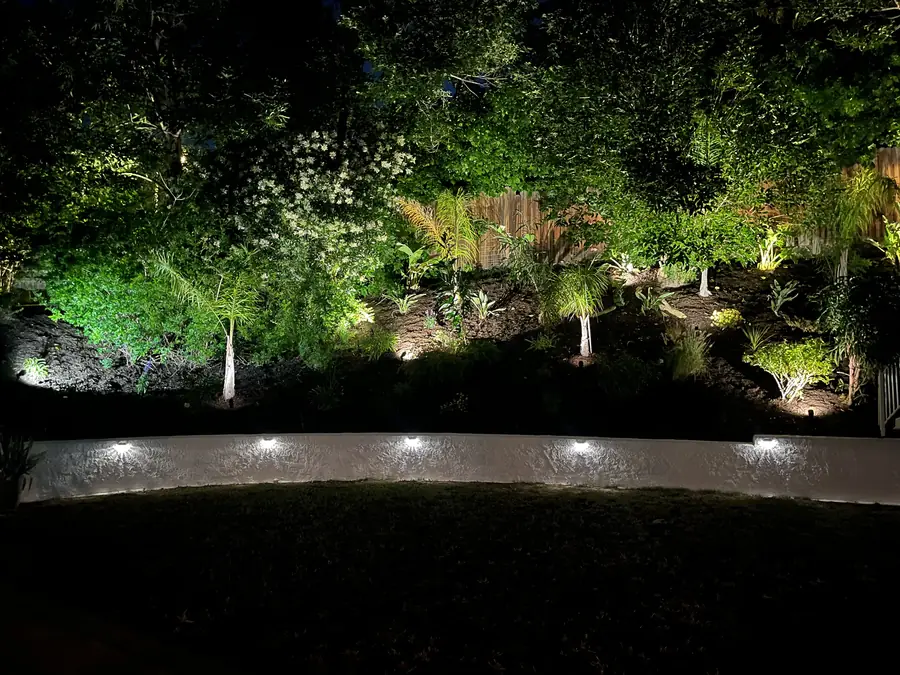
Grazing and washing surfaces at low level. On a level lot there are few grade changes to mark, so the low layer of the scheme comes from light played across vertical planes instead: a fence line, a block wall, a seat wall face, a hedge. Fixtures mounted low and aimed along the surface pick up texture and give the eye something to land on near the ground. Where a single low step or a raised patio edge does exist, it gets marked, because an unlit change of level is the one real hazard in a flat yard.
Quite a lot, and it is one of the better returns in the whole scheme. A wide wash across stucco makes the elevation read as a lit plane instead of a dark backdrop, and grazing a textured surface from close in throws shadow that gives it relief it does not have in daylight. The trick is restraint and warmth. Too much output turns the facade into a billboard. Enough to lift it just above the surrounding darkness, with the tree and path layers reading in front of it, is what makes the whole yard look considered.
This comes up regularly on houses of this vintage. The transformer needs a 120 volt source, and if there is no convenient exterior receptacle, one gets added in a weatherproof enclosure on an appropriate circuit, or the transformer is mounted where an existing source can reach it safely. We place the unit somewhere accessible and out of sight, commonly on a side wall near the panel or garage, so cable runs start from a sensible point. We sort this out during the walk rather than discovering it on installation day.
Less than on a large estate lot, which is a genuine advantage here. Voltage drop is the loss of voltage over the length of a cable run, and a fixture at the far end of a long undersized run receives less than 12 volts and burns dim and off color. Lots in this neighborhood are compact, so runs stay short. We still size the cable to the load, split the system into multiple runs instead of one long one, and use the transformer taps to bring each run into the correct range.
Slowly and by hand where it matters. Many of these properties still have their original irrigation running through the yard, and nobody has an accurate map of it. We trench the cable below grade at a consistent depth, working carefully in areas where old lines are likely, and route around root zones of mature trees rather than cutting through them. Where the run has to cross a walkway, it goes under in a sleeve. If we do nick something old and brittle, we repair it properly rather than patching over it.
Through hub connections rather than a long daisy chain. A hub is a single connection point where several fixtures are fed off one location on the main cable, which keeps each fixture roughly the same distance electrically from the transformer and gives you even brightness across the group. Every connection is a proper waterproof one, buried and sealed, not a wire nut wrapped in tape. Connections are the number one failure point in low voltage lighting, and they are exactly the part you never see once the job is finished.
They are what we install, and for good reason. LED draws a fraction of the wattage of the old halogen lamps, which means far more fixtures on a single transformer and much less heat sitting in the housing. Lamp life is long enough that relamping stops being an annual chore. The thing worth specifying is color temperature. A warm output flatters planting, stucco and stone. Cooler light reads clinical outdoors and makes a residential yard look like a parking structure, so we keep the whole system consistent and warm.
The good ones do. Ultraviolet load here is heavy and constant, and afternoon surface temperatures on a west facing wall or an open bed are high, which is hard on plastic housings, gaskets and lens seals. Cheap fixtures chalk, cloud over and let water in within a few seasons. We specify solid brass or copper bodies, which weather to a patina instead of degrading, with sealed lenses and serviceable lamp modules. Paying at the fixture level is what keeps a system from needing wholesale replacement while the wiring underneath is still perfect.
Some combination of photocell and timer. A photocell reads ambient light and brings the system on at dusk, which beats a fixed clock time because sunset moves through the year. A timer then shuts it down at whatever hour you choose, so the yard is not lit at three in the morning for nobody. Astronomical timers do both from the calendar. We set it up so you are not adjusting anything seasonally, and everything can be overridden by hand when you are entertaining late.
Aiming and shielding, both of which happen at night after the system is energized. Houses on these blocks sit fairly close together, and a fixture aimed thoughtlessly puts light straight into a bedroom window across the fence. We use glare guards and hoods on uplights, set fixtures so the source is not visible from the sidewalk or a neighboring yard, and adjust each one on site while looking at the actual result. The intent is that you see what is lit and never the thing doing the lighting.
Because the fixture is the easy part. Two yards can carry identical hardware and look nothing alike, and the difference is in decisions: how many layers the scheme has, where each fixture sits, how it is aimed, whether the runs are sized so everything burns at the same brightness, whether the connections are sealed to last. A modest fixture placed and aimed well beats an expensive one pointed at the wrong thing. On flat ground like this, where nothing is handed to you by the terrain, that gap is even wider.
Staging works well, and low voltage is built for it. We size the transformer and lay the main runs for where the system will eventually go, then energize the front yard or the patio first and extend later without digging up what is already in. As for who does it, one licensed contractor handles all of it. Daniels Landscaping stays accountable for the work. The people trenching the cable, setting the fixtures and aiming them at night work under one licensed contractor.
Call (818) 443-9300 and we will walk the property with you. We look at what is worth lighting, where power can come from on an older house, how the layers should build across a flat lot, and where cable can run without hitting the old irrigation. You receive a free written estimate covering the transformer, the runs, the fixture types and counts, and the aiming visit. Daniels Landscaping holds California license 1138709, and every question about the system goes to us directly.