
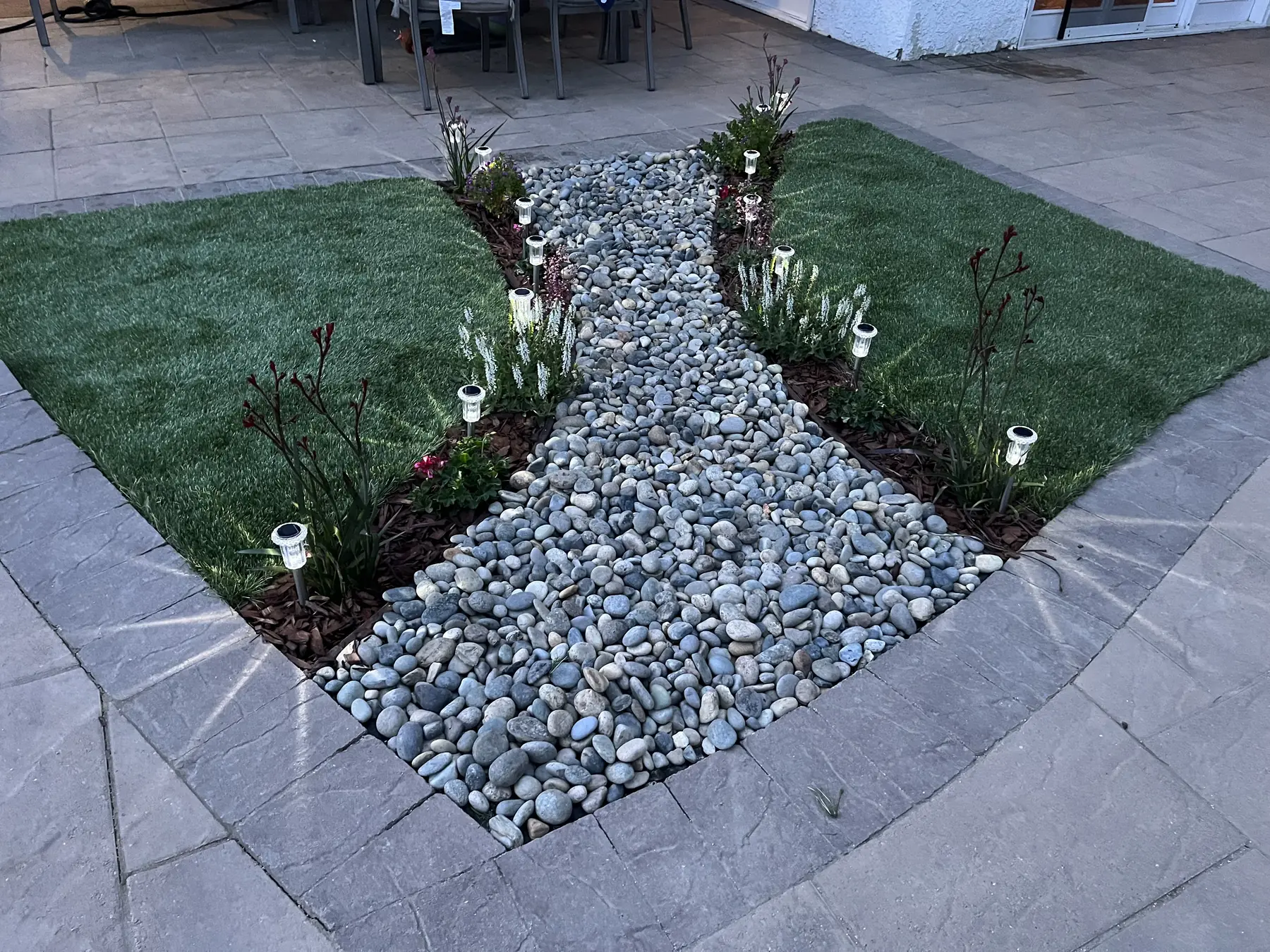
This is a planting island set into a stamped concrete pool deck, a rectangular opening in the paving with the pool immediately alongside it and a planted slope rising behind. The finished layout runs a river rock dry creek bed straight down the middle, with a panel of artificial turf either side, mulched planting beds along both edges, and staked path lights through the borders.
The obvious version of this job is turf across the whole opening. What was built instead handles the water better, needs no mowing in a strip a mower cannot reach, and gives the pool deck something to look at. This walks through why, and how each part is built.
What was actually there to work with?
A rectangular opening in stamped concrete, longer than it is wide, sitting in a pool deck. Before the work it held a patchy remnant of lawn on bare compacted soil, the kind of strip that never establishes because it is too narrow, too shaded at the edges, and walked across constantly.
The surround was already down and staying, which sets the constraint for everything else. The finished surface has to meet that concrete flush, because a lip at the edge of a pool deck is exactly what catches a wet foot.
An opening like this also collects water. The paving around it sheds everything that lands on it toward the one soft area in the middle, so whatever goes in that rectangle is taking runoff from a surface many times its own size, and it is doing that right next to a pool.
Why a dry creek bed rather than turf across the whole thing?
Three reasons, and drainage is the first. A dry creek bed is a channel of rounded cobble over a prepared base, and it gives all that runoff somewhere deliberate to go and somewhere to sit and soak while it drains away. Turf across the full width would have taken the same water with nowhere to route it, and the low point would have stayed soggy after every real storm, next to a pool deck people walk on barefoot.
The second is proportion. A narrow rectangle filled with one material reads as narrow. Splitting it lengthways into three bands, turf, rock, turf, gives the eye something to travel along, and the opening reads as a designed feature rather than a leftover gap in the paving.
The third is upkeep. Rock needs no mowing, edging, watering, or replacing. In a strip that narrow a mower would not fit anyway, so a full turf field would have meant hand trimming the edges forever, and grass clippings beside a pool are their own problem.
Swapping lawn for river rock and low-water planting is also the water-wise move. The EPA WaterSense program recommends exactly this kind of drought-tolerant landscaping to cut outdoor water use. See our landscaping work for more.
How is a dry creek bed built so it does not sink or scatter?
It is more than tipping rock into a trench, which is what a lot of them are. The channel gets excavated well below the finished level so the cobble sits down in the space rather than mounding above it. A compacted base goes in the bottom, then a permeable fabric so the rock cannot work its way down into the soil over the years, which is the usual reason a rock bed slowly disappears.
The cobble wants a mix of sizes. This bed uses rounded river rock in mixed greys, blues, and tans at a range of diameters rather than one uniform grade. Mixed sizes lock together and stay put. Uniform small gravel migrates, especially when water runs through it, and ends up scattered across the paving.
The edges keep it honest. Both sides are held by a mulched planting border with edging beneath, so the rock has something to stop against instead of creeping into the turf.
How does artificial turf get cut to fit shapes like that?
The two turf panels here are not rectangles. They are cut to angled shapes that follow the creek bed on one side and the concrete on the other, and that is where a turf install stops being simple.
The base preparation is the same as any install. Excavate, regrade, then crushed base compacted in lifts and screeded flat. The difference on a shaped panel is the cutting and the edges. Turf is laid oversized and trimmed to the line from underneath, so the cut is clean and the blades are not sheared off along the edge. Every panel edge then gets fastened down, because an unsecured edge on a shape this narrow will lift inside a season.
One detail worth noticing: the turf meets the stamped concrete dead flush, with no step and no gap. That is the base being set at the right depth before anything was laid, and it is the difference between an install you notice and one you do not.
That cutting and seaming is the same method we use on every artificial turf install, just at a tighter radius here.
What is planted along the borders, and why that choice?
The borders are mulched beds running both sides of the rock, planted with low material that stays in scale with the space. There is kangaroo paw, the tall red stems, alongside white flowering spikes and low spreading ground cover, over a fine bark mulch.
That palette suits a courtyard for practical reasons. Everything in it stays small enough not to overwhelm a narrow bed, none of it drops heavy leaf litter onto the rock or the paving, and all of it handles the reflected heat that comes off concrete on three sides. An enclosed paved courtyard runs hotter than open ground, and plants picked for an open garden bed will struggle in one.
The mulch is doing real work rather than decoration. It holds moisture at the root in a spot that dries fast, and it stops the soil washing into the rock channel every time the bed takes runoff.
Why put lighting in a space this small?
Because a courtyard is looked at far more than it is walked through. This one sits directly outside a set of patio doors, so it is on view from inside the house every evening, and an unlit rectangle outside a lit room reads as a black hole in the glass.
The fixtures are staked units set through the planting borders on both sides, spaced along the length rather than clustered. Lighting the borders rather than the channel is the right call. It grazes the planting, throws the texture of the cobble into relief from the side, and keeps the fixtures from glaring back at anyone looking out.
The principle holds at any scale. Light the edges and the texture, not the middle. There is more on how we approach it on our irrigation and lighting page.
Would this work in a bigger yard?
The dry creek idea scales up well and is one of the more useful things you can do with a low spot or a route where water already runs. On a larger property it can run tens of feet, carry a real volume, and be the drainage solution rather than sitting alongside one.
What does not scale is the proportion trick. In a narrow opening, splitting the space lengthways makes it read as intentional. In a wide open yard, a straight channel down the middle just cuts the lawn in half. Out there the same feature wants to curve, follow the natural fall of the ground, and disappear behind planting rather than running dead straight.
If you have a corner that stays wet, a strip too narrow to mow, or a paved area draining into one soft patch, this is usually the answer. It falls under our landscaping and hardscaping work.
Where do we do landscaping?
We install landscaping across the San Fernando Valley. See the detail, local projects, and pricing for your city:
- Landscaping in Arleta
- Landscaping in Burbank
- Landscaping in Calabasas
- Landscaping in Canoga Park
- Landscaping in Chatsworth
- Landscaping in Encino
- Landscaping in Granada Hills
- Landscaping in Hidden Hills
- Landscaping in Lake View Terrace
- Landscaping in Mission Hills
- Landscaping in North Hills
- Landscaping in North Hollywood
- Landscaping in Northridge
- Landscaping in Pacoima
- Landscaping in Panorama City
- Landscaping in Porter Ranch
- Landscaping in Reseda
- Landscaping in San Fernando
- Landscaping in Sherman Oaks
- Landscaping in Studio City
- Landscaping in Sun Valley
- Landscaping in Sunland Tujunga
- Landscaping in Sylmar
- Landscaping in Tarzana
- Landscaping in Toluca Lake
- Landscaping in Valley Glen
- Landscaping in Valley Village
- Landscaping in Van Nuys
- Landscaping in West Hills
- Landscaping in Winnetka
- Landscaping in Woodland Hills