
FAQ
Artificial Turf in Studio City, answered
The questions we hear most from Studio City homeowners.
The base is the majority of the job. Existing sod and topsoil are removed to a workable depth, the exposed subgrade is graded so water has somewhere to go, and crushed aggregate is placed in lifts and compacted, each lift before the next. The top of that base is screeded smooth, because every dip and ridge underneath will read through the finished surface. Turf goes on last. A synthetic lawn that looks lumpy or holds puddles almost always has a base problem, and there is no way to fix that from the top.
Face weight is the weight of yarn in a given area of turf, not counting the backing. It is the closest single number to density. Higher face weight means more fiber packed into the same space, which generally translates to a fuller look and better resilience under repeated foot traffic. Lower face weight products cost less and can be perfectly appropriate for an area that is looked at more than walked on. Face weight is worth comparing across products, but it should be read alongside pile height rather than on its own.
Pile height is the length of the blade from backing to tip, and longer is not automatically better. Very tall pile looks lush when new but tends to lie over and mat down where people walk regularly, and it is harder to keep standing upright. Shorter pile stays more uniform and recovers better in high traffic areas and around pets. Mid range heights suit most residential lawns. The right answer depends on how the space gets used, and we would rather match it to the actual use than default to the tallest option.
Yes, more than most people expect. Blades are extruded in different cross sections, and the shape determines how stiff the individual fiber is and how it handles light. Shapes with a spine or a fold resist bending, so the lawn stands back up after being walked on instead of staying flattened. Flatter blade profiles are softer underfoot but lie down more readily. Shape also affects glare, since some profiles reflect light in a way that reads as artificial. Seeing samples in daylight tells you more than any specification sheet.
Infill is granular material brushed down into the turf after it is laid, settling between the blades at the base. It weighs the turf down so it stays flat against the base, holds the fibers upright so the lawn does not look matted, protects the backing from sun exposure, and adds a little cushion. Skipping it or under filling produces a lawn that looks pressed down within months. Different infill materials exist and they suit different situations, particularly where pets are involved. It is topped up occasionally over the years.
Straight down. Quality turf has a perforated backing with drainage holes across the whole sheet, so rain and hose water pass through the turf rather than pooling. Below that, the compacted aggregate base is permeable and the subgrade beneath is graded so water keeps moving toward a low point or a drain. On a sloped property that path needs to be worked out deliberately. When a synthetic lawn holds water, the cause is virtually always the base or the grading below, not the turf itself.
No. The crew that shows up is ours, employed directly by us, from excavation through the final brush out. We do not farm any portion of this out to another company. With turf that is particularly meaningful, because the difference between a lawn that looks convincing in five years and one that does not comes down to base preparation, seam work, and infill, none of which are visible once the job is finished. One crew doing all of it means one standard throughout and one company answering to you afterward.
Rolls come in fixed widths, so most lawns require joining two or more pieces. A seam done well is genuinely hard to find. That requires laying every piece with the blade direction running the same way, since turf has a grain and pieces oriented differently will read as two shades of green. The edges are trimmed precisely, joined, and secured, and infill is worked across the joint so nothing telegraphs. Where the layout allows, we plan seam placement to fall away from the main sight lines into the yard.
The perimeter is fastened with nails or spikes driven through the turf into the compacted base at close spacing, which is what keeps the edge from lifting or creeping. Where turf meets a paved surface or a wall, it can often be tucked and secured against that edge cleanly. Where it meets a planting bed, a physical edging holds the boundary and prevents soil and mulch from spilling onto the lawn. Edge detailing is one of the clearest signals of install quality, because a lifting edge is immediately obvious.
It is often the better answer. The older neighborhoods in this area carry substantial mature canopy, and real grass under a dense tree stays thin, patchy and perpetually disappointing no matter how much is spent on it. Synthetic turf does not need light, so it stays uniformly green in deep shade. Shade also works in its favor on temperature, since a turf lawn under canopy runs much cooler than one in open sun. The main consideration is leaf drop, which needs periodic blowing off the surface.
Access is a real constraint here and it deserves attention early. Base rock is heavy and arrives in bulk, and the winding narrow streets on these slopes limit what size delivery truck can get to a property and whether a compactor or small machine can reach the work area. Excavated soil has to leave the same way. On tight properties, material comes in smaller staged loads and moves by hand. None of that makes a job impossible, but it changes the schedule and the cost, so we settle it during the walkthrough.
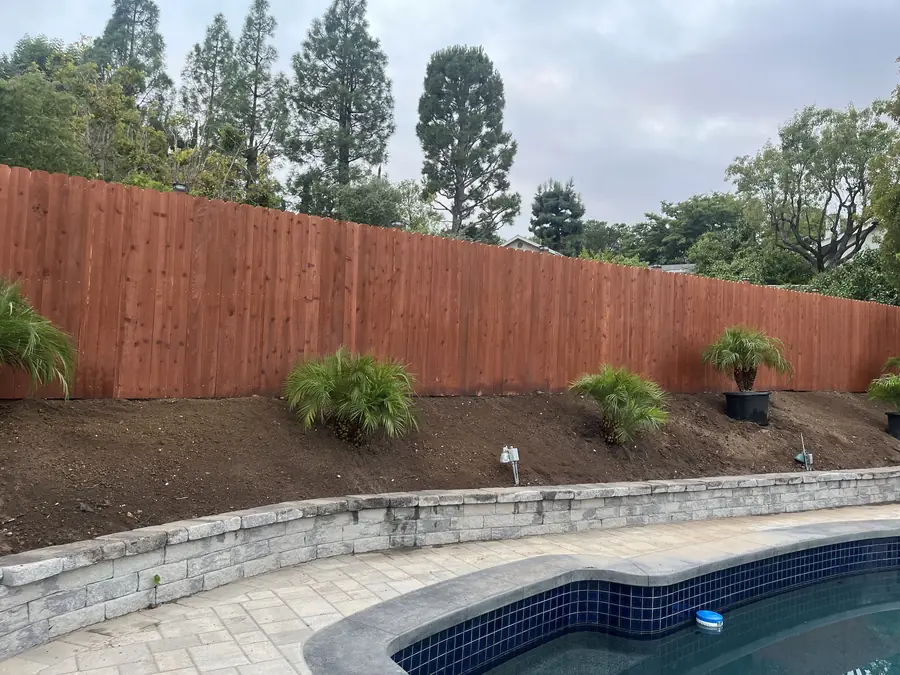
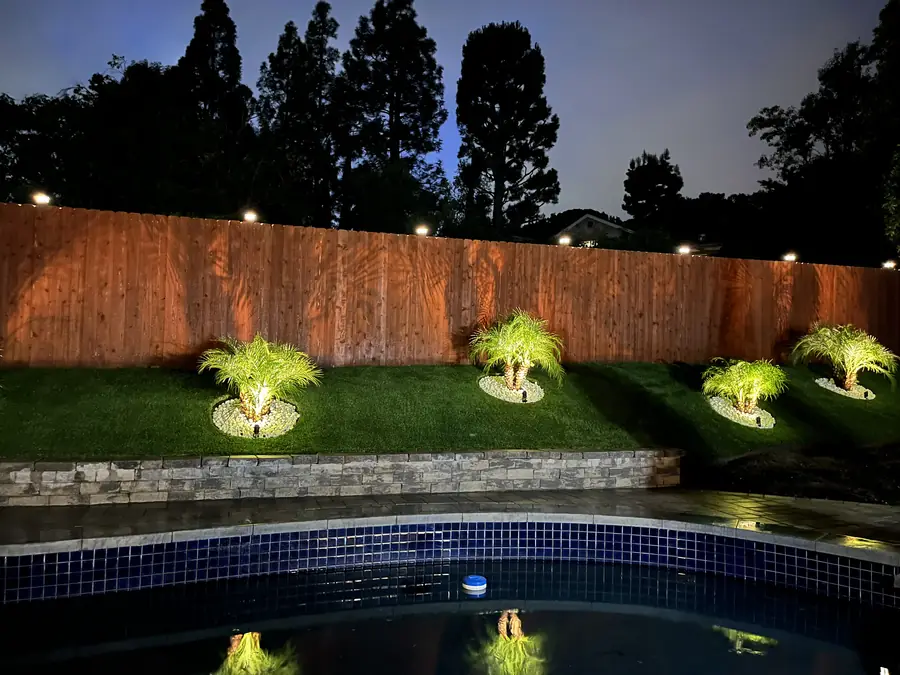
Yes, and it frequently does on these lots, where flat ground is scarce and often has to be created. Sloped installs need extra attention to anchoring, since gravity works on the material continuously, and the base has to be built so it does not migrate downhill over time. Terracing a steep slope with a retaining structure and putting a level turf panel on the flat area is often a better outcome than turfing the raw grade, because a level lawn is usable and a steep one mostly just looks green.
It works well, and many clients install it specifically because a dog destroyed the real lawn. Dogs cannot dig it up or wear bare patches into it, and mud stops being an issue entirely. Urine drains through the perforated backing the same way rain does. For odor control, the infill choice matters and there are options intended for pet use, and rinsing the area periodically keeps things fresh. Solid waste gets picked up as normal and the spot rinsed. Overall it is considerably less trouble than natural grass with a dog.
Routine care is light. Leaves and debris get blown or raked off, which matters more in the canopy heavy streets around here where drop is constant. Brushing the fibers against the grain occasionally in the areas that get walked on most keeps the pile standing upright. A rinse with a hose handles dust and general grime. Infill gets topped up every few years as it settles and works down. There is no mowing, no watering, no fertilizing, and no reseeding, which is the entire point for most people.
In direct summer sun it does warm up more than natural grass, and that is worth knowing before you commit. Several things reduce it in practice. Shade is the biggest factor, and many yards in this area sit under mature canopy for much of the day. Lighter colored infill absorbs less heat than dark. Hosing the surface down cools it quickly when needed. For a lawn that is in full unshaded sun and gets barefoot use at midday, we will talk that through honestly rather than gloss over it.
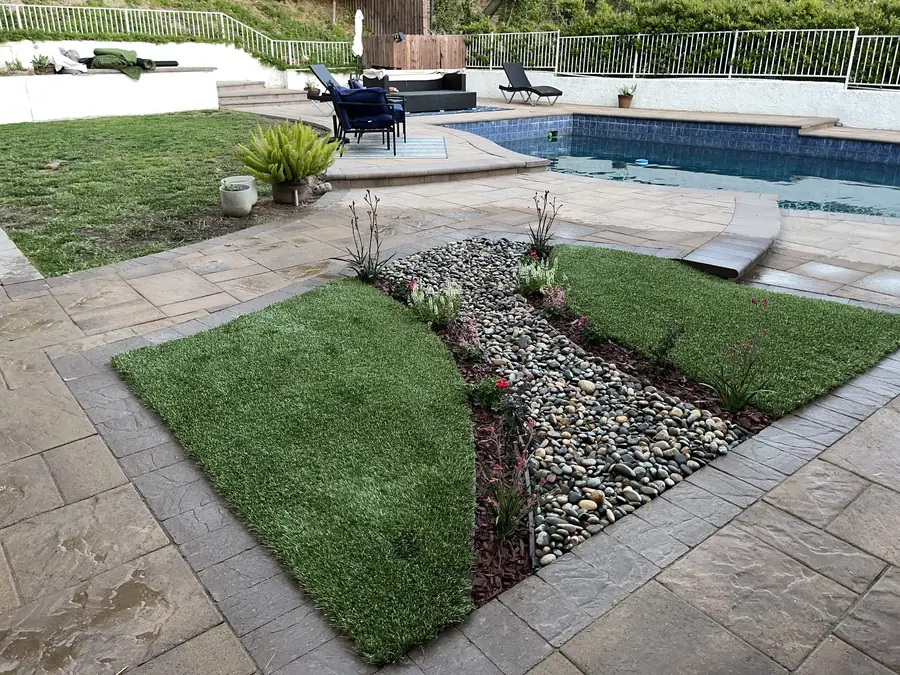
It combines very well, and on the smaller lots common in this area that mix usually produces the best result. A turf panel set into paving reads as a clean green field and gives you soft ground underfoot without the maintenance. Turf next to planted beds keeps a living, layered look while removing the highest maintenance element. What matters is the transition detail, since turf needs a firm defined edge wherever it meets another material, and that gets built into the design rather than improvised at the end.
Good quality turf, installed on a properly built base, lasts many years of ordinary residential use. The realistic failure points are the ones that come from cutting corners: a base that was not compacted settles and the lawn goes lumpy, seams that were rushed open up and become visible, edges that were not anchored lift. Fibers do eventually wear in the highest traffic paths and the color softens with sun exposure over a long span. Quality manufacturers back their products with warranties, and we go over those before you choose.
Give us a call at (818) 443-9300 and we will come look at the space, talk about how it will be used, and show you turf samples so you can compare pile and blade in real daylight. Daniels Landscaping carries California license 1138709, and your estimate is free and written. The written scope lays out excavation depth, base material and compaction, the specific turf product, infill, seaming and edging, so you know exactly what is being installed rather than just a square footage number.