
FAQ
Artificial Turf in Valley Glen, answered
The questions we hear most from Valley Glen homeowners.
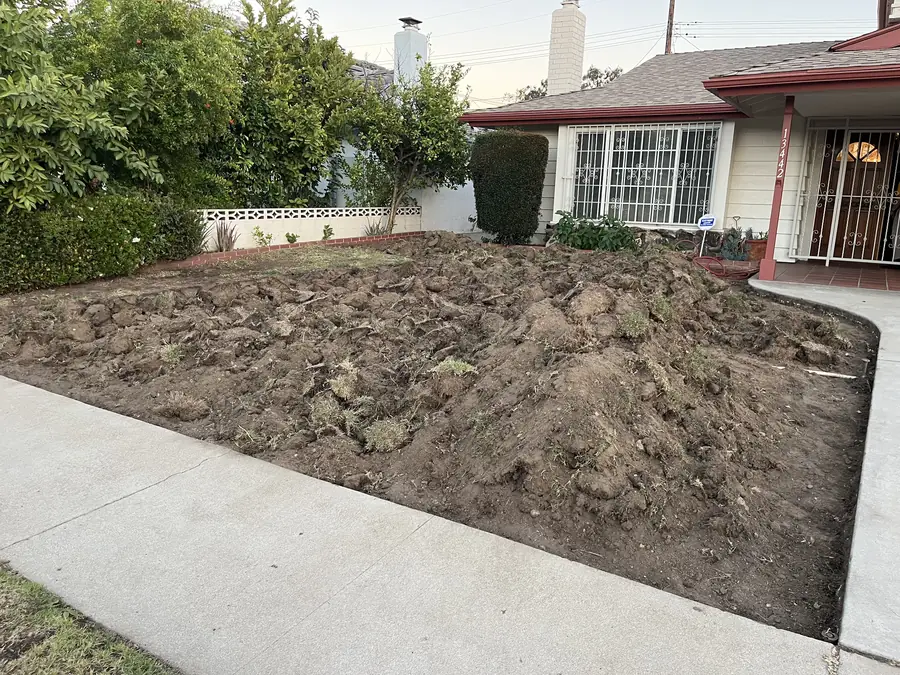
Far more excavation than most people picture. We strip the old lawn and soil down several inches, cap or reroute the sprinklers feeding that area, shape the subgrade to drain, then build compacted aggregate base in lifts. Turf rolls out over that, gets cut to the borders, seamed where panels meet, fastened at the perimeter, and finally infilled and power broomed so the blades stand up. The visible grass is the last hour of a job that is mostly earthwork, and that is exactly why it lasts.
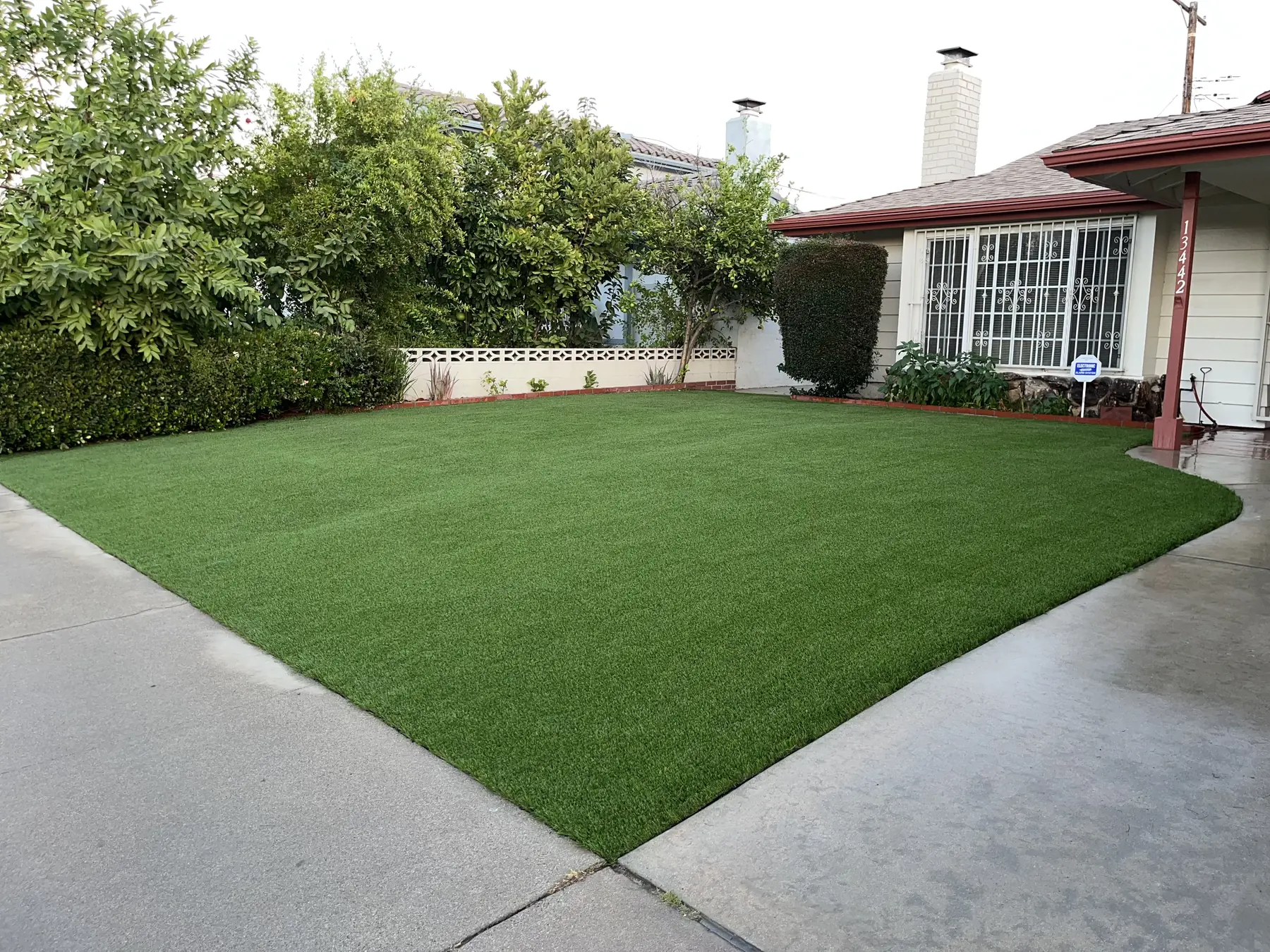
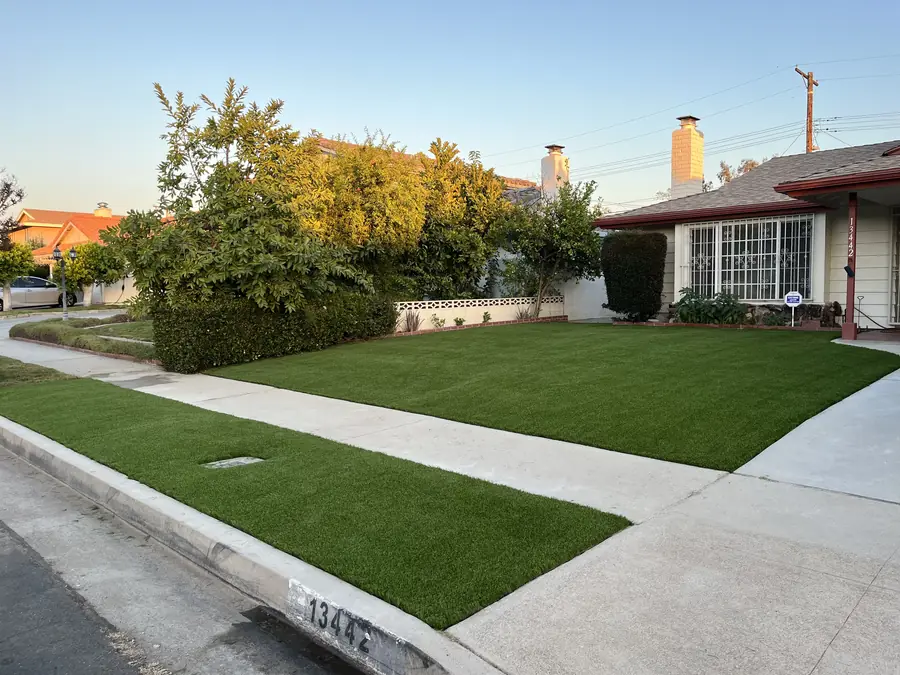
Something restrained. These are postwar single family homes on regular lots, and a front yard reads from the sidewalk, so a product with mixed green tones, a tan thatch layer underneath, and a moderate pile tends to pass as real. Uniform bright green with a tall pile is what makes a lawn look plastic from the street. We bring samples out and lay them on the actual ground in daylight, because turf shifts noticeably in color between a showroom and full Valley sun.
Think of face weight as the density number, measured as ounces of yarn in every square yard of turf. More fiber packed into that square resists matting where people actually walk. Pile height is simply how long the individual blades are. For a back yard people use, we generally point toward a solid mid range face weight and a pile in the middle of the scale, since very long blades lie over and look flat once furniture and traffic press on them. Low traffic ornamental strips can go lighter.
It matters for how long the lawn keeps standing up. Flat ribbon blades fold and stay folded. Shaped blades, the ones extruded with a spine or a fold down the center, have structural stiffness built into the profile and spring back after being walked on or heated. In an exposure like this one, where the surface bakes for most of the day through summer, that recovery is what separates a lawn still looking upright in year six from one that reads matted and shiny.
Infill is the granular material brushed down between the blades, usually a rounded silica sand, with coated or antimicrobial options where dogs are involved. It does three jobs. It weights the turf so it lies flat and stays put, it holds the fibers upright at the base, and it protects the backing from sunlight. A lawn installed light on infill looks fine for a season and then goes wavy and matted. We infill to spec and power broom it in rather than leaving it sitting on the surface.
Compacted crushed aggregate, built in lifts and plate compacted between each one, with the top layer screeded smooth so no stone telegraphs through the backing. Level ground makes this easier than a hillside job, since there is nothing to terrace or retain first, but it does not shorten the process. The base is what holds the surface flat for the life of the lawn. Where the ground is soft or full of old organic soil, we dig deeper and replace more of it before any aggregate goes in.
Straight down and then sideways, both by design. The backing is perforated, so rain and hose water pass through into the aggregate below. From there it needs somewhere to travel, and on ground this flat there is no natural fall to borrow, so we build one. The subgrade gets shaped to a deliberate pitch during excavation, and where the yard is fully enclosed we set collection at the low point and pipe it out. Drainage on a Valley Glen turf job is a decision, never an accident of terrain.
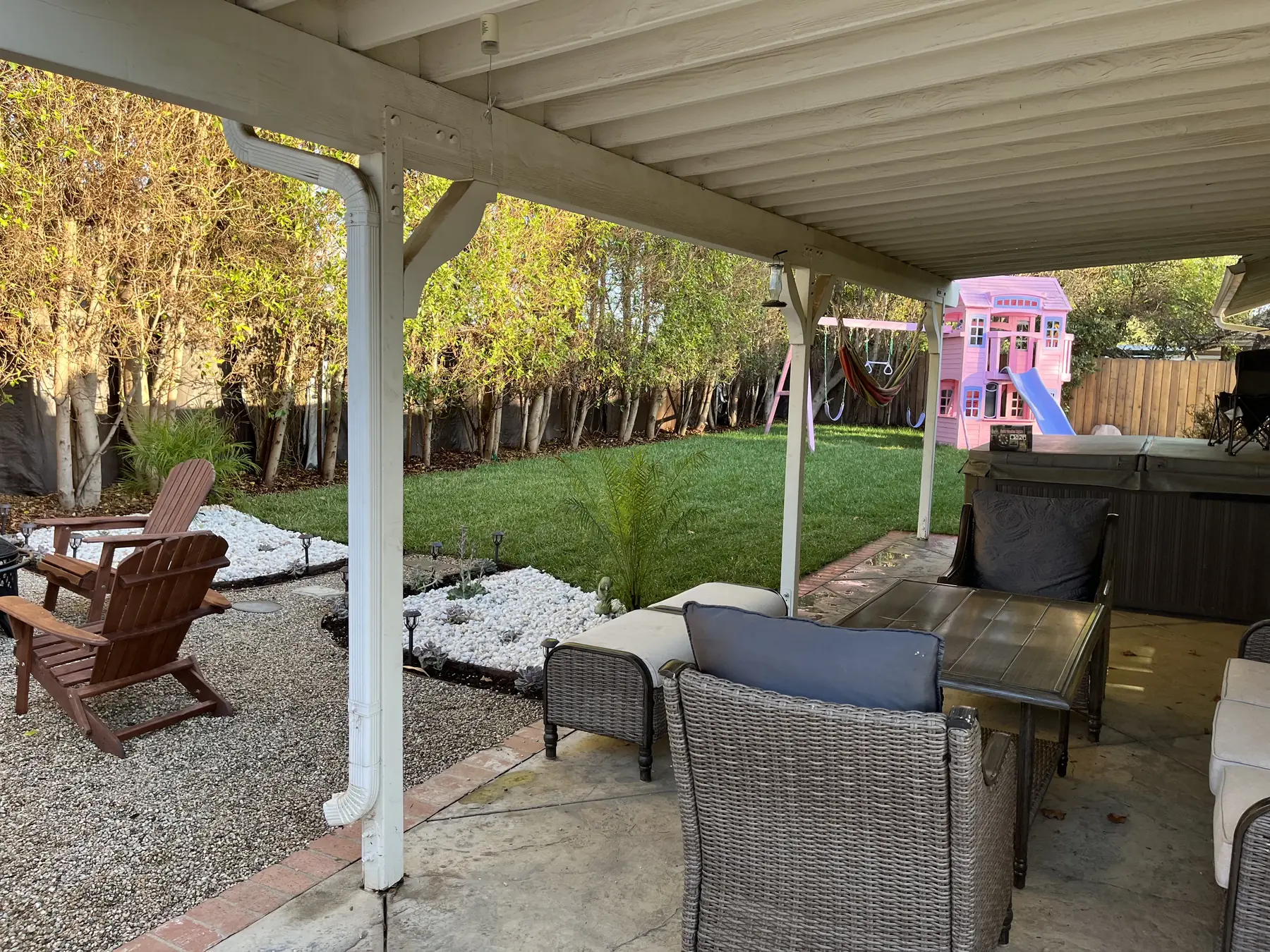
Hot. Synthetic fiber absorbs solar energy and has no evaporative cooling the way living grass does, so surface temperature climbs well above air temperature in open sun. West facing yards take the worst of it, because the late afternoon sun hits low and direct exactly when people want to be outside. Rinsing with a hose knocks the temperature down quickly but only for a while. The real fixes are shade over the area people use and honest planning about which parts of the yard should be turf at all.
Quality turf carries ultraviolet stabilizers in the yarn, and good product holds color for a long time. Cheap product does not, and this exposure finds out fast. Full sun most of the day, most of the year, is a heavier ultraviolet load than the same lawn would see under tree cover or on a shaded north side. What usually shows first is not dramatic fading but a dulling and a loss of blade resilience together. Buying on face weight and warranty rather than on price per square foot is the whole defense.
With attention, because a bad seam is the flaw everyone notices. Panels have to be laid running the same direction, since turf has a grain and reversed rolls read as two different colors. We trim the selvage edge off both sides, butt them without overlap or gap, and join them on seaming tape with adhesive, then nail through the joint at intervals. Once infill is brushed in and the blades stand up, a properly built seam disappears. On a modest lot there are usually few enough seams to place them where traffic is lightest.
The perimeter is where turf fails when it fails. We nail the edges into the compacted base at close spacing, tucking the turf tight against whatever it meets. Against a concrete walkway or paver border, the hard edge does the containment. Where the lawn ends at a planting bed with nothing solid to butt into, we set a bender board or steel edge first so there is a permanent line to fasten against. Loose or unsupported edges eventually curl, and once an edge curls the rest starts moving.
It holds up better than a live lawn does, and it is one of the more common reasons people call. Urine passes through the perforated backing rather than burning yellow spots, solids lift off, and there is no dirt left for digging. What matters is drainage below and infill choice above. We build the base to move liquid out rather than hold it, and use a coated infill that resists odor buildup. Rinsing the area regularly, particularly through hot weather, keeps it from developing a smell.
Not much, but not nothing. Leaves and debris get blown or raked off. Traffic lanes want a stiff broom pulled against the grain a few times a year to stand the fibers back up. Pet areas need periodic rinsing. Infill settles and compacts over years and can be topped up. That is the honest list. No mowing, no fertilizing, no reseeding, no watering schedule to fight over during a dry summer, which is the tradeoff people are usually making when they decide to go this route.
They come out of that zone properly. Many houses here still run irrigation installed decades ago, and the lawn heads sitting in the area being converted have to be capped below grade or the line abandoned cleanly, not just buried and forgotten. If the same valve also feeds planting beds that are staying, we separate the runs so the beds keep working. This is a good moment to look at what else is left of the old system, since half the leaks we find are on lines nobody has touched since the house was built.
Occasionally, and only when the slab is sound, drains somewhere, and sits at a workable elevation. Over a cracked and lifted slab it is a bad idea, because every flaw underneath telegraphs through and water gets trapped with nowhere to go. On most of these properties the original flatwork has settled past the point of being a useful subsurface, so it comes out and the area gets built from the subgrade up. We look at the actual slab before making that call rather than guessing.
Yes, and it is a sensible way to run it. Front yards are usually the smaller area, they carry the water use people want to cut first, and they are what the street sees. Doing that section first gives you a real look at the product on your own ground before committing the rest. Lots here are compact enough that neither phase turns into a long disruption. We plan both stages up front so the material matches when the second one happens rather than hoping the same product is still available.
One licensed contractor, the same people who work on every Daniels Landscaping project. One licensed contractor stays accountable for the work. The excavation, the base build and compaction, the seaming, the fastening and the infill are all done by employees of this company, working to the way we build. That is why the base under a lawn you cannot see is done right, and it is why you are talking to the same outfit next year if something needs attention.
Call (818) 443-9300 and we will come look at the yard. We measure the area, check what is under the existing lawn, look at where water needs to go on ground this flat, and talk through turf products against how you actually use the space. You get a free written estimate laying out the base build, the turf specified, the infill and the edge detail, so you can compare it line by line against anyone else. We work under California license number 1138709 as Daniels Landscaping.