
FAQ
Artificial Turf in Pacoima, answered
The questions we hear most from Pacoima homeowners.
For most yards on these streets, yes. Budgets around here are practical and the arithmetic is straightforward. A living lawn in this climate wants water through a long hot summer, plus mowing, feeding, and overseeding, and it still thins out where children and furniture land on it. Turf costs more the day it goes in and close to nothing afterward, which is the trade many owners here are glad to make. Where we would push back is a yard sitting in heavy shade with light traffic, or a family who genuinely wants living grass underfoot.
The base carries the whole job. We strip the existing lawn and several inches of soil, shape the subgrade to drain, then place crushed aggregate and compact it in lifts, screeding the final surface smooth. A loose or uneven base telegraphs through the turf as dips and ripples inside a year, and no amount of good product hides it. Where burrowing rodents are a concern a barrier goes down before the rock. Only once the base is firm, flat, and holding the intended fall does any turf come off the roll.
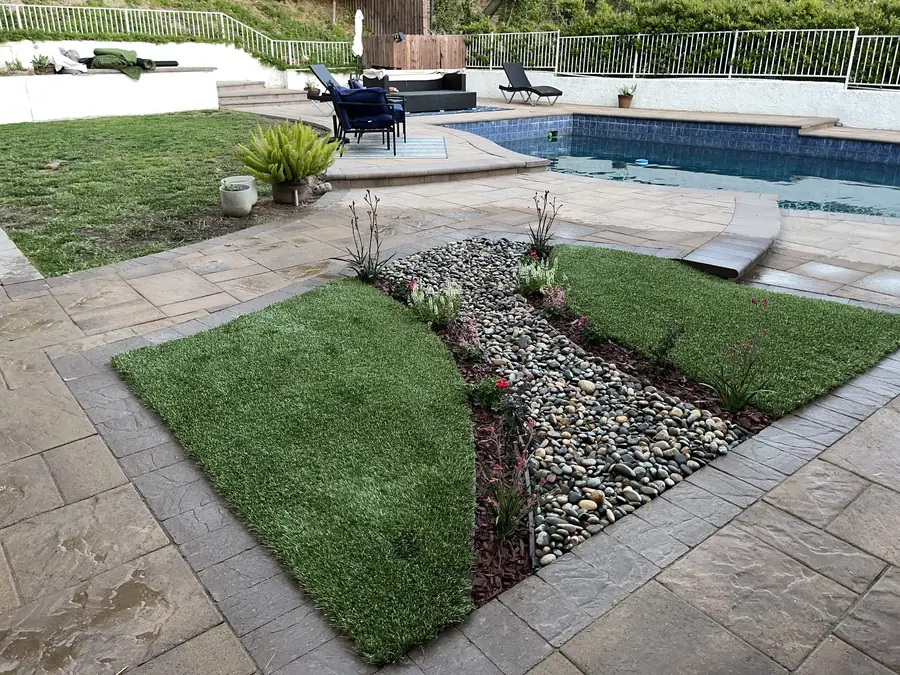
Down through the backing and into the rock below it, which is precisely why the rock matters. Turf backing is perforated, so water leaves the surface quickly. What happens next depends entirely on what was built underneath. Flat ground gives water no terrain to follow, so we grade the compacted base with a deliberate fall toward a planting bed, a drain inlet, or the side yard rather than assuming it will find its own way out. In tighter areas we tie a basin into solid pipe so runoff has a defined exit.
Warmer than living grass, noticeably so on a still afternoon in full sun. Real grass cools itself by transpiring and synthetic fiber cannot, so surface temperature climbs with direct exposure. The practical answers are shade and infill. A tree, a patio cover, or a fence line that blocks the late western sun makes a large difference, and lighter colored infill absorbs less heat than dark crumb. Rinsing the surface drops the temperature quickly for a short while. Turf placed in a shaded portion of the yard stays comfortable through the worst of the day.
Sun exposure is the main thing that ages a synthetic lawn in this climate. Good turf uses UV stabilized fiber, and after many seasons of hard sun the color softens slightly rather than bleaching away. Cheap product is where the difference becomes obvious, going brittle at the tips and shedding fiber underfoot. Backing matters as much as blades, since a poorly made backing stiffens under long UV load and begins cracking around the nails. We select product for this exposure specifically, and we would rather put samples in your hand than describe them.
Face weight measures how much fiber is packed into each square yard and it is the closest single number to density and durability. For a yard that gets real use, a mid to heavy face weight earns its money, because thin product lies over and stays flat in the traffic lanes. Pile height refers to the length of the blade itself. Something in the middle range looks natural and springs back up, while very long pile falls over and reads as fake within months. Shorter pile suits play areas, dog runs, and anywhere the surface is in constant use.
Blade shape controls resilience and shine together. Flat ribbon blades reflect light and look plastic from the sidewalk. Shapes carrying a spine or a fold down the center, sold under names such as S blade, W blade, or diamond, stand up better under weight and scatter light rather than glaring. Color is the other half of it. One flat green reads false immediately, so the products we install blend two or three green tones with a tan thatch layer at the base that imitates the dead material sitting under any real lawn.
Infill is the granular material brushed down between the blades once the turf is laid. It weights the lawn so it lies flat, holds the fibers upright, shields the backing, and gives the surface a softer feel underfoot. Rounded silica sand is the standard for most yards. Where dogs use the lawn we switch to a coated or antimicrobial infill that resists holding odor. Quantity is not negotiable, and an installation that skimps on infill shows it quickly as matting through the traffic lanes and a lawn that feels hard and hollow.
It holds up well, provided the product and the base are matched to that kind of use. Yards here are used rather than admired, and a lawn that takes folding tables, a canopy, a bounce house, and forty people at a birthday needs density more than a long soft pile. That is why we specify a heavier face weight with a moderate pile height and keep infill levels full so the fibers have support. Furniture legs deserve a moment of thought, since narrow metal feet under weight can dent any turf. Wide feet or pads solve it.
Dogs and turf get along well, which is part of why owners here make the switch. Solids lift off and the surface gets rinsed. Urine drains through the perforated backing into the rock, so the routine is a hose down plus a periodic enzyme cleaner to keep odor from building up in the infill. For homes with dogs we choose a shorter pile that rinses clean and an infill made for pets. Beyond that, upkeep is a stiff broom across the traffic lanes now and then to stand fibers back up, and blowing off leaves.
Turf comes off the roll at a fixed width, so any lawn wider than that carries at least one seam. We plan where those land before cutting, keeping them out of the main sight line from the house and the front walk, and running every roll in the same direction so the fibers lean together. Seaming means trimming the selvage edge cleanly, joining pieces over seam tape with adhesive or nailing tight along the join, then brushing infill across afterward. Done properly, you will not find the seam once the lawn settles in.
The perimeter gets nailed. Galvanized nails run at close spacing along every edge, driven into the compacted base so the heads disappear down into the fiber instead of sitting proud. Against a walkway, a patio, or a driveway apron the turf is trimmed tight to the hard edge and fastened there. Where the lawn meets soil or a planting bed, we set a bender board or a paver border first so there is something solid to fasten to and nothing for a shovel to catch later. Loose edges are what curl and lift.
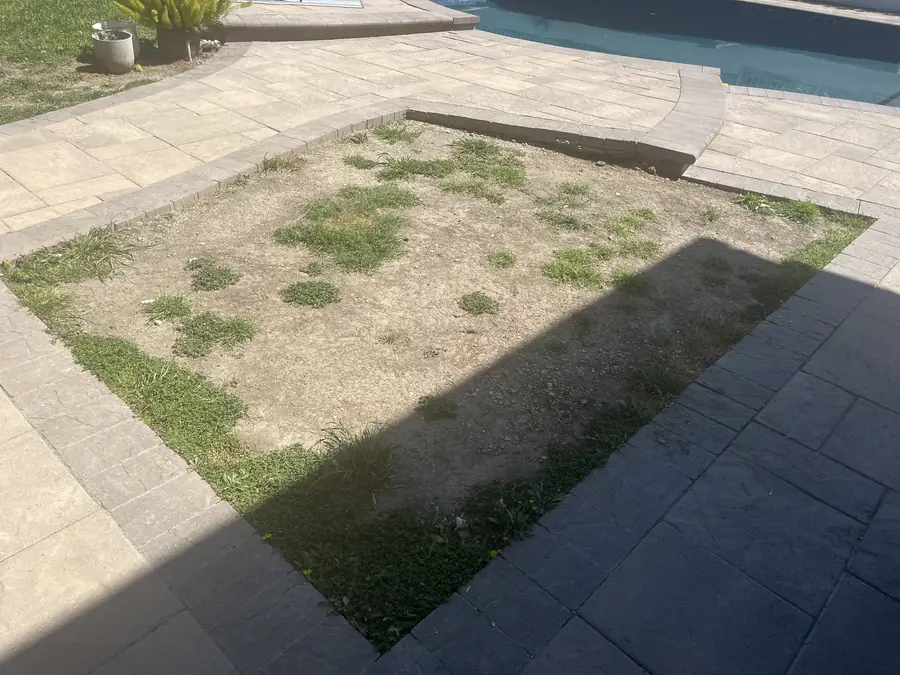
The dead lawn comes out rather than gets covered. Turf laid over old sod sits on material that decomposes, settles unevenly, and holds odor, so it is removed and a proper base built in its place. Old concrete is a separate question. A sound, well drained slab can sometimes take turf directly with a pad over the top, though most of the original flatwork we find at homes of that era is cracked, sunken, or lifted, and in that condition it is better broken out and hauled away. Removing it also lets us set the grade for drainage.
That zone stops being used, but nothing is abandoned carelessly. We cap the heads inside the turf area and shut the zone down at the valve rather than leaving pressurized line sitting under a finished surface. If planting beds remain around the lawn, those lines usually stay and are worth converting to drip while the yard is open, since drip suits beds far better than spray heads that used to overshoot onto grass. Marking and photographing line locations before the base goes down is standard for us, so anything below the turf can be found again.
With decent product over a base built correctly, a synthetic lawn in this climate has a long service life measured in many years rather than a couple of seasons. What ends it is rarely the fiber wearing through in the middle of the yard. Failure normally shows as edges lifting, seams opening, or the base settling, and all three trace back to installation rather than material. Manufacturer warranties run long, though they cover the product and not the workmanship beneath it, which is one more reason to care who performs the install.
Pacoima falls within the City of Los Angeles, so permit questions go to Los Angeles Building and Safety. Swapping a lawn for synthetic turf at ground level is normally not permitted work. Approvals come into play when the project also involves a retaining wall over the height threshold, a structure of some kind, or drainage that has to be tied into something beyond the property line. Properties like these are not typically governed by association rules, though if a recorded restriction exists we would rather learn about it before material is ordered.
Every part of it is handled by our own employees. Daniels Landscaping stays accountable for the work. The crew that pulls out the old lawn, hauls the debris, sets the grade, and compacts the rock is the same crew that rolls the turf, cuts the seams, nails the perimeter, and brushes in the infill. Turf is a trade where the invisible work decides the outcome, so keeping one crew accountable from demolition through the final pass of the power broom is not a preference, it is how the job gets done right.
Reach us at (818) 443-9300 and we will schedule a visit, measure the area, and bring samples so you can feel the difference between products instead of taking our word for it. The estimate is written and free, with no obligation attached. Pricing is broken out so removal, base material, turf, infill, and labor are each visible on the page. Daniels Landscaping carries California license 1138709 and installs with one licensed contractor start to finish, which means the person who quotes the job answers for the way it is built.