
FAQ
Artificial Turf in Porter Ranch, answered
The questions we hear most from Porter Ranch homeowners.
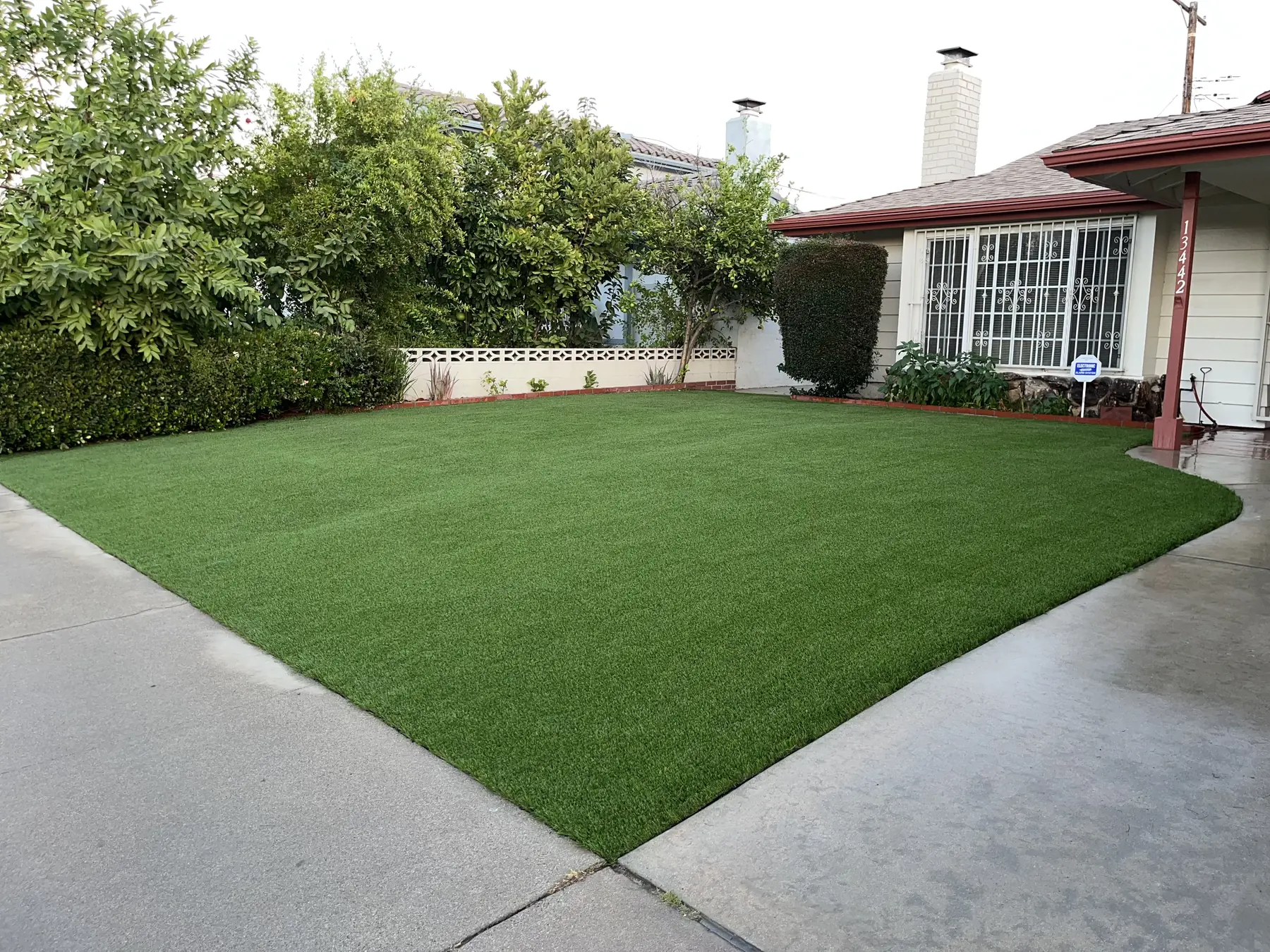
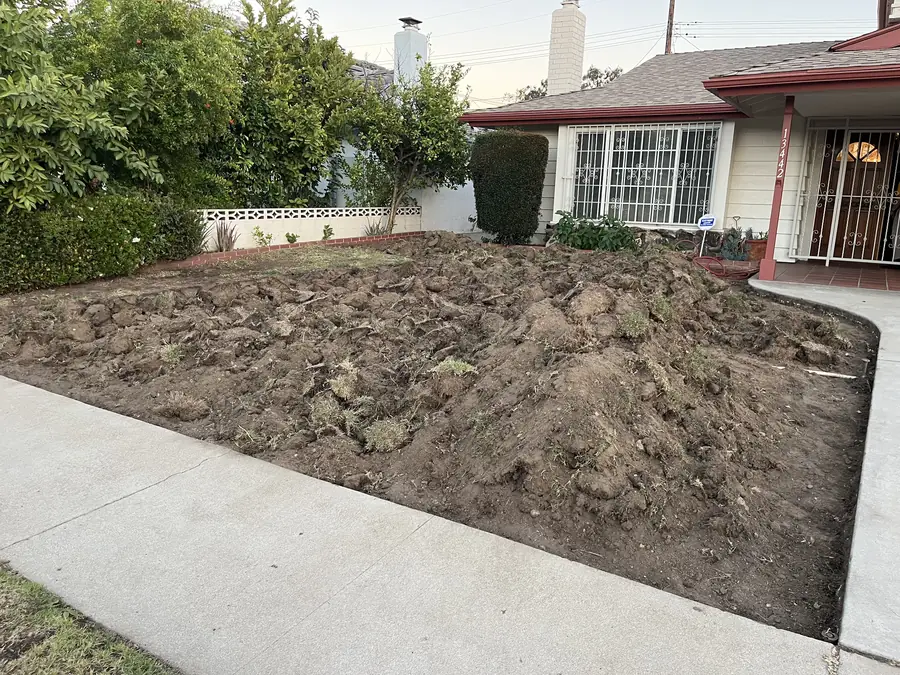
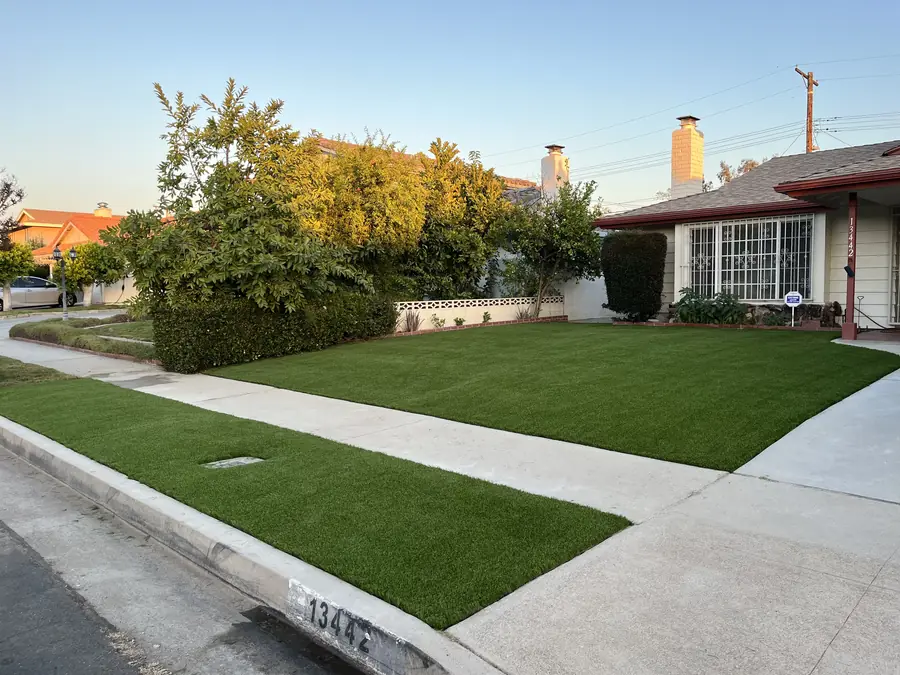
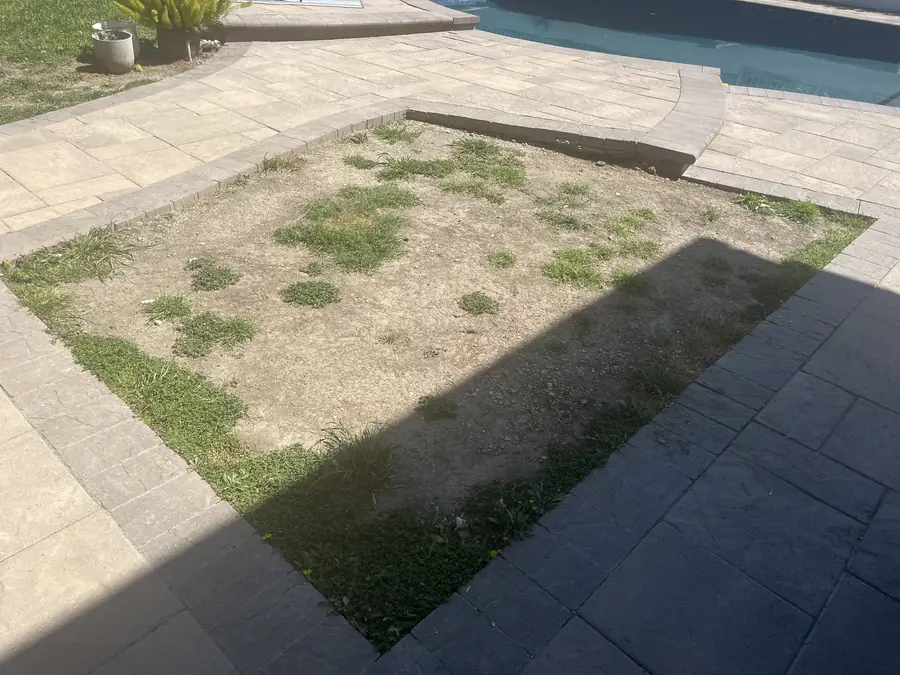
The existing lawn or surface is removed and the ground is excavated to depth, then a crushed aggregate base is placed in lifts and compacted until it is firm and shaped to drain. The turf is rolled out, allowed to relax so it lies flat, then trimmed to the borders, seamed where panels meet, and fastened around the perimeter. Infill is spread and brushed in, and the fibers are groomed upright. Everything that determines how the finished surface looks and lasts happens before the turf is unrolled, which is why most of the labor goes into the ground beneath it.
Face weight measures how many ounces of yarn per square yard the product carries, so it is a density figure, and a denser turf stands up to traffic longer and feels fuller underfoot. Pile height is simply how tall the blades are. Taller is not automatically better, since long blades in a low density product lie over and look matted quickly. For lawns that get used, a moderate pile height with a solid face weight outperforms a tall thin product every time. We keep samples on hand because the difference is obvious in your hand and invisible in a photograph.
Quite a bit. The cross section of each fiber controls how well it resists being flattened. Shapes with a spine or a rib, sometimes described as S, W, or M profiles, hold their form better than a flat ribbon blade, which folds over under foot traffic and starts to shine. Shine is what makes cheap turf read as plastic from across the yard. Better products also mix blade colors and add a curled thatch layer at the base to imitate the dead material in a real lawn. Those details separate convincing turf from obvious turf.
Infill is the granular material brushed down between the fibers after installation, and it does three jobs: it weighs the turf down so it stays put, it supports the blades so they stand upright, and it shields the backing from sunlight. Silica sand is the common choice. Coated sands and antimicrobial options exist and are worth considering for dog areas. Skipping infill or shorting the quantity is a shortcut that shows up quickly as matting and wrinkling. Infill also needs topping up over the years as some of it works down or gets carried off with cleaning.
Straight down. The backing is perforated, so rain passes through the turf into the aggregate base and then into the soil or into a drain line if the site needs one. That only works if the base was built to move water and the ground beneath it was shaped to send water somewhere. On the hillside lots common in this area, we grade the base to fall toward a defined outlet and tie in a drain where a terrace or a wall would otherwise trap water behind it. Turf placed over a flat, poorly drained pad puddles regardless of the backing.
Yes, entirely. Daniels Landscaping performs every stage under one licensed contractor. The same crew that excavates and compacts the base is the crew that seams the turf and brushes in the infill. We hold to that without exception. Seaming in particular is a skill that improves with the same hands doing it repeatedly, and it is the part of a turf job most likely to look wrong a year later if it was rushed by whoever happened to be available that day.
Panels are laid running the same direction so the fibers lean uniformly, because a panel installed backward reads as a different shade of green. Edges are cut to meet cleanly, joined with seam tape and adhesive or stitched, and the fibers along the joint are teased free so the line disappears. The perimeter is fastened with nails or spikes into the compacted base, and where the turf meets a bed or a walkway we set a bender board or a paver border to give it a clean, secured edge. A properly seamed lawn shows no line at all from standing height.
Most committees in these neighborhoods do allow it now, though the approval usually specifies the product, the color, and where it may be placed, particularly in front yards visible from the street. Because review covers material and color, we choose the specific turf before submission rather than after, and we provide a sample and the product data so the committee is looking at what will actually be installed. Substituting a different product after approval is the kind of thing that creates problems. Approval time belongs on the project schedule, since installation cannot start without it.
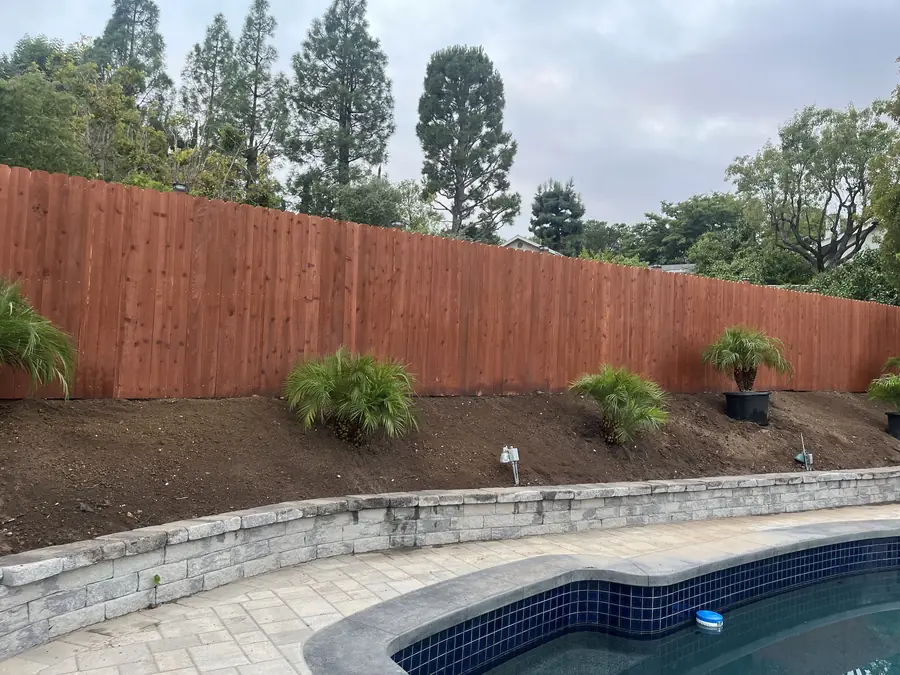
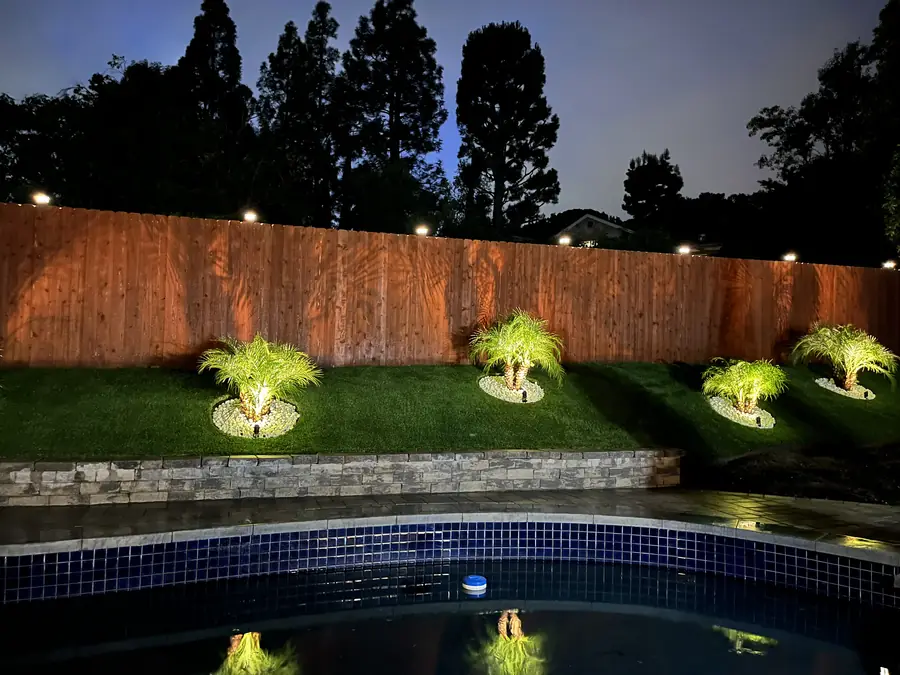
It can, and it works well on the flat terraces that make up most usable space on these lots. On an actual slope face the concerns are anchoring and water. The base has to be compacted so it does not creep, the turf needs additional fastening so gravity does not drag it downhill over the years, and seams are best oriented so water does not run along them. Very steep faces are usually better served by planting that roots into the soil. We look at the angle and the exposure before recommending turf on any pitched surface.
It deserves thought, because turf is a plastic product and heat sources damage it. We keep a noncombustible band of gravel, stone, or paving between the structure and any synthetic surface rather than running turf up against the wall, which matches how defensible space around a home here gets planned anyway. Grills, fire features, and stray sparks are the everyday risks, and those get separated from the turf with hardscape. None of this rules turf out. It simply means the layout near the house gets planned deliberately instead of by default.
Well, and it is one of the more common reasons people install it, since dogs cannot dig it into mud or wear a bare track through it. Liquid drains through the backing the same way rain does. Solids are picked up and the area is rinsed. For households with several dogs we specify a pet rated backing with a higher flow rate and a coated or antimicrobial infill, and an occasional enzyme treatment keeps odor down in warm weather. The base underneath matters here as well, because a base that drains slowly is what holds smell, not the turf.
In direct sun it gets noticeably warmer than living grass, since there is no evaporation cooling it. Yards in newer neighborhoods tend to have less mature canopy than older parts of the valley, and hillside lots that open to the west take hard afternoon sun with nothing shading them, so this is a real consideration up here. Lighter color blends and certain cooling infills reduce the surface temperature, and a quick rinse drops it immediately. Shade helps most of all. We usually place turf where it gets some afternoon relief and use hardscape or planting where it does not.
A quality product installed on a properly built base lasts many years, and the failure mode is gradual rather than sudden: the fibers lose their spring in the traffic lanes, the color fades slightly under sun, and the surface starts to look tired before it becomes unusable. Manufacturers publish warranties covering fading and wear, and we hand you that documentation. What shortens life most is a weak base, insufficient infill, and neglect, in that order. What extends it is periodic grooming and keeping the infill level where it belongs.
Far less than a lawn, but not none. Leaves and debris get blown or raked off, the fibers get brushed against the lean once in a while to stand them back up, and the traffic lanes benefit from a power broom periodically. Infill is checked and topped up as needed. Rinsing keeps dust down and cools the surface in summer. Weeds occasionally appear at the edges or in seams from windblown seed and pull out easily. There is no mowing, no fertilizing, no aerating, and no irrigation running on it.
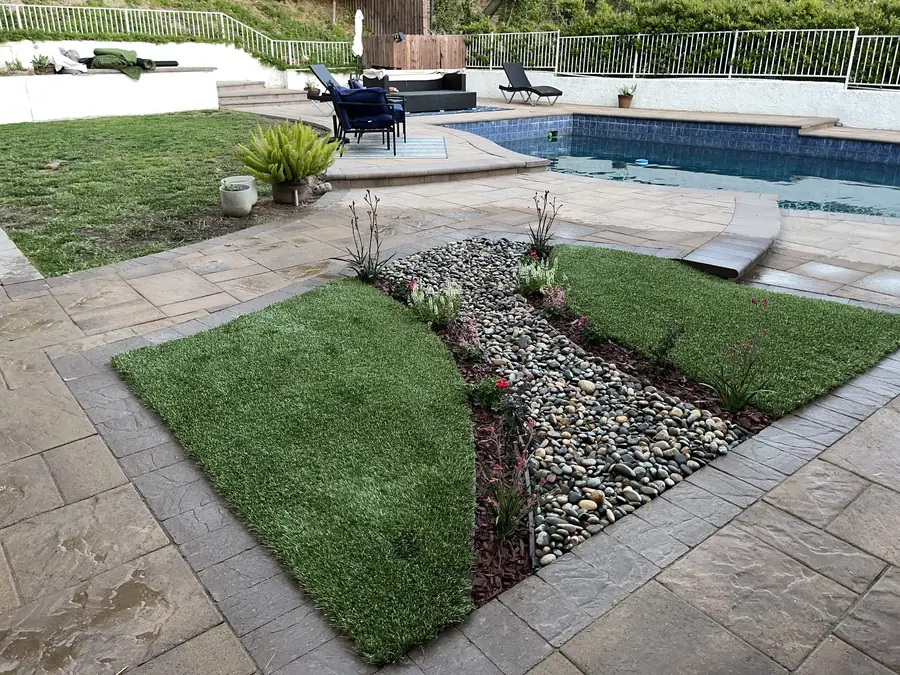
The lawn zone gets capped properly rather than abandoned. Because the homes here are relatively new, the builder irrigation is often still functional, and the valves that fed the lawn can be capped at the risers or, more usefully, reassigned to feed drip in the planting beds surrounding the new turf area. We pressure test what remains so a forgotten lateral is not leaking under a finished surface. Anything inside the turf footprint gets removed or capped below the base. A leak discovered after the base is compacted is an expensive discovery.
Good product installed well does not, and the difference between convincing and obvious comes down to specification and craftsmanship rather than luck. Multiple yarn colors, a brown thatch layer, and a moderate pile height read as a real lawn. Correct base preparation keeps the surface flat instead of rippled. Consistent panel direction, invisible seams, and a clean edge where the turf meets paving or planting do the rest. What gives cheap installations away is uniform bright green, a visible seam running through the middle of the yard, and lumps where the base was never compacted.
A few. Directly beneath messy trees it collects sap, fruit, and leaf litter that has to be cleaned off rather than decomposing into the soil. In an area you want to feel cool and planted, a large unbroken green rectangle can look flat and lifeless, and breaking it up with beds or paving reads better. Steep exposed slope faces belong to deep rooted planting. And in the band immediately around the structure, noncombustible material is the better choice. Everywhere else, particularly usable flat space that would otherwise be thirsty lawn, it earns its place.
Call Daniels Landscaping at (818) 443-9300 and we will measure the area, check how the ground drains, and bring samples so you can compare pile height, density, and color in daylight rather than on a screen. You receive a free written estimate covering the excavation, the base build, the specific turf product, the infill, and the edge treatment, which makes it straightforward to compare against another bid line by line. We carry California license number 1138709. There is no cost for the visit or the estimate, and the installation stays under one licensed contractor.