
FAQ
Artificial Turf in Panorama City, answered
The questions we hear most from Panorama City homeowners.
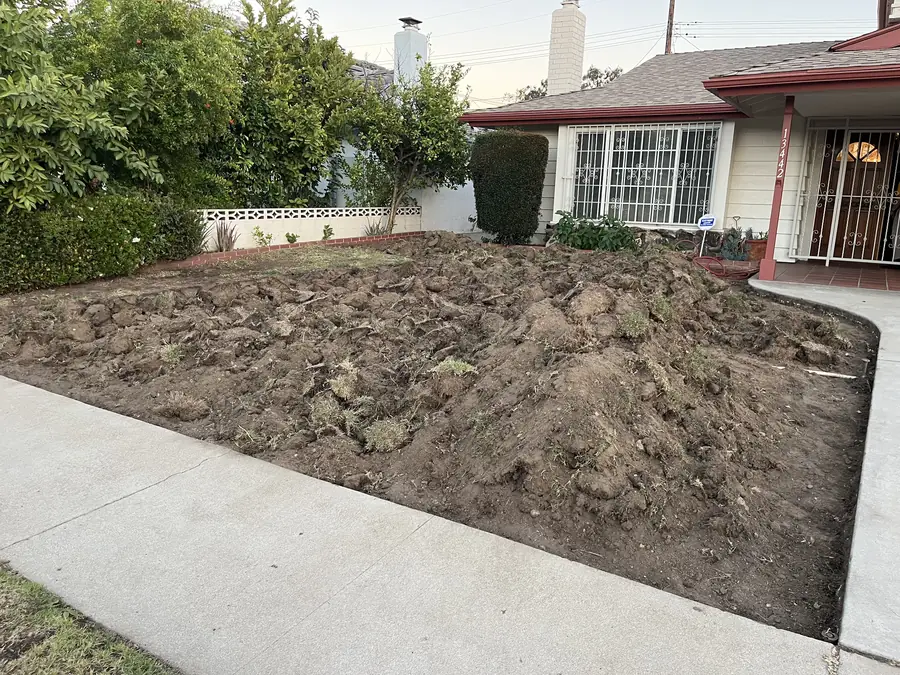
Almost all of the performance comes from the base. We remove the existing lawn and several inches of soil, compact the subgrade, then build up crushed aggregate in compacted lifts and grade it smooth with a slight fall. A finer layer is screeded over that so the surface reads flat with no dips. Turf rolls out on top, gets stretched, seamed, nailed at the perimeter and brushed with infill. If the base moves, the turf shows it immediately, since there is no forgiveness in a surface you can see across at a glance.
Water passes straight through the perforated backing, so the real question is what the base does with it. On level ground we build a consistent fall into the aggregate so water travels underneath and leaves the yard rather than pooling in the low spot. Where the surrounding grade will not cooperate, a perforated line in gravel below the base carries it out to daylight. Turf set on unsloped base over flat ground is exactly how you end up with a soft, sour smelling patch.
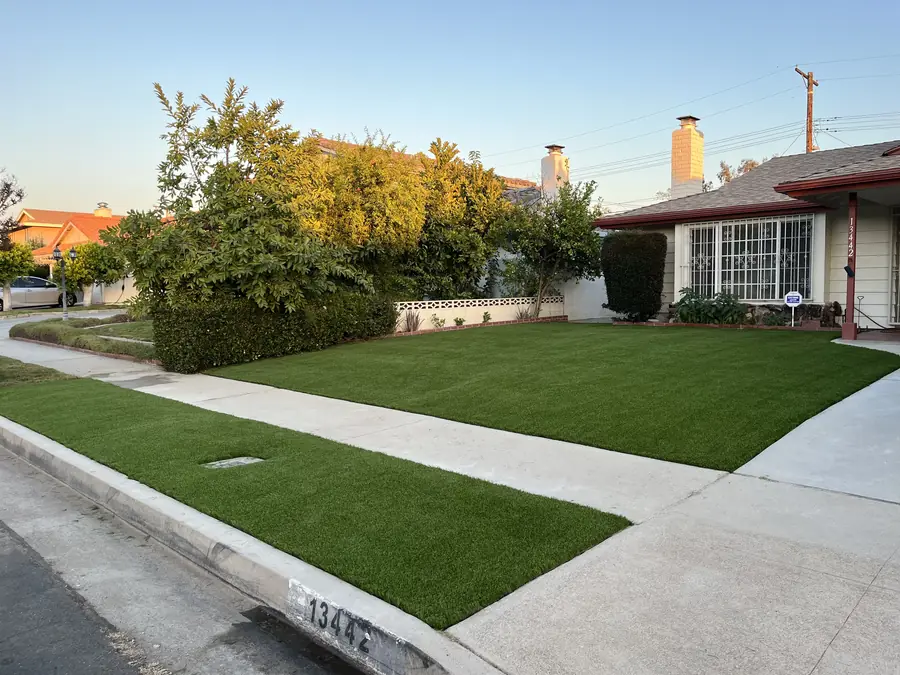
Front yards do best with a moderate pile, roughly an inch and a half, paired with a face weight heavy enough that the blades stand on their own. Very tall pile lies over and looks matted from the sidewalk, while very short pile reads as outdoor carpet. Face weight is the honest measure of how much yarn is in a product and matters far more than the name printed on the roll. Given how visible front yards are on these uniform streets, we push clients toward a denser product there.
Infill is the granular material brushed into the turf after installation. It weighs the surface down, holds blades upright and shields the backing from ultraviolet exposure. Silica sand is the standard, coated sand resists bacteria better, and some infills are made specifically to run cooler than plain sand. In a climate with consistently hot afternoons, that choice makes a real difference in both surface temperature and how quickly the lawn springs back after use. Infill also needs topping up over the years as it settles down into the pile.
Synthetic turf does run hotter than living grass in direct sun, and on an exposed lot with no mature canopy that is worth planning around. Lighter colored yarn and a cooler infill both help. Shade helps more, whether it comes from a tree placed on the west side, a patio cover or a sail over the seating area. A quick rinse drops the surface temperature right away, though not for long. Households that use the yard mostly in the morning and evening rarely find it a problem.
Careful seaming matters more on a compact yard, because every seam sits within a few steps of where people stand. We plan the roll layout to put seams where they are least visible and keep all blades running the same direction, since turf laid in opposing directions shows an obvious color break. Seams are glued or stitched onto seam tape rather than simply butted together. Perimeter edges are nailed into the compacted base and tucked against bender board, a paver band or a header so nothing lifts.
Every step is done under one licensed contractor. Daniels Landscaping stays accountable for the work. The people who strip out your old lawn also build and compact the base, roll and cut the turf, glue the seams, nail the perimeter and brush in the infill. No stage of the work is passed to another company. That is a deliberate choice, because turf hides nothing and the quality of a synthetic lawn is decided entirely by whoever prepared the ground beneath it.
Old lawn has to come out, not be covered. Organic material left underneath decomposes, settles and leaves hollows, and it gives weeds and pests somewhere to live. Existing concrete is a different question. Turf can be installed over a sound slab with a pad, but the original flatwork on most of these tract properties is cracked and pitched, so breaking it out and building a proper base usually makes more sense. We decide once we see what condition the surface is genuinely in.
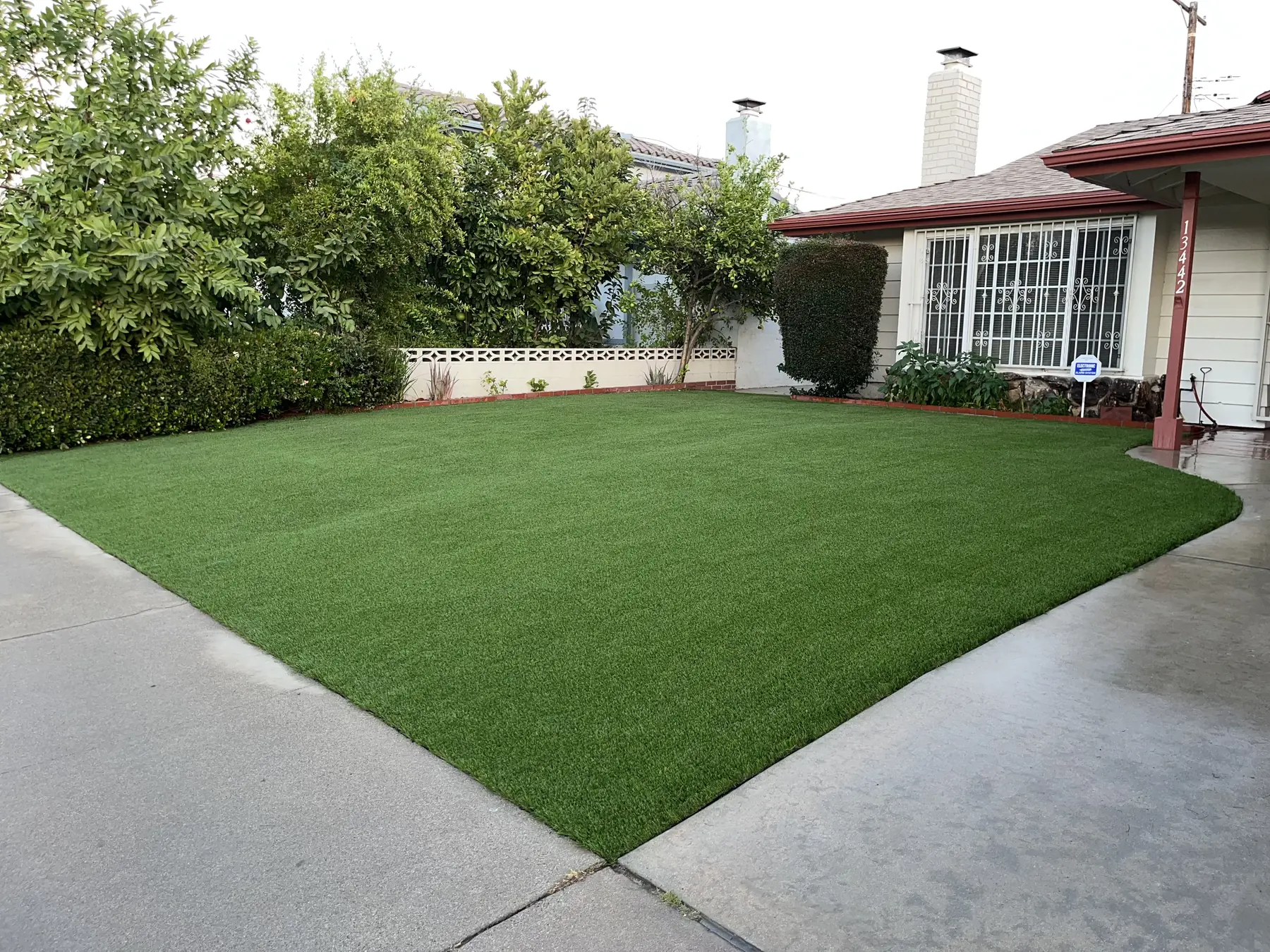
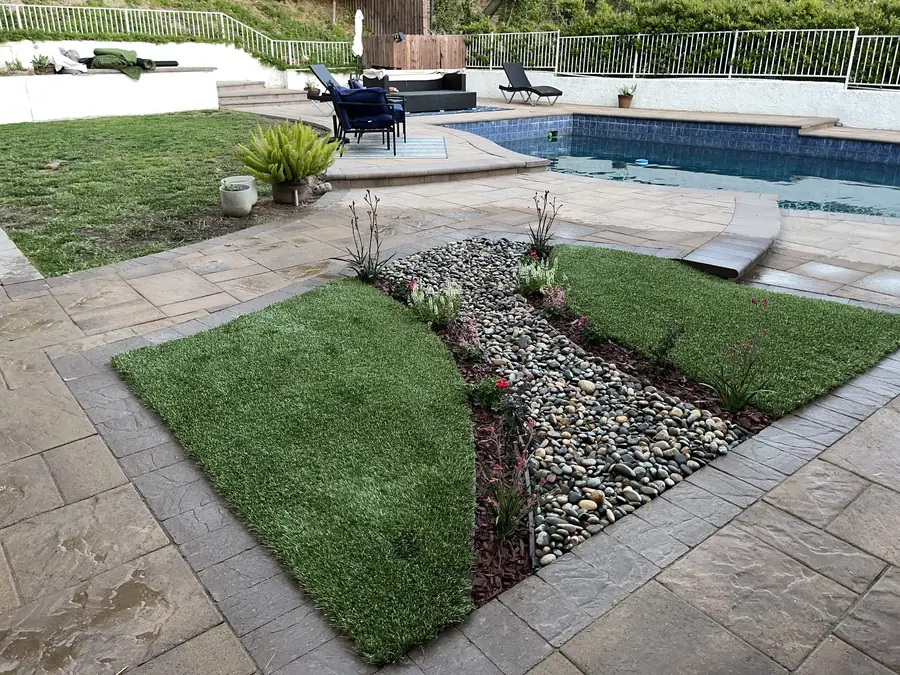
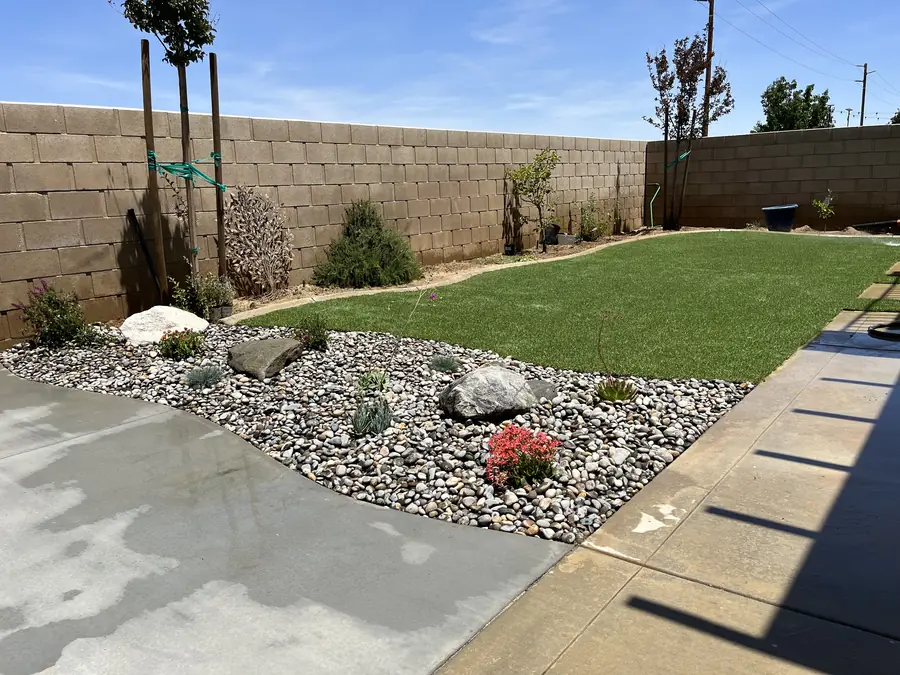
Not if it is designed with any intention. On a street of matching lots the default is a plain rectangle of green edged in concrete, and that is what makes turf look generic. Break the shape instead. Curve the edge, set a paver band or stone steppers through the field, run a planting bed along the front and keep the turf as one clean panel inside it. Combining turf with drought tolerant planting rather than covering the yard wall to wall is what makes it read as designed.
Turf handles dogs well, which is one of the main reasons homeowners here choose it. Urine drains through the perforated backing into the base, so what matters is that the base drains freely and the infill resists odor. Coated or antimicrobial infill helps in a yard with regular dog traffic. Solids get picked up and the area rinsed as needed. Nothing burns yellow the way living grass does, and there are no dug holes or worn dirt tracks running along the fence line.
Upkeep is minimal, though not entirely hands off. Leaves and debris get blown or raked off, and a stiff broom brought against the grain lifts blades flattened by traffic. A hose rinse clears dust, which builds quickly during a long dry stretch here, and handles pet areas at the same time. An enzyme cleaner deals with odor if the dogs favor one particular spot. Infill gets checked over time and topped up in the high traffic paths where it works its way down into the base.
A quality product on a properly built base has a long service life, and the base normally outlasts the turf itself. What ages the yarn is constant ultraviolet exposure, and lots here get plenty of it, so strong UV stabilization is worth paying for. Traffic patterns show before the material actually fails, which is why brushing and infill top ups matter. When the surface eventually comes up for replacement, the base underneath is usually still sound and can be reused.
The old system gets capped rather than left live. Most of these homes still have their original sprinklers under the front lawn, and once turf goes down those heads serve no purpose while a leaking valve beneath a sealed surface becomes a problem you cannot see. We cap the lawn zones, and where the yard keeps planted beds we convert what is worth keeping to drip on its own valve. Any line that has to remain gets checked before turf covers it.
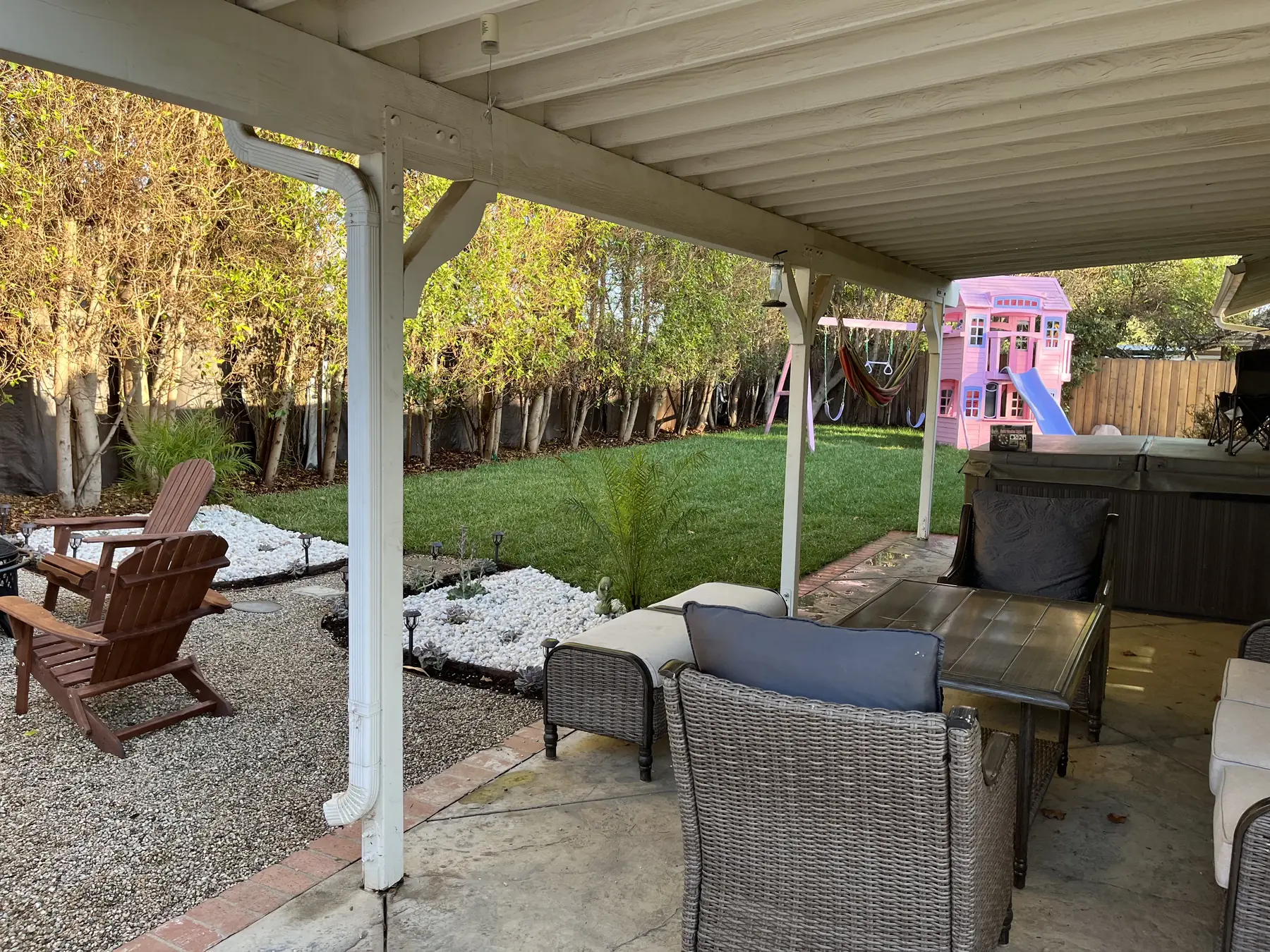
Partial installations are common and often the smarter call. Front yards get the turf because they stay visible and are rarely used hard, while the back keeps planting, paving or a play surface. Splitting the work also fits how most homeowners in this area budget, letting the yard finish in stages with nothing redone later. The only requirement is that grading and drainage for the whole property get sorted at the start, since those are difficult to revisit once surfaces are down.
Blade shape decides how the lawn behaves underfoot and how it catches light. Flat blades look shiny and lie down faster, while profiles with a spine or stem, such as S and W shapes, stand up longer and resist matting. Color should be a blend rather than one uniform green, with a tan or brown thatch layer underneath, because that is what keeps a surface from reading as plastic. We bring samples to the property so you can judge them in your own sunlight.
Irrigation for the lawn area drops to nothing, and on a full sun lot in this climate a living lawn is the thirstiest thing in the yard by a wide margin. That is the real appeal under ongoing California water restrictions, since the surface stays green regardless of what the watering rules permit that season. Occasional rinsing uses a fraction of what a lawn schedule consumes. Planting beds that remain still need water, which is why we put them on their own drip zone.
Turf installation by itself does not require a building permit. What can apply are property level rules, such as limits on impervious coverage or requirements about how much of a front yard may be non living material, and some homeowner associations set standards on appearance and product. Local water agency programs carry their own conditions as well. We flag anything relevant before starting, and we build the installation to drain through rather than shed, which matters for coverage questions.
Phone (818) 443-9300 and we will schedule a walk through of your yard. We measure the area, check how the ground drains, look at whatever irrigation is currently in place, and bring samples so you can compare pile height, blade shape and color in your own light, then send a free written estimate laying out base depth, product and edging. Our synthetic lawn installations are performed under California license 1138709. There is no cost for the visit or the written estimate and no obligation attached to either.