
FAQ
Hardscaping in Sylmar, answered
The questions we hear most from Sylmar homeowners.
Think of it as every walking or sitting surface that is built rather than grown. Paver patios, entry walkways, stone landings, gravel and decomposed granite paths, garden steps, low seat walls, and the borders and edging that hold planting beds in place all belong to this category. On larger Sylmar parcels the paths matter as much as the patio, because distance between the house, the gate, the barn, and the far end of the property is real. We plan those routes first, then decide the surface each one deserves.
A slab is one rigid piece that depends on control joints and reinforcement to manage its own cracking. Dry laid paving is thousands of small units resting on compacted aggregate, so movement gets absorbed across joints instead of tearing a surface apart. That flexibility matters on ground like ours, which was washed down out of the mountains and settles unevenly. Individual pavers also lift out for a repair and go back with no patch line. Mortared and poured work still has its place, and we build both, but the two behave differently underfoot and over time.
Depth follows use rather than habit. A garden path carries feet, a driveway apron carries vehicles, and the aggregate section thickens accordingly. What never changes is the method. Subgrade is cut, rock and loose material are cleared out, aggregate goes down in thin layers, and a plate compactor passes over each layer separately until it stops moving under the machine. Compacting one deep pile in a single pass leaves the bottom half soft, and every settled paver anyone has ever pointed at came from that shortcut.
Both, and the good part outlasts the bad. Getting through alluvial ground full of cobble is slow work, and occasionally a buried rock forces the excavation line or a footing to shift. Once the digging is done, though, that same ground is close to ideal underneath paving. Water passing through joints and base has somewhere to go instead of sitting there and softening the section from below. Yards on heavy clay elsewhere in the Valley need drainage work to reach the condition Sylmar starts with naturally.
Gravity pushes a field of pavers steadily toward the low side unless something holds it. Edge restraint along every open perimeter, spiked into the compacted base rather than into loose soil, is the piece doing that job. On grade we also run the paver pattern so the joint lines do not form a continuous straight track down the fall of the slope, since a running joint gives the field a path to slide along. Base compaction gets extra attention on the downhill edge, because that is the side under load.
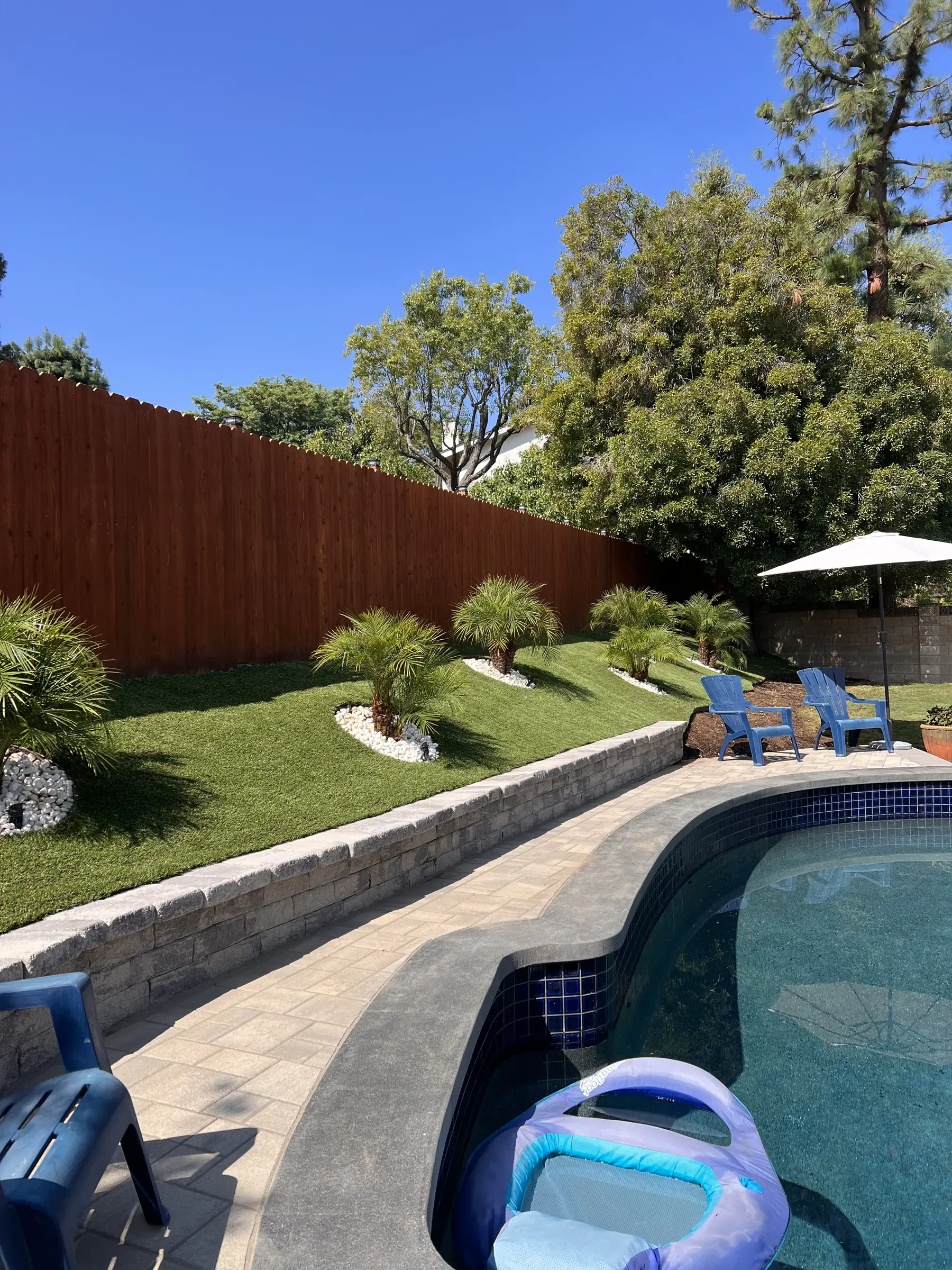
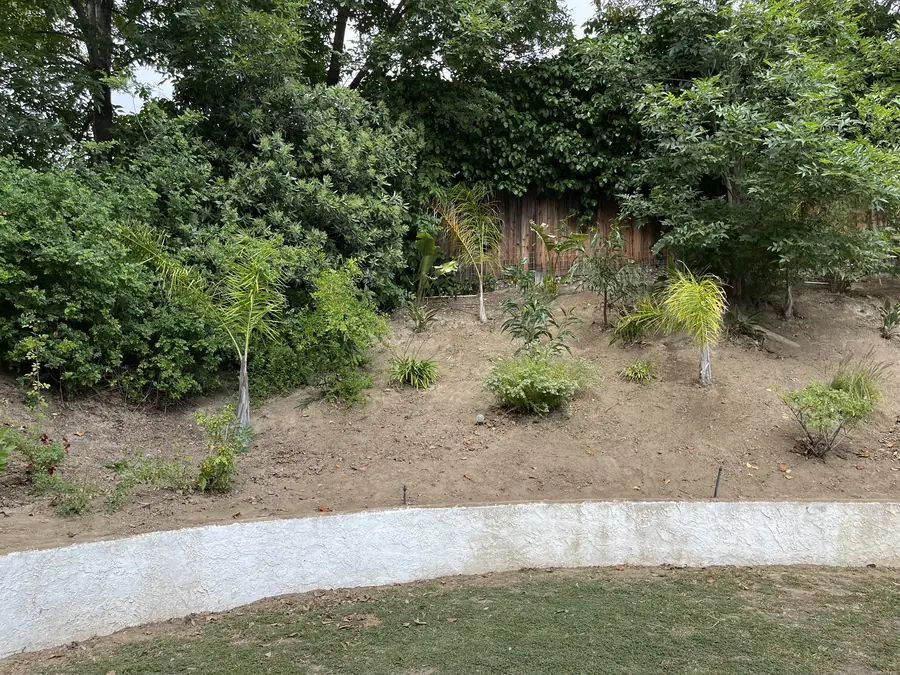
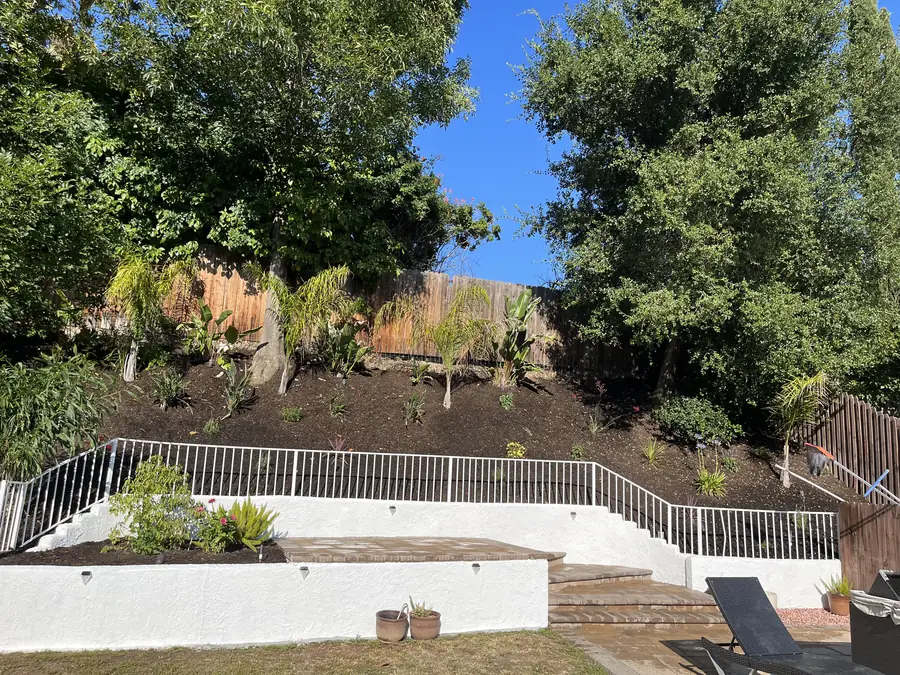
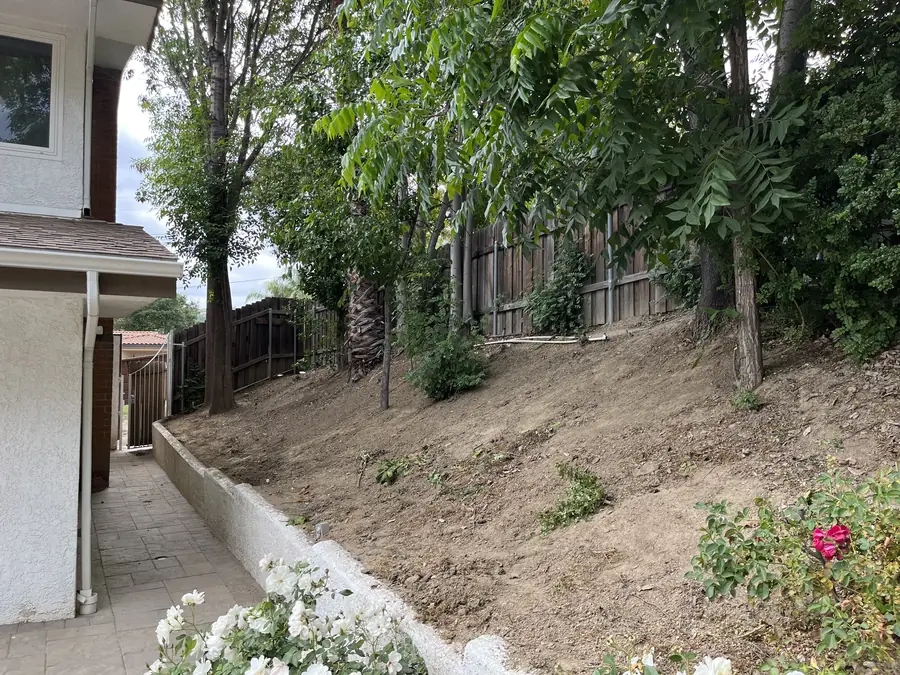
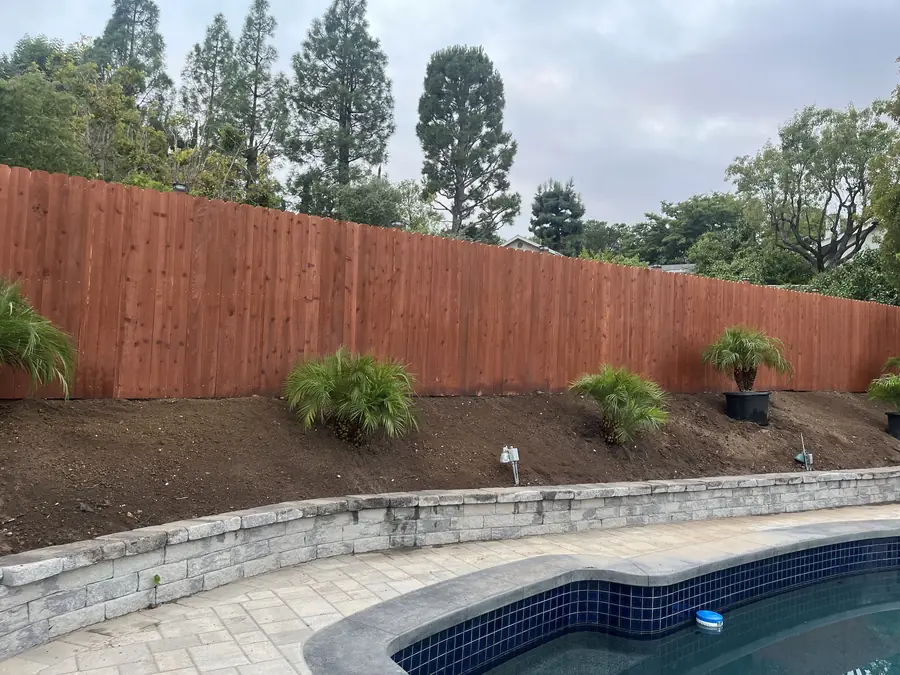
That is frequently the only way level ground exists at all. Terracing takes a continuous slope and turns it into two or three flat platforms held by low walls, joined with steps, each one wide enough to be genuinely usable. A pair of modest terraces almost always beats one enormous cut, because the retaining stays shorter, the excavation stays smaller, and the finished yard still belongs to the hillside it sits on. Height of the retaining decides whether an engineered design is required, so we settle that before laying anything out.
Steps come out of the same family of materials as the paving. Segmental block units, thick natural stone treads, or a paver tread over a block riser all get set on compacted aggregate, with each step bearing on firm ground rather than on backfill from the excavation. Rise and run stay consistent from bottom to top, since an inconsistent step is what people trip on. On a long climb we break the run with a landing. Where the ground turns rocky, digging the step bench is the slow part.
It does more than fill a gap. Joint sand transfers load from one paver to its neighbors, so the field behaves as a single surface and no individual unit takes a wheel or a chair leg alone. Sand swept into the joints gets vibrated in so it packs the full depth rather than bridging near the top. Polymeric sand binds slightly once wetted, which resists washout and slows weed growth. Some loss over the years is normal, and topping the joints back up is straightforward maintenance.
Loose fines and strong wind are a poor combination, and Sylmar gets real wind. Decomposed granite left unbound sheds its fine material and eventually reads as bare gravel with dust blowing off it. Mixing in a stabilizer, compacting the surface, and containing the whole area with solid edging keeps it together and keeps it out of the pool and off the patio. For gravel we lean toward an angular, slightly larger stone that locks together rather than a smooth rounded pebble that scatters and rolls.
Horse traffic needs footing that drains, stays firm, and does not turn slick. Compacted decomposed granite and angular gravel handle approach lanes, the path from the house out to the barn, and washrack surrounds well, and both accept the occasional truck or trailer tire. Pavers make more sense right around the tack room and any area people walk daily in boots. Edging matters more here than anywhere else on the property, since traffic constantly pushes loose material outward and a contained edge is what keeps the line from disappearing.
It genuinely helps. Sylmar sits at the wildland interface, and the strip of ground closest to a structure is the zone where fuel matters most. Stone, pavers, decomposed granite, and gravel do not burn, so a patio, a walkway, or a wide gravel band along a wall breaks the continuity that lets fire travel through planting to the building. We keep wood mulch away from wall lines and use mineral surfacing there instead. It is a design decision that gives you usable space and reduced fuel from the same square footage.
Runoff arrives from above on these properties, so the paving is designed around water rather than in spite of it. Surfaces are pitched at a fall you never notice walking but water follows every time. Upslope of a patio we set a swale or an intercept line to catch flow before it reaches the field. Beneath the pavers, the compacted section rests on ground that already percolates well, and any collected line is piped out to daylight where the grade cooperates. Storms up here move fast, so capacity gets sized for that.
Natural stone reads softer against the foothill backdrop and no two pieces match, which is exactly why some people want it. Irregular flagstone wants a thickness that will not snap and a careful hand setting it, so the labor runs higher and the joints stay wider. Manufactured pavers arrive uniform in dimension, which speeds installation and yields crisp lines and a tight geometric field. Lighter tones stay cooler underfoot through a Valley summer than dark ones. Seeing both dry on the ground in daylight settles the question faster than any catalog.
A low seat wall earns its keep twice. It gives permanent seating that never blows over in the wind that comes through this pass, and it defines the edge of the patio so the space feels like a room instead of a slab in the middle of a yard. Along a terrace it doubles as the retaining that holds the upper level. Borders and steel or masonry edging do quieter work, separating gravel from planting and paving from soil, and keeping each material where it was installed.
Sylmar falls inside the City of Los Angeles, so permitting runs through Los Angeles Building and Safety. A patio, walkway, or gravel area sitting at grade normally does not require one. Retaining walls do once they pass a height threshold, and that comes up regularly on the sloping lots here, because terracing is how flat ground gets made. Work touching the public right of way, such as an apron or a sidewalk crossing, has its own requirements. We sort out which parts of a project apply before any digging starts.
Upkeep is light. Sweep it, rinse it, top up joint sand when it thins, and pull the occasional weed that finds a joint. Sealing is optional and mostly a matter of whether you want the color deepened and stains resisted. The advantage over a slab shows up in repair. If a section settles, or if a line has to be trenched through later, those pavers lift out, the base gets fixed, and the same units go back down. Once the sand is reswept, the repair is hard to find.
One licensed contractor handles it, start to finish. One licensed contractor is accountable for every job. The employees who cut the subgrade and fight the rocky ground on your Sylmar lot are the same people who compact the base, build the terrace walls, set the steps, lay the field, and sweep the joints. Consistency between stages is exactly why the finished surface holds up, and it means there is never a question about who is accountable for a detail. One company stands behind every piece of what gets built.
Call (818) 443-9300 and we will schedule a walk of the property. On site we look at the fall of the land, how much rock is likely waiting under the surface, where water enters from above, what the wind does across the site, and how close the paving needs to come to the structures. You then receive a free written estimate covering scope and materials rather than a number guessed at the curb. Daniels Landscaping holds California license 1138709 and stays accountable for the build throughout.