
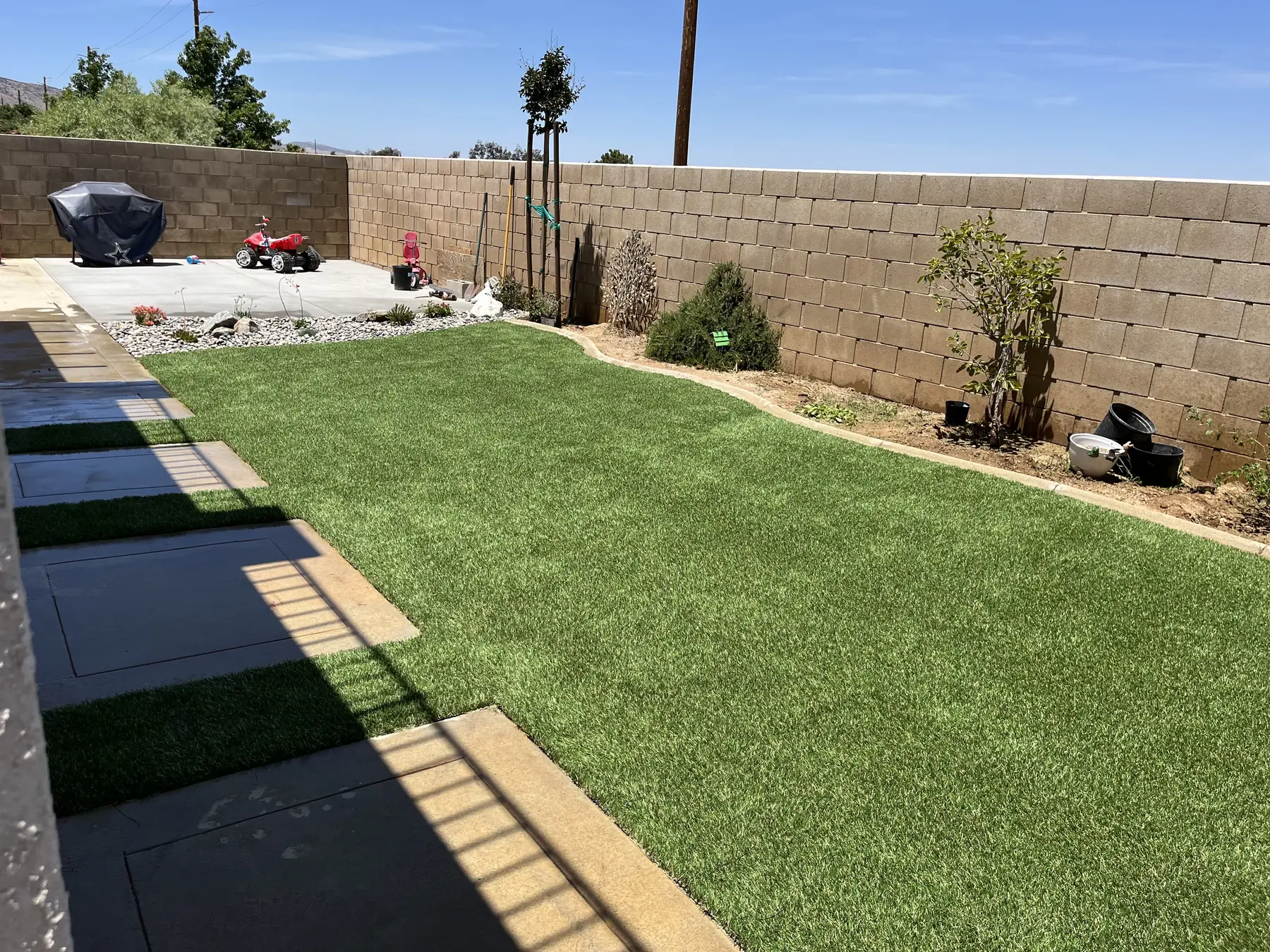
For most San Fernando Valley driveways, pavers are the better long term choice and poured concrete is the better budget choice. Pavers cost more to install, flex with the ground instead of cracking, and let you lift and replace a damaged section in an afternoon. Concrete costs less, goes down faster, and will crack somewhere, because that is what concrete does on soil that swells and shrinks with the seasons.
Daniels Landscaping builds both paver hardscaping and concrete driveways across the Valley, so this is the comparison we give people on the walkthrough rather than a sales pitch for the expensive one. LIC #1138709.
How do pavers and concrete compare at a glance?
Pavers win on lifespan, repairs, and resale value. Concrete wins on up-front cost and install speed. Here is the short version before the detail below.
| Factor | Pavers | Poured concrete |
|---|---|---|
| Up-front cost | Higher | Lower |
| Install speed | Slower, laid by hand | Faster, one pour |
| Lifespan on Valley clay | Flexes with the ground, decades | Cracks somewhere over time |
| Fixing damage | Lift and swap the affected pavers | Saw out and re-pour a section |
| Digging up later | Lifts cleanly and relays | Demolition and a new slab |
| Drainage option | Permeable pavers soak rain in | Sheds all runoff |
Why does the soil matter so much here?
Most of the San Fernando Valley sits on expansive clay. It takes on water in winter and swells, then dries through summer and shrinks back. That movement happens under everything you build, every year, and it is the single biggest factor in how a driveway ages out here.
A poured slab is one rigid piece. When the ground beneath it moves unevenly, the slab has nowhere to go, so it relieves the stress by cracking. A good contractor manages that with control joints, which are the tooled lines cut into the surface. Those give the crack a designed place to happen so it lands in a straight line instead of wandering across the middle. What control joints cannot do is stop the movement.
A paver driveway is hundreds of separate pieces sitting on a compacted base. When the ground shifts, the field flexes and absorbs it. Nothing snaps, because nothing was rigid to begin with.
What does each one actually cost?
Concrete is meaningfully cheaper to install. You are paying for forming, steel, one pour, and finishing. Pavers cost more because the labor is different in kind: deeper excavation, base material compacted in layers, a screeded bedding course, then every paver placed and cut by hand, then edge restraint and joint sand.
Where the numbers converge is over the years you own it. A cracked slab is very hard to repair invisibly. Concrete changes color as it cures and ages, so a patched section reads as a patch for the life of the driveway. The usual honest fix is replacing a whole panel between joints, and eventually replacing the lot.
With pavers, a stained, chipped, or sunken piece lifts out and a replacement drops in. Keep a small stack of spares from the original order and repairs cost you an hour rather than a weekend and a concrete truck.
Which one is more comfortable in a Valley summer?
This matters more here than most places. Woodland Hills is regularly the hottest spot in Los Angeles County, and the Pierce College weather station recorded 121 degrees in September 2020, the highest temperature ever measured in the county.
Surface color drives how a paved area feels underfoot far more than the material does. A dark charcoal paver and dark grey concrete will both be unpleasant barefoot in July. Lighter buff, sand, and pale grey tones stay usable. If the driveway connects to a pool deck or a play area, pick the color outside in the afternoon sun rather than in a showroom, because the same sample reads completely differently under fluorescent light.
What about drainage and water running off?
Both surfaces shed water, which means you are replacing ground that used to absorb rain with something that does not. If nobody plans for that, the water finds its own route, and often that route runs toward your garage or your foundation.
Either way the surface should be graded to fall away from the house at a slope you cannot feel walking on it but water certainly can. Channel drains or a catch basin handle the volume where a long driveway funnels a lot of water toward one point.
Pavers have one option concrete does not. Permeable paver systems use wider joints filled with open graded aggregate, so water drains through the surface and back into the ground rather than running off it. That is worth considering if you have a drainage problem you would rather solve than move somewhere else.
If runoff is a real concern on your lot, permeable pavers are one of the few hard surfaces that let rain soak back into the ground instead of shedding it to the street. The US EPA lists permeable pavement as a green stormwater practice for exactly this reason.
Which is better if the driveway needs digging up later?
Pavers, without much argument. Utility lines, irrigation mains, and sewer laterals all have a habit of needing attention at the worst time, and quite a lot of them run under driveways.
Breaking concrete to reach a line means demolition, disposal, and a new pour that will never quite match. Lifting pavers means stacking them to one side, doing the work, recompacting, and putting the same pavers back. When it is done properly you cannot tell anyone was there.
So when should you just pour concrete?
Plenty of times, and we say so. If the budget is fixed and the choice is between concrete now or pavers in three years, pour the concrete. If it is a long straight run, a side yard, a utility pad, or a surface nobody looks at, the extra spend on pavers buys you very little.
Stamped concrete sits in between and is worth understanding before you pick it. You get a patterned surface for less than natural stone, but it is still a slab, so it still cracks along the joints, the color needs resealing every few years, and a repair is very difficult to hide. It looks best on large areas where the pattern reads as a whole.
What should you ask before you sign anything?
Ask how deep the base goes and whether it is compacted in layers or dumped in one lift and rolled over the top. Ask whether edge restraint is included on a paver job, because without it the perimeter creeps and the joints open. Ask what thickness and what steel on a concrete job, and where the control joints will fall. Ask whether demolition and haul away are in the price.
A bid that is much cheaper than the others is usually cheaper somewhere specific, and it is almost always underneath, where you will not see it until year three. More on how the base is built is on our hardscaping page, and the concrete side is covered on our concrete and masonry page.
Before you sign, verify the contractor's license yourself on the California CSLB site and confirm the classification covers concrete and masonry work. Ours is LIC #1138709.
- How deep is the base, and is it compacted in layers or dumped in one lift?
- For pavers, is there an edge restraint, and what holds it in place?
- For concrete, where are the control joints and how is the slab reinforced?
- Is the license current on the CSLB site, and does the class cover the work?
- What is the written warranty, and what voids it?
Where do we do hardscaping?
We install hardscaping across the San Fernando Valley. See the detail, local projects, and pricing for your city:
- Hardscaping in Arleta
- Hardscaping in Burbank
- Hardscaping in Calabasas
- Hardscaping in Canoga Park
- Hardscaping in Chatsworth
- Hardscaping in Encino
- Hardscaping in Granada Hills
- Hardscaping in Hidden Hills
- Hardscaping in Lake View Terrace
- Hardscaping in Mission Hills
- Hardscaping in North Hills
- Hardscaping in North Hollywood
- Hardscaping in Northridge
- Hardscaping in Pacoima
- Hardscaping in Panorama City
- Hardscaping in Porter Ranch
- Hardscaping in Reseda
- Hardscaping in San Fernando
- Hardscaping in Sherman Oaks
- Hardscaping in Studio City
- Hardscaping in Sun Valley
- Hardscaping in Sunland Tujunga
- Hardscaping in Sylmar
- Hardscaping in Tarzana
- Hardscaping in Toluca Lake
- Hardscaping in Valley Glen
- Hardscaping in Valley Village
- Hardscaping in Van Nuys
- Hardscaping in West Hills
- Hardscaping in Winnetka
- Hardscaping in Woodland Hills