
FAQ
Irrigation in Granada Hills, answered
The questions we hear most from Granada Hills homeowners.
More than most people assume. A zone can only deliver the water that available flow and pressure allow, so a bigger yard does not get one bigger zone, it gets additional ones. Properties on the northern acreage, including horse keeping parcels, commonly split into many stations covering lawn, shrub beds, trees, slope areas and planting along corral or pasture edges. Grouping by plant water need matters as much as square footage. We measure the service, calculate available flow at the point of connection, and build the zone count around that number instead of guessing.
Friction is the culprit. Water loses pressure with every foot of travel, every fitting and every gain in elevation, and on deep lots the mainline may run a long way before it reaches the far corner. Heads at the end of an undersized line then throw short and leave dry gaps. We size pipe generously for distance rather than using one diameter everywhere, keep velocity in a sensible range, locate valves closer to the areas they feed, and add pressure regulation where the static reading sits higher than the nozzles want.
Spray heads throw a fixed fan over a short distance at a high application rate, which suits small, tight lawn shapes and narrow strips. Rotors turn a stream back and forth, covering large open areas with far less water per hour. Rotary nozzles sit between the two, fitting a standard spray body but throwing several slow rotating streams, so they apply water gently enough for slopes and heavier soils. Choosing the right family for each area is the difference between even coverage and a lawn covered in wet and dry patches.
Sprinklers are designed so the throw from one head reaches the next head, which sounds wasteful and is not. Coverage runs heaviest close to a head and thinnest at the edge of its arc, so that overlap is what evens everything out. Matched precipitation means every nozzle on a zone applies water at the same rate regardless of arc, so a quarter circle and a full circle deliver the same depth per hour. Mixing mismatched nozzles produces zones that must run long enough for the driest spot and drown everything else.
Anywhere the target is a plant rather than a surface. Shrub beds, perennial borders, hedges, vegetable areas and individual trees all take drip well, because emitters place water at the root zone with almost nothing lost to wind or evaporation. Drip also keeps foliage dry, which discourages disease, and it stops overspray onto walls, windows and paving. The tradeoff is maintenance. Emitters clog, tubing gets nicked by a shovel, and rodents chew lines, so drip needs filtration, pressure regulation and occasional inspection instead of being forgotten.
Yes, and it is one of the more cost effective upgrades on an established yard. The valve, wire and mainline are already there, so the conversion often happens right at the head. We fit a conversion assembly with filtration and pressure regulation, run distribution tubing through the bed, and place emitters plant by plant rather than in a uniform grid. Run times change completely afterward, since drip applies water slowly and deeply, so we reprogram that station rather than leaving an old schedule in place to confuse everyone.
It is the practice of grouping plants with similar water needs onto the same valve so one schedule can genuinely suit them. Putting thirsty turf and a bed of established natives on a single station guarantees that one of them is being mistreated. We separate lawn from shrubs, sun from shade, slope from flat ground, and trees from everything else, then set independent run times per zone. A properly hydrozoned landscape wastes less, looks more even, and lets you cut back in one area during restrictions without losing the rest.
Deeply and infrequently, which is close to the opposite of a lawn schedule. The tree lined character of Granada Hills comes from established canopies whose roots spread wide and sit below the top few inches of soil, and short daily cycles never wet that depth. We run dedicated tree lines with emitters placed out toward the drip line and beyond, never crowded against the trunk, and we water long enough to soak deep, then allow a real dry interval. Trees sharing a lawn valve are a common reason older specimens quietly decline.
By treating the root zone as a no machine area. Under the canopy of an established street tree or a large specimen in the yard, we hand dig, or tunnel beneath a root instead of cutting through it, and route the line around the heaviest root mass wherever the layout permits. Trenchers are efficient and completely indifferent to what they slice. Where a route has no alternative, we keep the trench shallow and narrow near the tree, backfill promptly, and water afterward so disturbed roots recover.
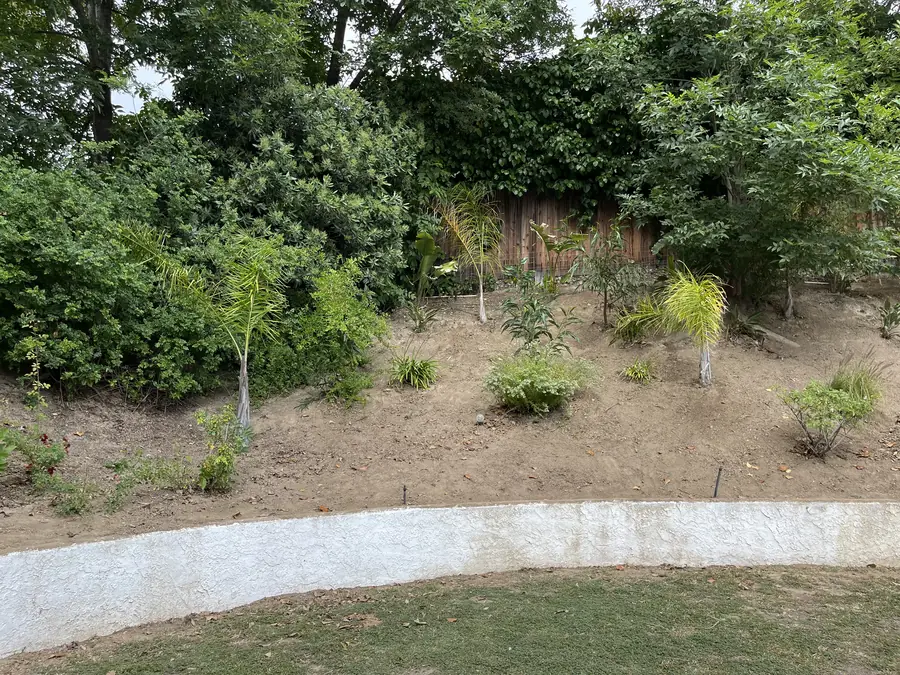
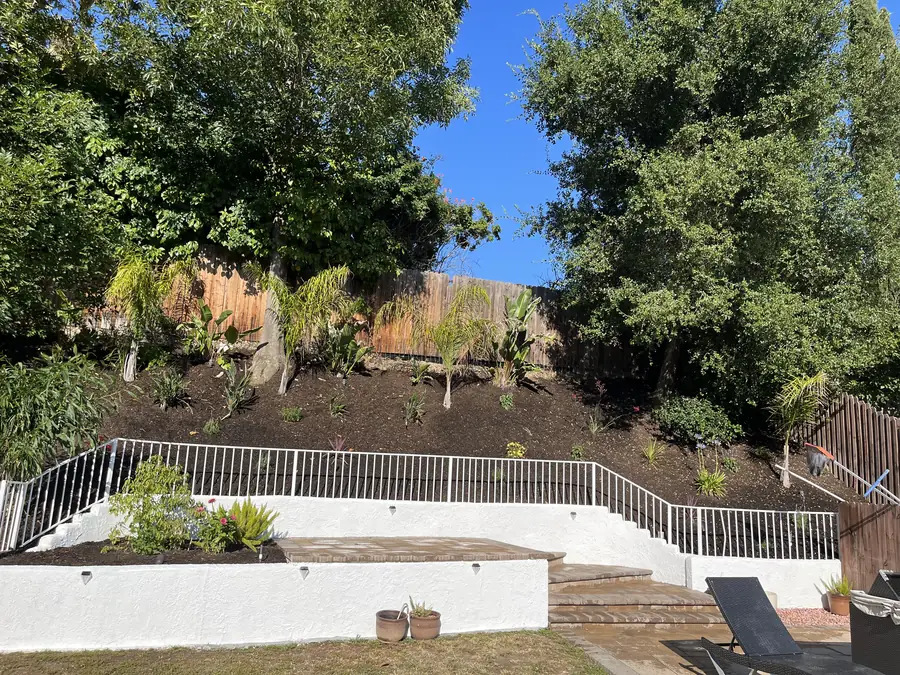
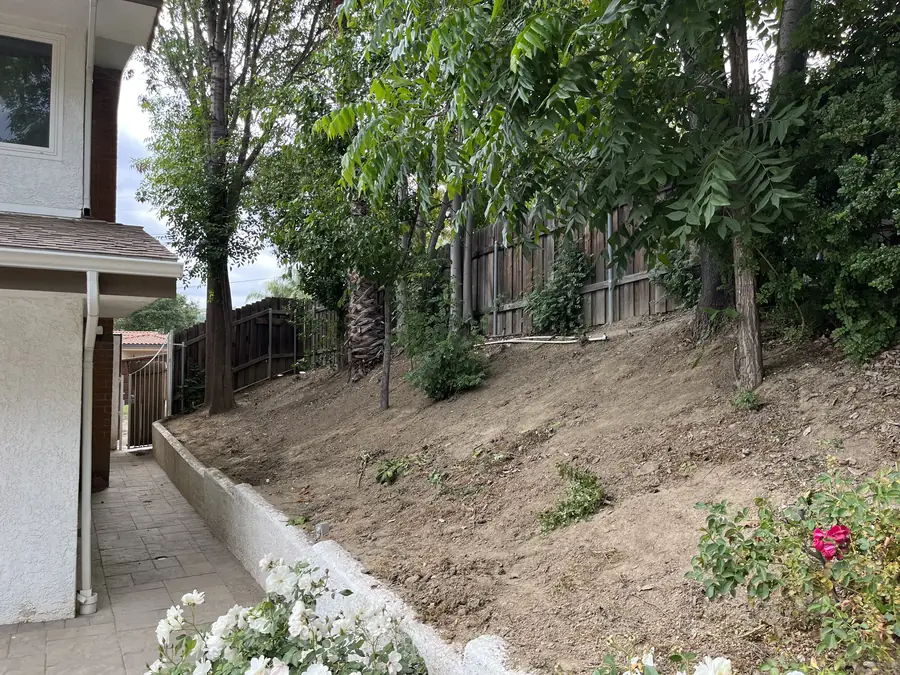
Two tools do most of that work. Low precipitation nozzles apply water more slowly than the soil can absorb it, so it soaks in rather than sheeting downhill. Cycle and soak scheduling then splits a run time into several short cycles with rest periods between them, letting each application move into the ground before the next one arrives. Terraced foothill lots also want separate zones for the top and the bottom of a grade change, because the base of a slope stays wetter on its own without any help.
It is part of doing that job properly. Clearance zones around a structure at the wildland interface still need planting that stays green and low in fuel, and a stressed, dry plant is the opposite of that. We run drip through those areas so water reaches roots without soaking siding or fencing, keep spacing generous so plants do not knit into a continuous mass, and put the clearance zone on its own valve so it can be watered on its own schedule no matter what the rest of the yard is doing.
For most properties here, yes. A weather based controller adjusts run times using local evapotranspiration data instead of repeating one schedule in January and July, and that alone removes a large share of wasted water. Adding a rain sensor or a flow sensor gives it real conditions to react to, so the system stands down during a storm and can alert you when a line breaks. The value comes from correct setup, though. A smart controller loaded with the wrong plant, soil and nozzle information simply automates a bad schedule.
They protect two different things. Excess pressure makes spray heads mist rather than form droplets, and that mist drifts off instead of landing on the plants, while the same pressure stresses fittings until something splits. Regulated heads or a master regulator hold working pressure where nozzles perform as designed. Backflow prevention is a code requirement that keeps irrigation water, which sits in pipe alongside fertilizer, soil and animal waste, from being drawn into the household supply if pressure drops. We install the assembly where it stays accessible for testing.
A manifold is a group of valves fed by a common mainline and housed together in a box for access. Grouping them keeps wiring tidy and makes troubleshooting simple, since one lid gives you the whole cluster. On sprawling properties, several smaller manifolds placed near the zones they serve beat one distant bank, because shorter lateral runs hold pressure better. We set boxes at finished grade in spots you can actually reach, not buried behind a hedge, and we label the valves so a repair years from now stays easy.
We start with the evidence the system already gives us. A meter that keeps turning with everything shut off points to a mainline leak, while a soggy patch that appears only after one station runs points to a lateral or a cracked fitting on that zone. From there we isolate valve by valve, watch pressure behavior, listen at the manifold, and look for the green stripe or sunken soil marking the path of a running line. Then we open a small area, repair it, and pressure test before backfilling.
California restrictions limit when and how long you may water, so a system has to deliver what the landscape needs inside a narrow window. That pushes design toward efficient nozzles, careful hydrozoning, drip in beds, and controllers that shift automatically as rules change. Deep infrequent watering fits restriction schedules better than daily light watering anyway, so an efficient system tends to be a compliant one. Local water agencies sometimes offer rebates for qualifying upgrades. We will point you toward your provider to check current programs, but we promise nothing about eligibility.
No. Daniels Landscaping installs, repairs and programs irrigation with one licensed contractor. Every trench, fitting, valve and controller on your property is handled under one licensed contractor. Buried work is the easiest place for corners to be cut, because once the trench is closed nobody sees the glue joints, the pipe depth or the wire splices. Keeping the work inside the company means the same standard applies on every job and the same people answer for the result.
Reach us at (818) 443-9300 and we will schedule a walk of your Granada Hills property. We check static pressure and available flow, look over existing valves, heads and controller, review plant material and exposure, and run each zone to see what is truly happening rather than what the timer claims. After that you get a free written estimate describing the design, materials and scope in plain language. Daniels Landscaping is licensed in California under number 1138709, and the installation stays under one licensed contractor.