

FAQ
Landscape Lighting in Sylmar, answered
The questions we hear most from Sylmar homeowners.
Distance is the reason. Voltage falls as current travels along a wire, and when a long driveway or a pasture edge puts a fixture hundreds of feet from the transformer, the last one on an undersized run receives noticeably less than the first. With LED that shows up as dimming, a shift in color, or a fixture that never comes on at all. We calculate load against distance for each run, use heavier gauge cable where the length demands it, split the property across several runs, and use transformer taps so every fixture lands inside its operating range.
On acreage, usually more than one. We total fixture wattage and choose capacity with real headroom so nothing runs at its limit and fixtures can be added later, but capacity is only half the question. A single unit at the house cannot feed a gate, a barn area and a rear terrace hundreds of feet away without long compromised runs. Placing two or three transformers closer to the groups they serve shortens every run, holds voltage steady, and makes later service simpler. Each one mounts near a dedicated exterior receptacle at a height clear of irrigation spray.
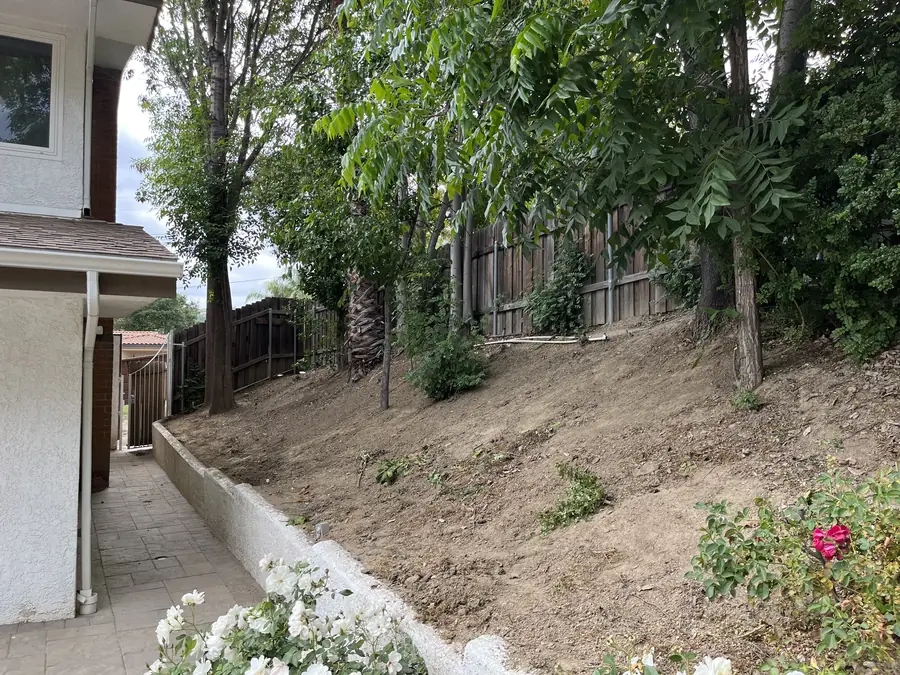
It shapes the route more than anything else does. Low voltage cable sits shallow, just below soil or mulch, and gets sleeved where it crosses under paving or a drive. In alluvial ground full of cobble, the straight line often is not the practical line, so we follow bed edges, planting gaps and softer material instead of fighting rock the entire way. Sharp stone bearing against cable is a long term problem, so runs get bedded in clean material where a trench turns stony. Routes are recorded too, so later digging does not find the cable the hard way.
A daisy chain puts every fixture at a different distance from the transformer, so each receives slightly different voltage, and on the long runs a large parcel demands, that difference turns visible. A hub takes one heavy cable out to a central point and feeds several fixtures from there on leads of equal length, keeping them electrically similar and their output consistent. Service is easier as well. When a fixture fails you are working at one accessible junction with proper waterproof connectors instead of hunting for a splice buried somewhere along a chain.
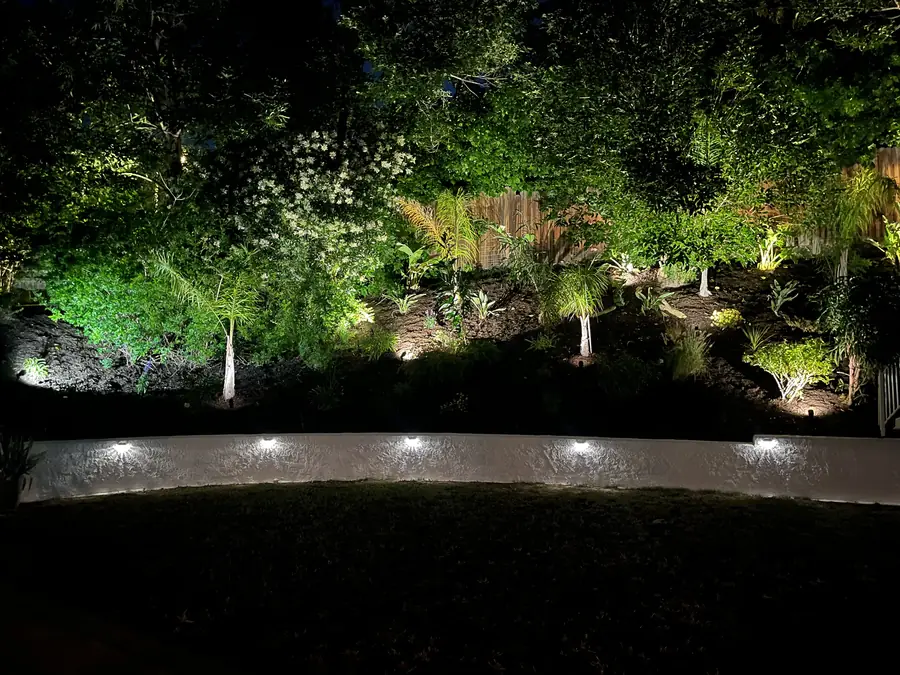
Most yards here end up with several working together. Path lights lay a low pool of light along walks and the long approaches common up here. Bullets and uplights are directional, aimed into a trunk, a wall or a specimen shrub. Well lights bury flush so the source disappears and only the effect remains. Step and wall lights make treads and low surfaces readable without shining into the eyes of whoever is using them. Wash and flood fixtures spread softer light across a fence, a facade or a mass of planting. The mix follows what the property has worth showing.
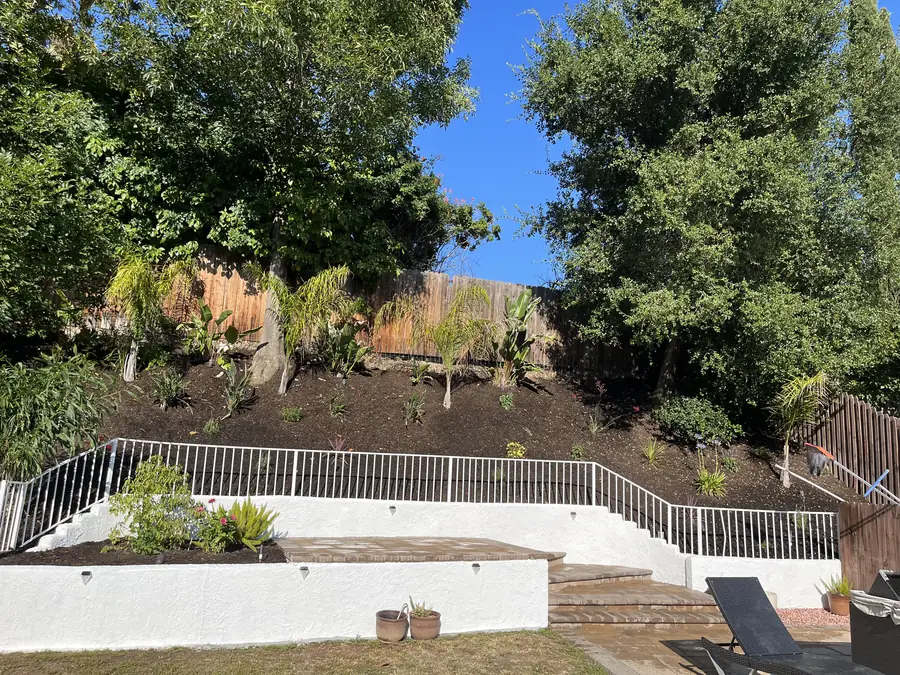
Safety leads wherever the grade changes. Every tread, landing and transition needs enough light to read its edge, delivered by step lights recessed into risers, wall lights set into adjacent masonry, or low fixtures placed beside the run. Where a yard steps down in terraces, each level gets lit a little differently so the eye understands there is a drop instead of a flat surface. Sources stay shielded and below eye level on a stair, since a bright fixture in the face of somebody walking down a slope is worse than leaving that flight dark.
Aim it inward. A property backing onto open hillside looks out at unlit natural ground, so light thrown toward the boundary reads as glare and erases that view rather than adding anything to it. We point fixtures across and down into the property, shield anything facing the open side, and reduce output near the edge. Lighting the cleared ground immediately around a structure is genuinely useful, both for seeing where you are walking and for anyone who needs to come up the drive at night. LED fixtures also run cool, which is a sensible quality near dry vegetation.
From more than one side. A large canopy takes two or three uplights spaced around the trunk so the branch structure gains depth instead of flattening into a wall of leaves, with beam spreads chosen for the height of the crown. On tall specimens we sometimes mount fixtures up in the tree and aim down through the branches, which throws dappled shadow across the ground and looks far more natural than a single hot spot at the base. Mounting hardware allows for growth, and we return to adjust it rather than letting anything bite into bark.
By spacing for rhythm instead of lining fixtures up at even intervals the whole way. A drive of any length reads better when light marks the things that matter, meaning the entry, a curve, a grade change, a turnaround or a gate, with quieter stretches between them. Wider spacing at lower output keeps the eye relaxed, and light thrown across the drive onto planting does more for the sense of arrival than a row of bright markers ever will. Fixtures are also set back from the wheel path, since anything within reach of a turning trailer eventually gets flattened.
Yes, and those areas ask for different treatment than the garden does. Working ground needs usable, even light on the surface, so the approach favors wider washes and well placed downlight rather than the decorative uplighting that suits a front yard. Glare control counts for more than usual, because a fixture aimed carelessly at animal eye level is a real nuisance. Since these areas normally sit well back from the house, they are strong candidates for their own transformer and their own control, so they can be switched separately from the ornamental lighting.
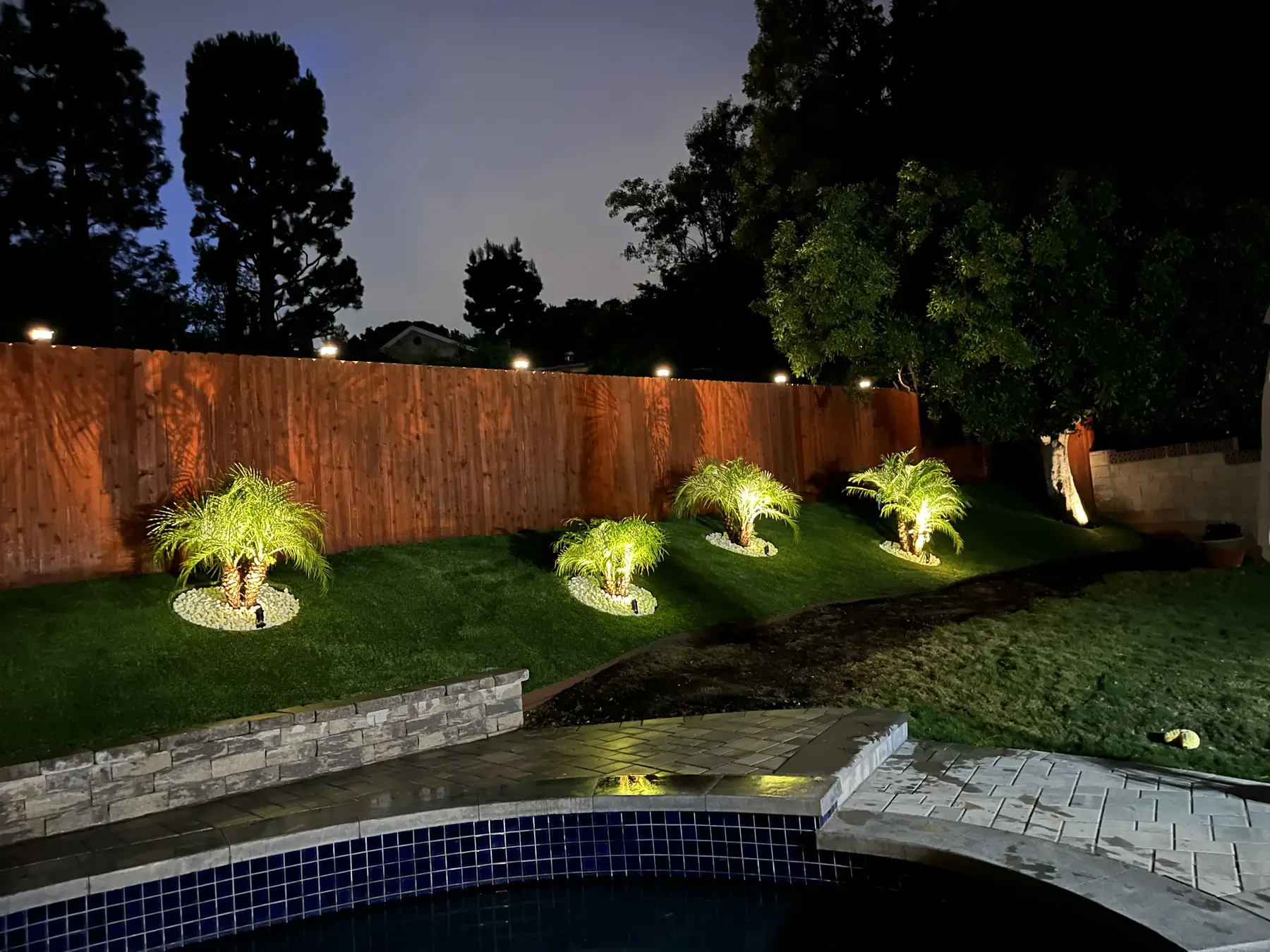
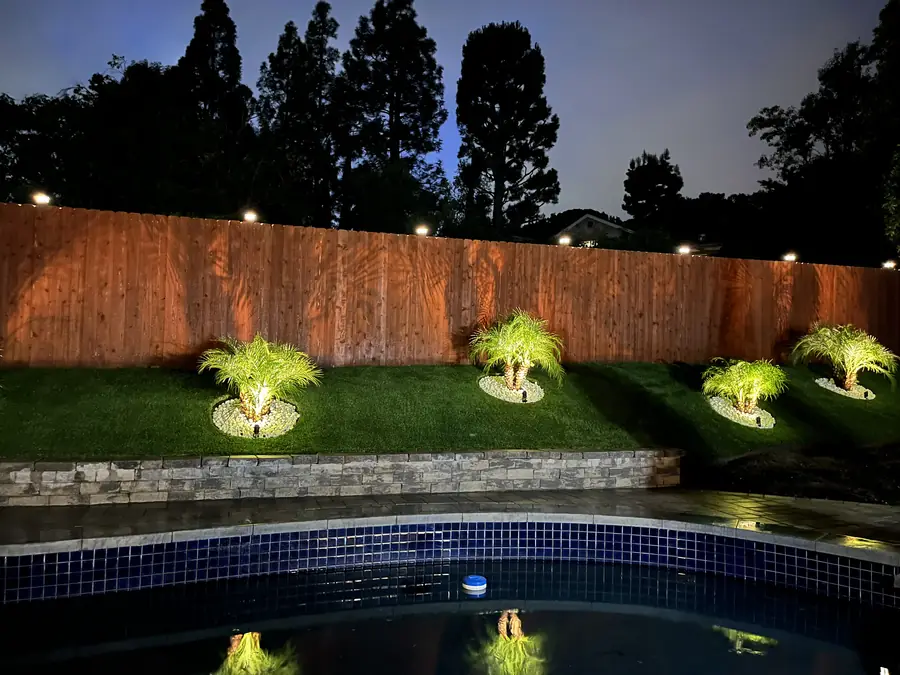
It means using several intensities and directions so the property gains depth rather than one flat glow. A workable scheme carries a foreground of soft path or step light, a middle layer picking out planting, a wall or a water feature, and a background of taller uplights that push the far boundary back so the yard does not appear to stop at the patio edge. Contrast does the work. Leaving some areas dark gives the lit ones meaning, while lighting everything to the same level produces something closer to a parking lot than a garden.
Placement and shielding first, then aiming after dark. Fixtures go where the source falls outside the normal sightline from the patio, the windows and the neighboring property, and they get glare guards, cowls or louvers wherever an angle cannot be avoided. Sloping ground complicates this, because a fixture that stays discreet viewed from above can sit at eye level viewed from below, so we check the sightline in both directions. Final aiming happens at night with the system live, walked from the places where people actually sit and stand, since daylight aiming is guesswork.
Brass and copper are the long term answer. They weather into a patina instead of failing, and they tolerate irrigation water, sprinkler minerals and direct soil contact far better than thin aluminum or plastic. Stainless steel performs well too. Inexpensive fixtures tend to give out in the same two places, the lens gasket and the wire entry, where moisture works in and finishes the electronics. Since the labor to set a fixture is identical no matter what the fixture cost, the body itself is generally the smartest place to spend, particularly where dust and wind are constant.
LED draws a small fraction of what halogen lamps needed, which puts more fixtures on one transformer and sends less current through the cable, and that second point counts for a great deal on the long runs this area requires. Lamp life is long enough that changing bulbs stops being a routine chore. Color temperature can also be controlled, so warmer tones suit stone and structures while something slightly cooler reads more naturally in foliage. We keep temperature consistent within a scheme, because a mix of warm and cool fixtures across one property simply looks accidental.
With a photocell, a timer, or both together. The photocell senses darkness and brings the transformer on at dusk, which tracks the season automatically rather than drifting out of step through the year. A timer or an astronomic clock then handles the off time, whether that is a fixed hour or a set number of hours after sunset. Where separate transformers serve a gate, a working area and the garden, each can run on its own control, so an entry or a drive stays lit late while the ornamental lighting shuts down earlier.
Usually. The first job is finding out what is actually there, meaning transformer capacity, cable gauge, how the runs were connected, and how much load already sits on each one. Sometimes there is room to add fixtures directly. Other times the transformer is at its limit or the cable is too light to carry more length, and the honest answer is a second transformer or a fresh run rather than piling more onto what exists. Failed fixtures, corroded connectors and cable cut by later digging are all repairable, and on long runs we test rather than guess.
One licensed contractor, all of it. Daniels Landscaping stays accountable for the work. The same team that plans the layout digs the cable routes, sets the transformers, makes the connections and comes back after dark to aim every fixture. That continuity matters, because lighting is judged at night by feel rather than against a checklist, and the person adjusting a beam angle should be the person who understood the intent from the first walk. You deal with one company from the opening visit through the final aiming.
Call (818) 443-9300 and we will visit your Sylmar property, ideally once in daylight and once after dark so we can see what the yard already offers. We look at trees worth uplighting, paths and steps that have to be readable, surfaces that take a wash well, where power is available, and how far the runs need to reach. You then receive a free written estimate covering fixture counts, transformer capacity and scope. Daniels Landscaping carries California license number 1138709, and one licensed contractor performs every part of the work.