
FAQ
Irrigation in Sylmar, answered
The questions we hear most from Sylmar homeowners.
Shorter cycles more often, which surprises people who were told that deep and infrequent watering is always correct. Ground at the foot of the mountains is alluvial, coarse and full of rock, so it accepts water quickly and then lets it keep going. A single long soak sends much of that water below the root zone where nothing can reach it. Splitting the same total run time into several shorter applications with rest periods between them keeps moisture in the layer where roots actually live. We build schedules that way from the start, then adjust after watching how the yard responds.
Because fine spray does not survive them. Wind moving through the pass carries small droplets away from the target, so water lands on paving, fencing and the driveway next door instead of on the plants it was meant for. Nozzles producing a larger droplet, and rotors that throw a stream rather than a mist, hold their pattern far better under those conditions. Pressure control is part of it as well, since a head running above its design pressure atomizes water into precisely the droplet size the wind removes. Where the exposure is constant, drip carries more of the load.
More than owners expect at first. A single zone can only deliver what available flow and pressure allow, so a larger area is covered by adding stations rather than by stretching one further. Parcels up here commonly include lawn near the house, shrub beds, trees, a slope, clearance planting and the edge of a corral or pasture, and every one of those wants a different schedule anyway. We measure static pressure and available flow at the point of connection, then build the station count from that number instead of estimating it off the lot size.
Friction, distance and elevation together. Water gives up pressure at every foot of pipe, every fitting and every gain in height, and on acreage that climbs toward the foothills a mainline may travel a long way and rise as it goes before reaching the far end. Heads on an undersized line then throw short and leave dry arcs between them. We size pipe generously for the distance rather than running one diameter everywhere, keep velocity sensible, locate valves nearer the areas they feed, and add regulation where static pressure sits above what the nozzles want to see.
It slows the work and it changes routes. Cobble left behind by everything that washed out of the mountains sits all through the soil profile, so a trench rarely runs as clean as one dug in the middle of the valley. Where a line meets rock, we route around it or adjust depth instead of forcing through and leaving pipe resting on a sharp edge that eventually wears a hole in it. Bedding matters for the same reason, so lines are laid on material free of sharp stone and backfilled with the same care.
Spray heads throw a fixed fan over a short distance at a high application rate, which suits small tight lawn shapes and narrow strips. Rotors turn a stream back and forth across large open areas and apply far less water per hour, which fits the bigger lawn and pasture edge areas common up here. Rotary nozzles fit a standard spray body but throw several slowly rotating streams, applying water gently enough for a slope or for ground that has taken all it can hold. Matching the family to the area is what produces genuinely even coverage.
Sprinkler coverage is heaviest close to the head and thinnest at the outer edge of the throw, so the spray from one head is designed to reach the next. That overlap is what evens out application rather than wasting water. Matched precipitation is the other half of it, meaning every nozzle on a station applies at the same rate no matter its arc, so a quarter circle and a full circle put down the same depth in the same time. Mismatched nozzles force a station to run long enough for the driest spot and drown the rest.
Anywhere the target is a plant rather than an area of ground. Shrub beds, hedges, perennial borders, vegetable areas and individual trees all take drip well, since emitters put water at the root zone with nothing lost to the wind, and that counts for a great deal at this end of the valley. Drip keeps foliage dry and stops overspray onto walls, fencing and paving. The tradeoff is attention. Emitters clog, tubing gets nicked by a shovel and rodents chew lines, so drip wants filtration, pressure regulation and an occasional inspection.
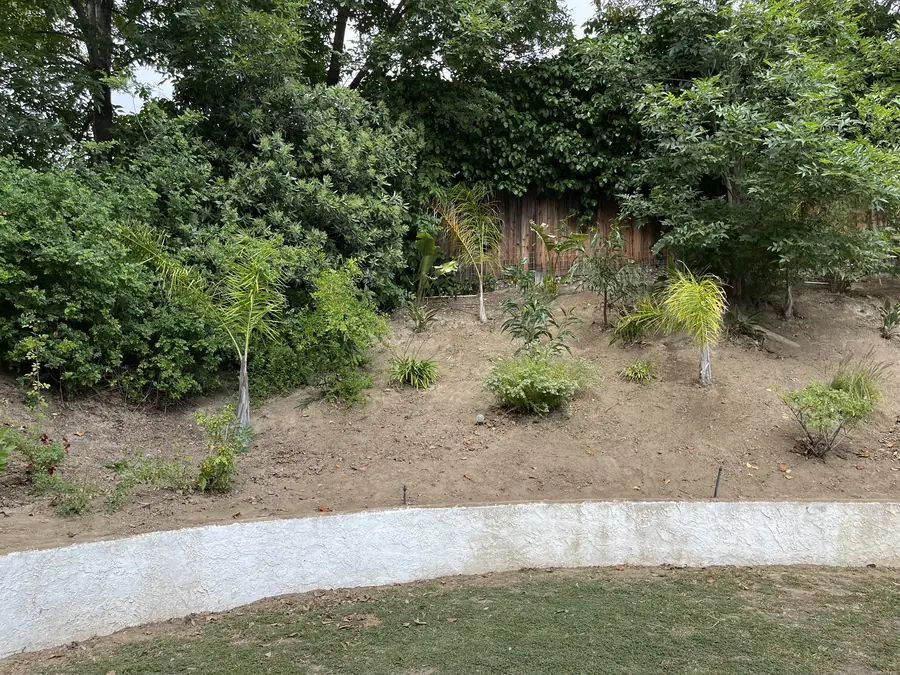
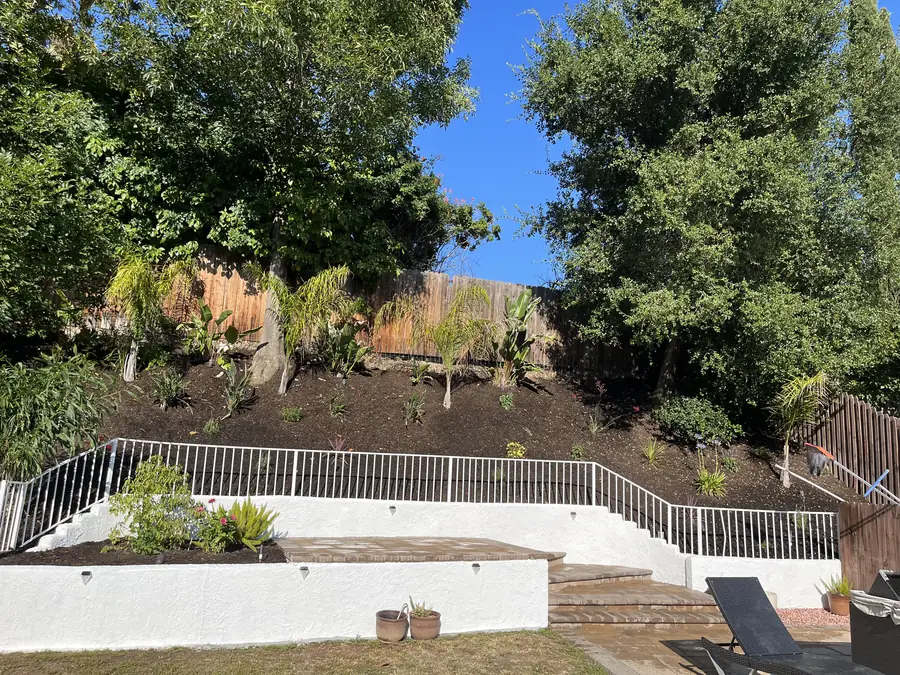
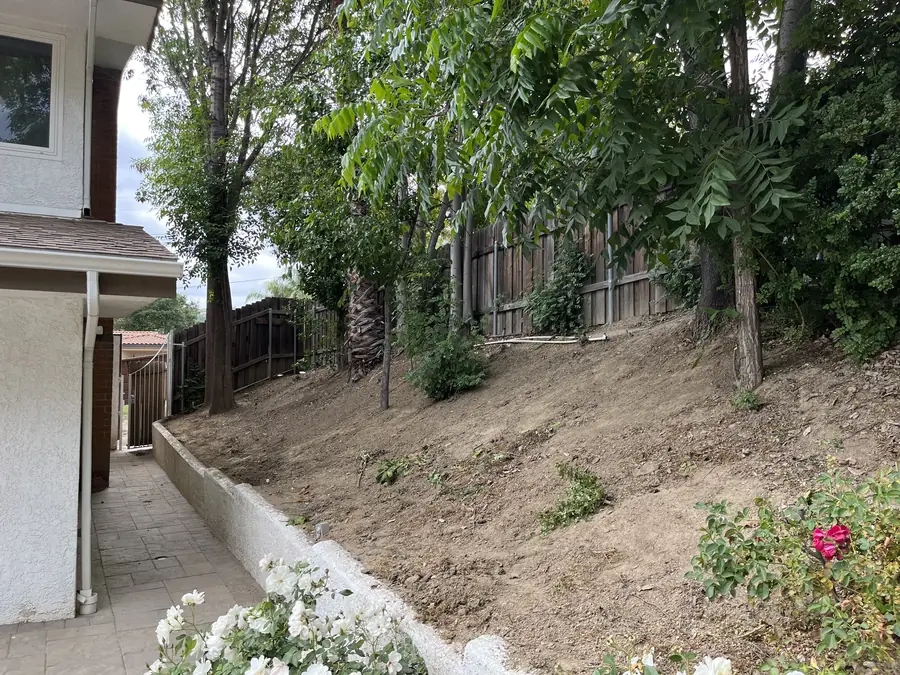
Two things carry most of that load. Low precipitation nozzles apply water more slowly than the ground can take it in, so it soaks rather than sheeting downhill, and cycle and soak scheduling breaks a run time into several short applications with pauses between them. Ground rising toward the mountains also wants the top and the bottom of a grade change on separate stations, because the base of a slope collects moisture on its own and stays wetter without any help. Running both from one valve guarantees the bottom is soaked while the top is still dry.
It is part of doing that job properly. Clearance areas around a structure still need plants that stay green and low in fuel, and a plant under water stress is the opposite of that. We run drip through those areas so water reaches roots without soaking siding, fencing or decking, keep spacing open so nothing knits together into a continuous run of fuel, and put the clearance area on a valve of its own. That way it can be watered on its own schedule regardless of what the rest of the property is doing.
On their own line, and deeper than any lawn schedule reaches. Tree roots spread wide and sit below the top few inches of soil, and on coarse ground that drains this quickly a short lawn cycle never gets down to them. We run dedicated tree lines with emitters placed out toward the drip line and past it, never crowded against the trunk, and we water long enough to wet that depth before allowing a genuine dry interval. Trees sharing a lawn valve are a common reason older specimens quietly decline with no obvious cause.
For most properties here, yes. A smart controller uses local evapotranspiration data to adjust run times instead of repeating one schedule through January and July, and on ground that dries out as fast as this does, that responsiveness saves real water. Adding a rain sensor or a flow sensor gives the controller actual conditions to react to, so the system stands down in a storm and can warn you when a line breaks. Setup decides the value, though. A controller loaded with the wrong soil, plant and nozzle information simply automates a poor schedule.
They address two separate problems. Excess pressure turns spray into mist, and mist is exactly what the wind through the pass removes before it ever lands, while that same pressure works on fittings until something splits. Regulated heads or a master regulator hold working pressure where the nozzles were designed to perform. Backflow prevention is a code requirement that keeps irrigation water, which shares pipe with soil, fertilizer and whatever else is in the ground, from being drawn back into the drinking supply if pressure drops. We locate the assembly where it stays reachable for testing.
Usually, and it is one of the better value upgrades on an established yard. The valve, the wire and the mainline are already in place, so the conversion often happens right at the head using an assembly that carries filtration and pressure regulation. Distribution tubing then runs through the bed and emitters are placed plant by plant rather than on a uniform grid. Run times change completely afterward, since drip applies water slowly, so that station gets reprogrammed instead of being left on an old schedule nobody understands six months later.
We begin with what the system is already telling us. A meter that keeps moving with everything shut off points at the mainline, while a wet patch appearing only after one station runs points at a lateral or a fitting on that zone. From there we isolate valve by valve, watch how pressure behaves, listen at the manifold, and follow the green stripe or the settled soil marking a running line. That narrowing matters more on acreage, because nobody wants a trench opened across a hundred feet of yard on a hunch.
They limit when and how long you may water, so a system has to deliver what the landscape needs inside a narrow window. That pushes design toward efficient nozzles, careful hydrozoning, drip in the beds, and controllers that can be adjusted as the rules change. Ground that drains this quickly fits the shorter multiple cycle approach reasonably well, since that pattern applies water in usable amounts rather than losing it below the roots. Local water agencies sometimes run rebate programs for qualifying upgrades. We will point you to your provider, and we promise nothing about eligibility.
One licensed contractor does all of it. Daniels Landscaping stays accountable for the work. Every trench, glue joint, valve, wire splice and controller setting on your property is the work of one licensed contractor. Buried work is the easiest place in this trade for corners to be cut, since once a trench is closed nobody can see how the pipe was bedded or how the wire was spliced. Keeping it inside the company means one standard on every job and the same people answering for the system after it is running.
Call (818) 443-9300 and we will schedule a walk of your Sylmar property. We check static pressure and available flow, inspect the existing valves, heads and controller, look at plant material, exposure and slope, then run each station so we see what is truly happening rather than what the timer claims. After that you receive a free written estimate covering design, materials and scope in plain language. Daniels Landscaping holds California license number 1138709, and the installation stays under one licensed contractor and the programming from beginning to end.