
FAQ
Artificial Turf in Arleta, answered
The questions we hear most from Arleta homeowners.
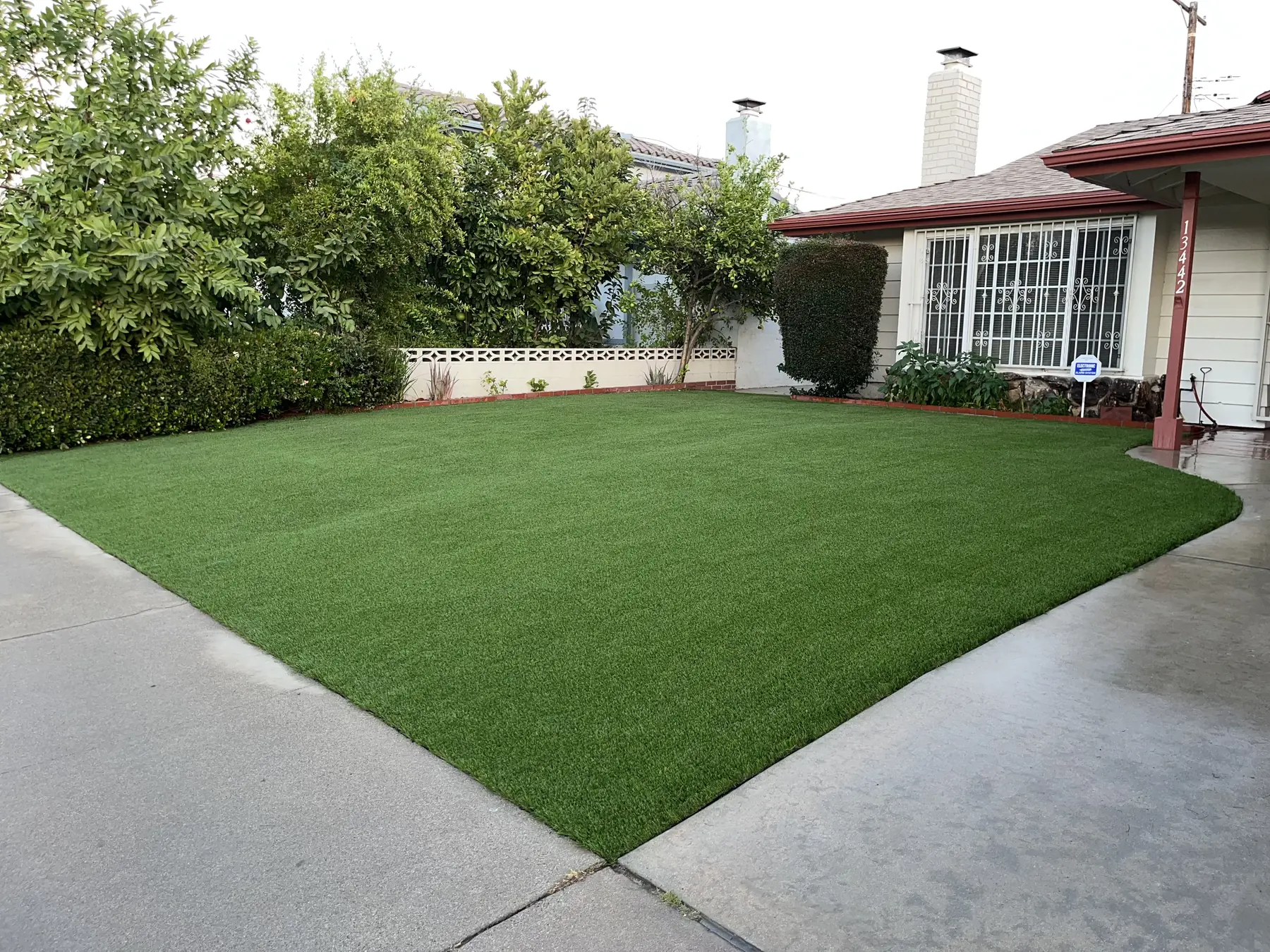
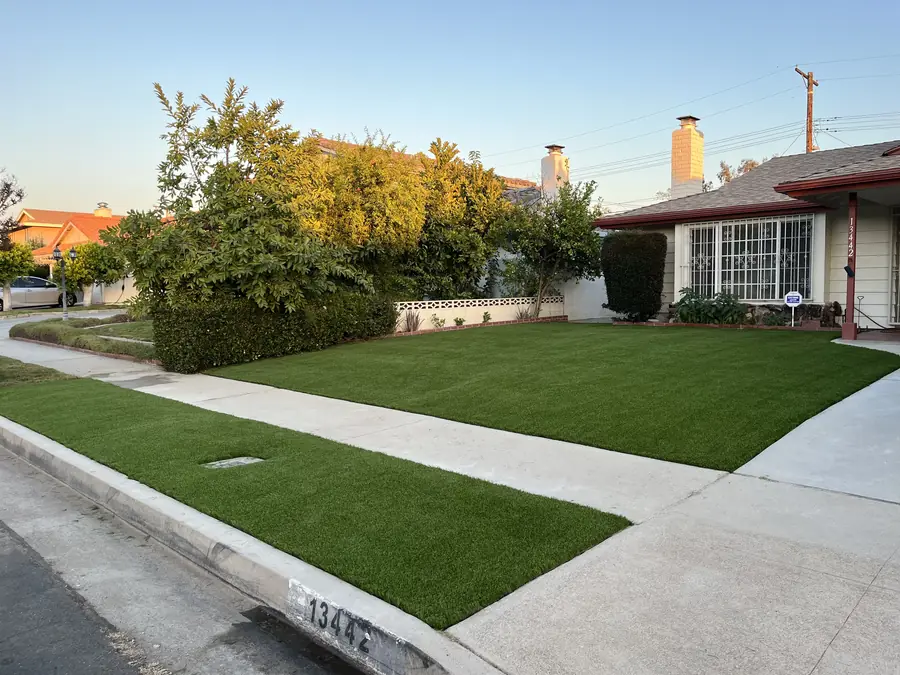
It tends to be, for practical reasons. On a compact lot the lawn is often the entire back yard, and a live lawn that small struggles to look good, since it takes the same watering and mowing regardless of size and shows every worn path. Synthetic turf stays green through summer, holds up under daily use from kids and dogs, and hands back the weekend maintenance. The catch is that in a small space the lawn is right in front of you, so installation quality shows immediately and is worth paying for.
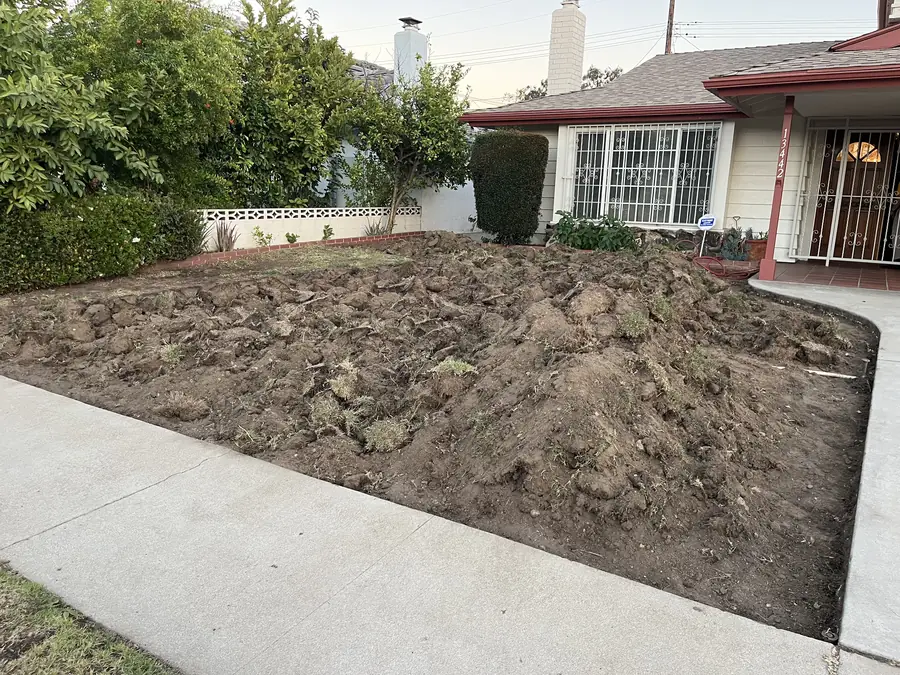
The base carries everything. We strip the existing lawn and a few inches of soil, compact the subgrade, then bring in crushed rock, place it in lifts, and compact each one to a firm plate. That surface is graded smooth and given a slight fall for drainage, often with a thin layer of finer material screeded on top so no stone edges telegraph through the fibers. Where site conditions justify it, a weed barrier is added before the turf goes down. If the base is soft or uneven, no quality of turf will hide it.
Water passes straight through the perforated backing into the aggregate base, which is why the base has to stay permeable and cannot be capped with fines that seal it off. From there the water needs somewhere to go, and on flat ground it will not find its own way. We pitch the base toward a planting bed, a drain, or the side yard, and where the area is boxed in by fences and neighboring structures we set a basin or a perimeter drain line under the turf and pipe it out to the curb.
Planning, mostly. Turf arrives in wide, heavy rolls that will not turn a tight corner, so on constrained properties we cut sections to a manageable size in the driveway and carry them through, laying out those cuts so seams land where they are least visible. Base rock travels the same way, by wheelbarrow when a machine cannot clear the gate, and the excavated soil leaves along that route. It is slower than an open access job, which is why we measure the path before quoting rather than after.
Face weight is the ounces of yarn per square yard, and it is the closest thing to a density rating. Higher face weight resists matting, which matters on a small yard where the same few paths get walked every day. Pile height is the blade length. Anything much over an inch and a half tends to lie over and look flat in a compact space, so a mid range height with good density usually looks better than tall, sparse turf. We bring samples so you can compare them in your own light.
More than most people expect. Flat blades look glossy and lie down quickly. Shaped blades, meaning S, C, W, or a stem down the middle, have structural stiffness built into the yarn, so they stand back up after being walked on and reflect less light, which reads as more natural. A thatch layer of curled brown and green fiber at the base adds realism and helps hold the blades upright. On a yard you look straight down at from the house, those details are noticeable.
Infill is brushed down between the blades to weight the turf, keep it flat, and hold the fibers upright. Rounded silica sand is the standard and does the job well. For households with dogs we use a coated or antimicrobial infill that resists odor retention and rinses more cleanly, paired with a base that drains freely so urine passes through instead of sitting. Quantity matters as much as type, since under filled turf mats down early and over filled turf feels hard and looks thin.
Warmer than live grass, and that is worth knowing before you buy. In full afternoon sun the surface can become uncomfortable for bare feet and for dogs, though it cools within minutes once shaded or rinsed with a hose. Lighter colored turf and cooling infills help to a degree. If your back yard takes direct sun all afternoon, we plan for it, whether that means a tree, a shade sail over a seating area, or keeping a hose bib within easy reach of the lawn.
Turf comes in fixed roll widths, so any area wider than a roll has at least one seam. In a small yard we plan the layout to put seams away from the main sight line coming out of the house, and to run every blade in the same direction, because turf laid with opposing nap shows a color difference in sunlight. Seams are joined with seam tape and adhesive, with edges trimmed precisely so the stitch rows neither double up nor leave a gap. Done properly, they disappear.
Perimeter and seams do the holding. We nail the edges into the compacted base with galvanized spikes at close spacing, adding nails through the seams where needed. Where turf meets a patio, a walkway, or a wall, it is trimmed tight and fastened along that line so nothing lifts. Infill contributes as well, since the weight of the sand keeps the field from moving or wrinkling through temperature swings. A lawn that ripples after a hot week is almost always short on infill, nails, or base compaction.
Anywhere turf does not meet a hard surface, it needs a real edge to fasten into. Bender board, a treated wood border, a steel edge, or a small concrete mow strip all work, and the choice usually follows what already exists in the yard. That edge keeps the turf from curling, stops bed soil and mulch from washing across the lawn, and gives the boundary a crisp line. On a small lot the perimeter is a large share of what you actually see, so the edge detail carries much of the finished look.
Routine care is light. Solids get picked up as they would on any lawn, the area is rinsed with a hose, and a periodic enzyme cleaner keeps odor from developing in the infill. Cross brushing the blades against the grain now and then stands the fibers back up in traffic paths and redistributes infill. Leaves and debris come off with a stiff broom, a blower, or a plastic rake. In a family yard seeing heavy use, brushing a few times a year is what keeps the routes everyone walks from looking worn.
Quality turf on a properly built base holds up for many years of normal residential use, and manufacturers back their products with warranties covering fading and wear. The variables that shorten it are constant traffic along one line, a poor base that settles into dips, and infill that was never topped up. Ultraviolet exposure eventually softens color on any synthetic product. What fails first in practice is rarely the fiber, it is the base and the edges, which is why so much of the schedule goes below the surface.
The math tends to favor turf on small lots. The install costs more than sod up front, then it stops costing anything monthly, no water, no mowing service, no fertilizer, no reseeding the worn patch by the gate. Homeowners in this neighborhood generally prefer something durable that does not demand attention, and a small lawn is the highest maintenance square footage in the yard. If you love the smell and feel of real grass and have the sun to support it, live lawn remains a fair choice.
Permitting in Arleta runs through Los Angeles Building and Safety, since the neighborhood is inside the City of Los Angeles. Installing synthetic lawn at grade, including the excavation and base work, normally does not require a permit on a residential property. It becomes a question when the same project adds a retaining element above the height threshold, a structure, or significant drainage changes. If your scope triggers anything, you will hear it from us before the estimate is signed, not after the base is dug.
One licensed contractor, every step of the way. Daniels Landscaping stays accountable for the work. The crew excavating and compacting the base is the same crew seaming, nailing, and brushing in the infill. Turf is one of those trades where the visible result depends almost entirely on unseen work, so having one company answerable for both the base and the finish removes any question about who fixes something if it needs correcting. Nobody hands your yard off partway through, and the standard does not change between stages.
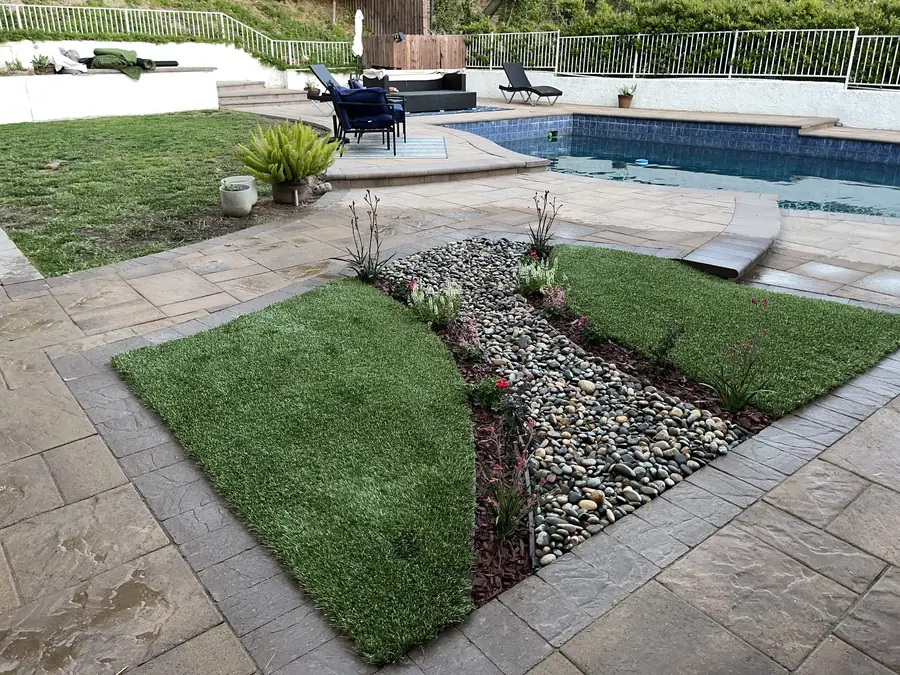
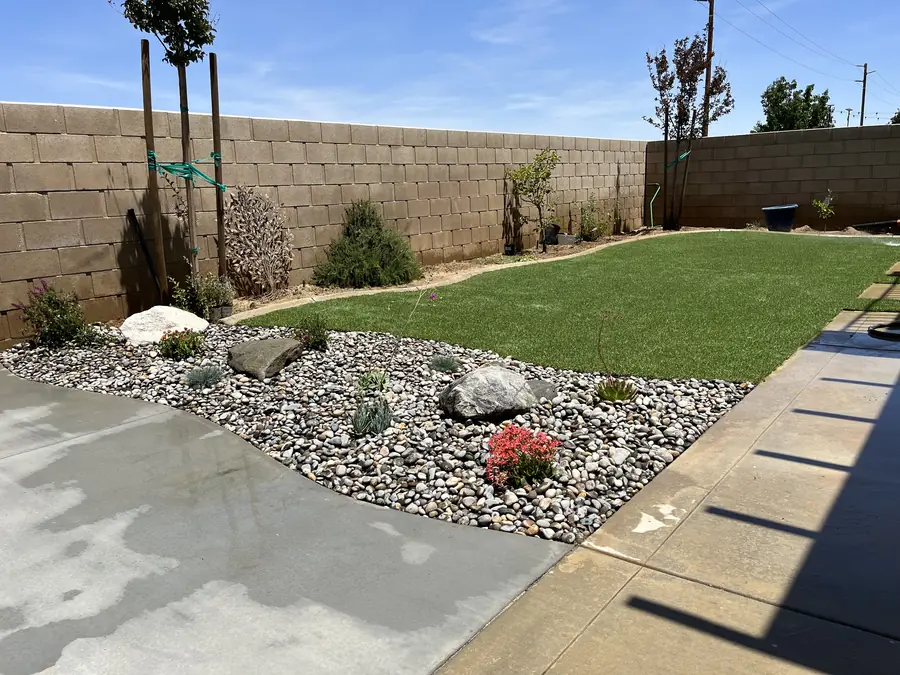
That is usually the better design. A rectangle of turf running fence to fence in a small yard reads as flat and artificial no matter how good the product is. Framing it with a planting border, a paver band, a few specimen shrubs, or a raised planter along one side gives the eye something else to land on and makes the space feel deeper than it measures. It also leaves room for the screening planting most people here want, since the houses stand close and privacy comes from vertical material.
Call (818) 443-9300 and we will set up a visit. The site walk costs nothing, and the written estimate we leave with you is free as well. We measure the area, check drainage and the access through the side yard, and bring samples so you can compare face weight, pile height, and blade shape side by side in your own light. The estimate breaks out excavation, base, turf, infill, and edging separately. Daniels Landscaping carries California license 1138709 and installs with one licensed contractor.